Your referrals are strong, but your pipeline is unforecastable. When buyers ask AI engines who to shortlist, your technical competence remains invisible.
A real MSP business plan turns gut-feel growth into a financeable system that satisfies both the founder and the CFO. This practical structure bypasses generic filler to focus on demand generation, AI visibility, and unit economics like CAC, gross margin, and payback.
Start with the executive summary that a CFO can underwrite.
Key Takeaways
- An MSP business plan must model MRR, churn, tool COGS, and CAC payback. A generic business plan template misses these and cannot be underwritten by a CFO.
- Niche selection is a financial decision: your ICP determines sales cycle length, tooling COGS, compliance burden, and gross margin target.
- Demand is infrastructure. Audit your citation share across 10 ICP queries in Google and AI tools to score your AI shortlist visibility.
- Tie every hiring milestone to an MRR threshold (e.g., first service coordinator at $100k MRR) to avoid premature headcount that destroys margins.
- A defensible managed service provider business plan PDF includes a one-page KPI table, pricing with scope exclusions, and a 12-month cash view with growth and churn scenarios.
An MSP business plan is a structured financial and operational document that models monthly recurring revenue, gross margin, customer acquisition cost payback, and capacity thresholds. Designed to be underwritten by a CFO or growth partner, not just used for internal planning.
NUOPTIMA’s engagement with Cortavo, a managed IT provider, produced $210,000+ contracted value and a $1,000,000+ MQL pipeline by December 2025, with 4x more AI citations than the closest competitor, and $403,330 in contracted sales value at a 4.6x return by month twelve. Read the Cortavo case study to see the system in action.
1. Turn Your Executive Summary Into an Underwriting Document
To prevent a fluffy MSP business plan, make your executive summary a one-page underwriting sheet. Finance partners ignore generalities. Lead with your core metrics:
- $150k MRR and 65% gross margin
- Sub-1% churn and 12-month CAC payback
- $15k net new quarterly MRR target
State your wedge in one sentence: "We secure HIPAA-regulated clinics in Ohio because our zero-trust compliance baseline makes us the safest option to audit."
To grow beyond referrals, pair founder relationships with a compounding demand engine using SEO and AI search visibility. Protect gross margins through automated ticketing and standard SOC 2 baselines to scale delivery without premature headcount.
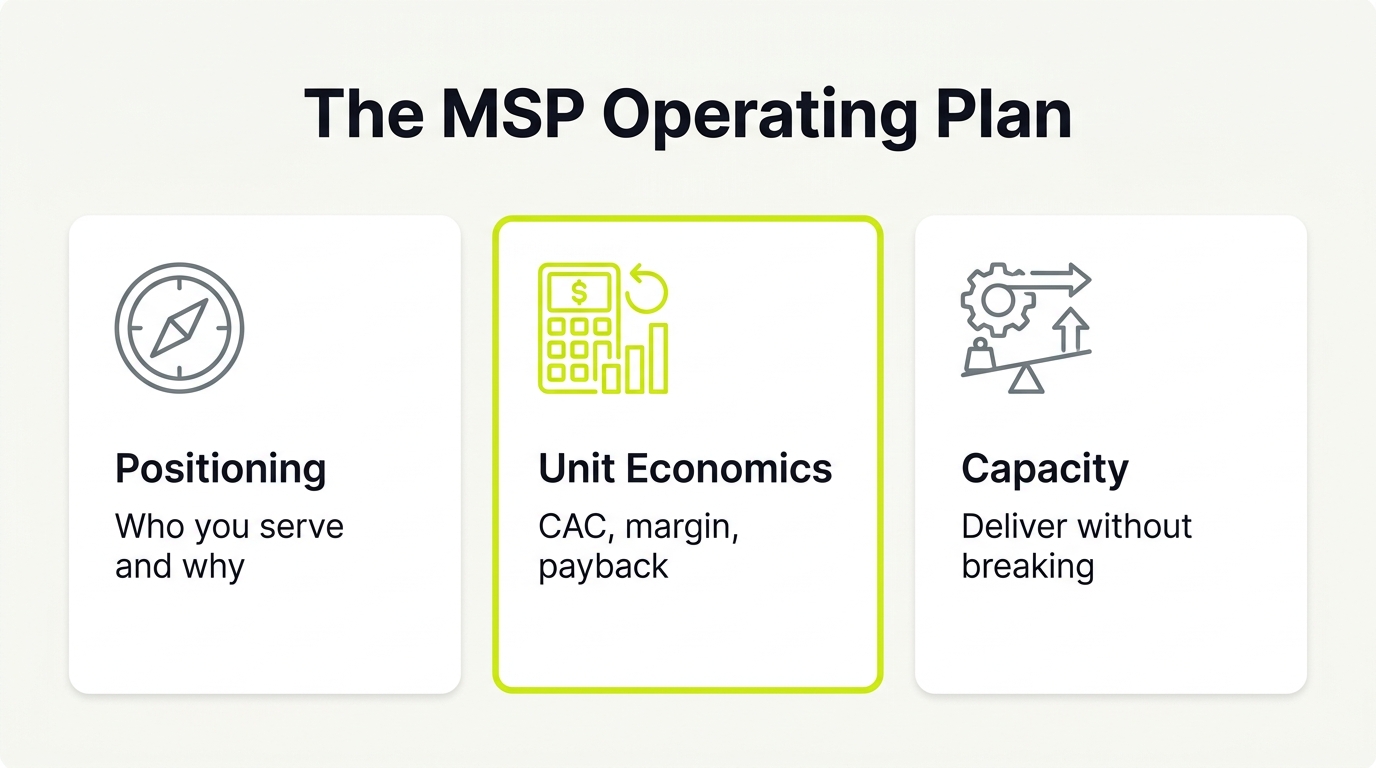
2. Define Your High-Margin ICP and Wedge to Cut Sales Cycles
Your niche choice is a direct financial decision. It dictates your sales cycle length, tooling COGS, compliance burden, and retention. To protect utilization and margins, you must explicitly document who you will not serve.
Use this 10-line alignment sheet to stop commodity positioning:
1. Size: 50 to 150 seats.
2. Vertical: HIPAA-bound healthcare.
3. Trigger: Failed audit or insurance renewal.
4. Buyer: CFO or COO.
5. Disqualifier 1: Co-managed setups removing admin control.
6. Disqualifier 2: Low-price, no-contract bids.
7. Competitor A (National): Beat with local response case studies.
8. Competitor B (Regional): Beat with third-party compliance proof.
9. Competitor C (Cheap): Beat with zero-trust standards.
10. Target: 65% gross margins.
3. Design Your Multi-Channel Demand Engine and CAC Payback Model
An effective MSP marketing strategy treats demand as infrastructure. Track referrals, partners, SEO, AI answers, and paid capture against these CAC benchmarks:
- Lead-to-meeting: 30%
- Meeting-to-proposal: 50%
- Proposal-to-close: 30%
- Cycle: 60 days
- Payback: 12 months
Audit your citation share by testing 10 queries in Google and AI tools to score your answer presence:
1. Best MSP [City]
2. Healthcare IT [City]
3. Compliance IT near me
4. Co-managed IT [City]
5. HIPAA IT [City]
6. Law firm IT [City]
7. [Competitor] alternatives [City]
8. Managed IT cost [City]
9. SOC 2 IT [City]
10. IT shortlist [City]
Get a free MSP marketing audit at nuoptima.com and read our MSP Content Marketing Guide.
4. Build a Three-Tier Service Packaging and Pricing Model
Scope creep eats margins when service agreements lack boundaries. To protect gross profit, treat your packaging as a strict margin-control system.
Divide your offering into three distinct layers:
- Core managed IT: The baseline infrastructure support every client receives.
- Baseline security: The non-negotiable minimum security posture required to safely deliver service.
- Monetized add-ons: High-margin extras like compliance audits, MDR, and vCISO consulting.
Underwrite this model with clear pricing mechanics: per-user or per-device rates, client seat minimums, and upfront onboarding fees. Price rising tooling COGS and SOC licensing directly into these tiers. Finally, append explicit "included versus excluded" clauses to make out-of-scope requests billable.
5. Standardize Your Sales Process to Predict Close Rates
Scaling requires translating founder "unconscious competence" into a repeatable sales funnel. This reduces sales leakage, protects onboarding costs, and ensures growth no longer depends entirely on the founder.
Standardize your pipeline into six distinct stages:
- Decision-maker meeting and discovery
- Technical assessment and business-impact presentation
- Proposal meeting and signature
Protect margins by disqualifying bad-fit prospects who exhibit these red flags:
- Price-only buyers
- No-decision-maker access
- High tolerance for poor security hygiene
Support this assessment-driven flow with a technical checklist, standardized proposal template, onboarding plan, and proof library. Track stage conversion rates and time-in-stage to forecast revenue and capacity with precision.
6. Align Your Operations and Capacity Model to Protect Gross Margin
Selling faster than you can deliver destroys margins and reputation. Link your operational service promises directly to capacity thresholds.
Build your capacity model using precise inputs:
- Promises: 8x5 support, 1-hour critical response, and bi-annual QBRs.
- Metrics: 0.5 tickets per seat, 40 onboarding hours, and 80% engineer utilization.
- Escalation: Clear Tier 3 ownership path.
Staff according to strict MRR milestones:
- $100k MRR: First service coordinator.
- $150k MRR: Dedicated vCIO.
- $200k MRR: New sales capacity.
If margins compress, immediately halt custom projects, out-of-scope work, and non-ICP onboarding to protect core service delivery.
7. Model Your Advanced Security Posture and SOC Pricing
Most MSPs stumble into cybersecurity, only to watch unexpected 24/7 monitoring overhead swallow their margins. Your plan must define where baseline controls end and advanced security begins.
Building an in-house SOC is rarely viable. Explicitly document your partner-led SOC or MDR decision, detailing:
- 24/7 coverage and escalation paths
- Tooling and compliance reporting obligations
- Onboarding fees
Model these security costs as COGS. Add per-endpoint SOC license costs directly into your pricing sheet before quoting. When frameworks like NIST demand advanced audits, treat them as mandatory scope priced as premium add-ons to protect your delivery margins.
8. Map Your Technology Stack to COGS for Audit-Ready Financials
A generic software list means nothing to a CFO. To build an underwriteable plan, translate your stack into a direct COGS model mapped across six categories:
- Core productivity
- Endpoint and security
- Backup and recovery
- Identity management
- Monitoring and management
- Documentation
For each category, define the cost basis (per user or per device), the billing method, and a 65% gross margin target.
Choose your operational path:
- Lean-start: Fund minimum viable ops (domain, email, payments) first, adding delivery tooling as client revenue grows.
- Scale: Deploy unified automation tools early to support rapid onboarding.
Avoid long-term vendor lock-in before you validate your ICP and gross margins.
9. Model Your Unit Economics and Financial Scenarios for CFO Underwriting
A decision-grade financial model lets you fund hiring and marketing without betting the company.
Your model must output:
- A 12-month cash view and 3-year P&L
- Gross margins by offer line
- A hiring plan tied to revenue
Underwrite this with realistic unit economics. For a $3,000 MRR client with a $9,000 CAC and $2,500 onboarding cost, a 65% gross margin yields a ~6-month payback. Use best, base, and worst cases to find the exact number of logos required.
Stress-test against a referral slowdown, tool cost increases, and churn spikes. Track these risks on a dashboard showing net new MRR, utilization, and pipeline coverage.
Run a Market Research Section a CFO Can Sanity-Check
Your financial model is only credible if the demand behind it is real. Before you underwrite MRR growth, size the market your ICP actually lives in and prove the money is there.
Build a one-page market research section with three inputs:
- Serviceable market: Count the target-size accounts in your geography and vertical (for example, HIPAA-bound clinics of 50 to 150 seats within a 90-minute drive). A named, countable list beats a top-down percentage of a national figure.
- Spend per seat: Anchor your average contract value to what those accounts already pay for managed IT, then show the seat count needed to hit your MRR target.
- Competitive set: Name three incumbents by category (national, regional, price-cutter) and state, in one line each, why a switching buyer picks you. This is the same wedge you documented in your ICP sheet, expressed as displacement, not aspiration.
Keep it grounded. A CFO discounts any plan that claims a fraction of tens of thousands of MSPs as its market. Show a reachable segment you can win in 2026 with your current delivery capacity, and tie the segment size directly to the logo count in your unit economics model.
Pressure-Test Your Plan With a One-Page MSP SWOT
A SWOT is not a filler exercise here. It is a risk register that tells a finance partner which assumptions could break your model. Keep each quadrant to three lines tied to a metric or a named account, not adjectives.
- Strengths: The margin-protecting realities you can prove, such as sub-1% churn, a documented sales process, or a compliance baseline that shortens sales cycles in a regulated vertical.
- Weaknesses: Founder-dependent selling, thin cash runway, or reliance on a single tooling vendor whose COGS you cannot yet forecast.
- Opportunities: A failed-audit trigger event, an underserved vertical near your geography, or AI-search visibility your competitors have not claimed yet.
- Threats: Price-only competitors, rising SOC and endpoint licensing COGS, and referral concentration that leaves your pipeline unforecastable.
Map each threat straight into a scenario toggle in your financial model. A referral slowdown, a tool-cost increase, and a churn spike should each appear as a weakness or threat above and as a stress test below, so the plan reads as one connected argument rather than two disconnected documents.
How to Build and Execute Your MSP Business Plan: A 4-Step Action Guide
Step 1: Assemble the Core Plan Structure in 90 Minutes
Open a fresh document and copy the items of your MSP business plan into the document as H2s. Spend exactly 90 minutes on this first pass. Keep prose short. Insert the operational and financial figures you already know, such as your seat pricing and engineer salaries. Mark all unknown metrics as assumptions to preserve your momentum.
Step 2: Build the Financial Companion Spreadsheet
Build a dynamic companion spreadsheet to serve as your operational engine. Avoid the text-only approach of traditional templates. Structure your model with five distinct tabs:
- Client unit economics: Calculate your customer acquisition cost (CAC), onboarding costs, and average contract value (ACV).
- Tool COGS per seat: Itemize every license cost in your technical stack to find your true cost per endpoint.
- Hiring milestones: Set clear monthly recurring revenue (MRR) triggers that dictate when to hire your next engineer.
- Pipeline model: Map out conversion rates from the initial discovery meeting to the signed agreement.
- Scenario toggles: Stress-test your model against a 10 percent churn spike or a flat sales quarter to satisfy CFO review.
Step 3: Export Your Plan for Lead Capture and AI Citation
Export your completed plan for lead capture and AI citation. Convert the document into a polished Managed Service Provider Business Plan PDF featuring a one-page KPI table at the front. Publish a dedicated landing page on your website that explicitly states what you do, who you serve, the geographical markets you cover, and your proof. This public structure provides the explicit data that search engine crawlers and AI models require to index your business accurately.
Step 4: Run the GEO Visibility Checklist
Run a practical GEO visibility checklist. Test 10 ideal customer profile (ICP) queries in Google and major generative AI tools. Record which competing brands are cited in the answers. List any missing proof assets you need to publish, such as case studies, competitor comparisons, and third-party mentions.
To build the compounding demand engine described in Step 3, read our MSP Growth and Content Marketing Guide to start scaling your authority. If you want to see how your business scores in AI search right now, request a free pipeline and attribution audit at nuoptima.com.