
An MSP certification is third-party proof (an audit, framework, or vendor tier) that reduces buyer risk. These credentials support premium positioning and faster procurement approvals by converting referral reputation into Google and AI shortlist visibility.
This guide separates organizational audits, vendor partner tiers, and technical training.
Key Takeaways
- MSP certifications fall into three categories: organizational audits (SOC 2, ISO 27001), MSP-specific audit programs (MSP/Cloud Verify), and vendor partner tiers. Each serves a different buyer risk model.
- SOC 2 Type II is typically required to win mid-market enterprise deals; it proves operational effectiveness over 6 to 12 months, not just point-in-time control design.
- ISO 27001 only makes commercial sense if you target regulated verticals, manage multi-site clients, or lose contracts because buyers require formal governance.
- Vendor partner tiers provide real credibility only when paired with published implementation evidence and named client outcomes. A logo without proof is not authority.
- To appear in AI shortlists, build a public Trust and Compliance page with scope statements, active renewal dates, and downloadable security one-pagers that search crawlers can index.
An MSP certification is third-party validation of a managed service provider's operational, security, or technical capabilities. Including organizational audits such as SOC 2 and ISO 27001, MSP-specific audit programs, and vendor partner tiers.
If your credentials are not findable, read our [MSP growth guide](/content-marketing-MSP-growth-guide) or contact [NUOPTIMA](https://www.nuoptima.com).
What "MSP Certification" Actually Refers To: Three Different Credentials
Search "MSP certification" in 2026 and Google returns three unrelated things. Sort out which one you mean before you spend a dollar or an hour, because the paths do not overlap.
- Managed Service Provider certification (this guide): Organizational audits and vendor tiers that prove an IT managed service provider is secure and capable, such as SOC 2, ISO 27001, and MSPAlliance MSP/Cloud Verify. This is the credential MSP owners and their buyers care about.
- Managing Successful Programmes (MSP): A project and programme management qualification from PeopleCert (the Foundation and Practitioner exams). It has nothing to do with IT service delivery; it is for programme managers running large change initiatives.
- Master Safety Professional (MSP): An occupational safety credential for safety officers. Unrelated to both of the above.
If you landed here wanting programme management or workplace safety, this page is not it. Everything below is about certifying a managed service provider as a business.
Professional Certifications Your Delivery Team Can Hold
Organizational audits prove the company is trustworthy; individual certifications prove your engineers can actually do the work. Buyers and AI shortlists increasingly look for both. You do not need every badge, and you should map credentials to the services you sell rather than collect them. The main professional certification families an MSP delivery team draws from:
- CompTIA: Vendor-neutral baselines covering fundamentals, networking, and security concepts. Common as an entry standard for the service desk.
- Microsoft: Role-based credentials across Azure, Microsoft 365, and security administration, relevant if your stack leans Microsoft.
- Cisco: Networking and infrastructure credentials for teams that design, run, or troubleshoot client networks.
- Cloud platforms (AWS, Microsoft Azure): Architecture and operations credentials for MSPs delivering cloud migration and managed cloud.
- Security and service management (ITIL and vendor-neutral security credentials): Frameworks and security tracks that standardize how the desk runs and how it defends client environments.
Choose the two or three families that match your ICP and service lines, set them as a hiring and renewal baseline, then publish the standard on your careers and proposal pages so it reads as proof, not vanity.
1. MSP-Specific Organizational Certifications
Telling a prospect or an AI search engine that you follow industry best practices does not win contracts. Buyers need proof, and so do the LLMs building shortlists. An organizational MSP certification, such as the MSPAlliance MSP/Cloud Verify, requires an independent audit of your operational, financial, and security procedures. It is renewed on a strict annual cadence.
This credential provides a vendor-agnostic maturity claim that is easier to cite than "we follow best practices." To operationalize this trust signal:
- Build a public proof page detailing your audit scope and renewal date.
- Draft a short RFP paragraph for your sales team to paste into proposals.
- Update your brand metadata so AI engines cite this verified status.
2. SOC 2 Audits: Unblocking Enterprise Procurement and Deal Velocity
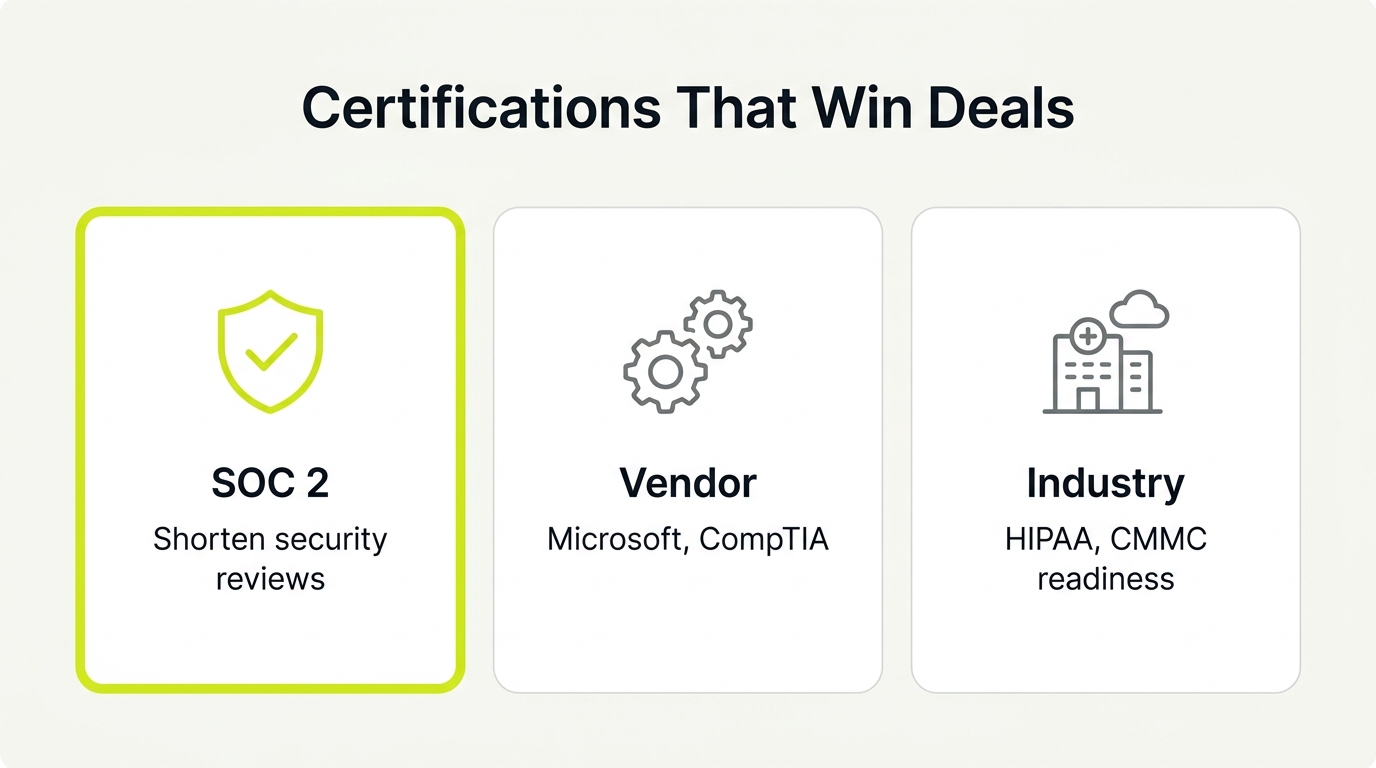
Nothing stalls a late-stage enterprise deal faster than procurement friction. A SOC 2 audit is not an individual technician certificate; it is an organizational attestation proving your systems secure client data. This credential can shorten or reduce lengthy security questionnaires, accelerating vendor approval with CFOs and compliance stakeholders. (Note: SOC 2 costs, timelines, and renewal requirements vary widely. Check current guidance from your auditor and the AICPA for up-to-date figures.)
Match your audit type to your target market:
- SOC 2 Type I: Evaluates control design at a single point in time, offering rapid credibility for early-stage enterprise deals.
- SOC 2 Type II: Tests operational effectiveness over six to 12 months, providing the ongoing assurance that larger, regulated buyers demand.
To boost deal velocity and AI findability, publish a sanitized controls summary page for crawlers, but keep the full audited report gated under NDA.
3. ISO 27001: The Security Governance Operating System
ISO 27001 turns ad-hoc tool configurations into a repeatable security operating system. As a certifiable Information Security Management System (ISMS) standard, it proves to skeptical enterprise prospects that you run security as a defensible system rather than a series of manual checkmarks.
The financial and operational grind is real. This investment only makes commercial sense if you target highly regulated verticals, manage multi-site clients, or lose contracts because buyers demand formal governance.
To control implementation costs, handle these foundational steps internally:
- Define your precise compliance scope.
- Build your asset inventory and risk register.
- Establish your policy library and weekly evidence collection rhythm.
Once certified, protect your credibility. Cite only your verified certification status, exact scope statement, and audit cycle. Never overclaim.
4. CMMC Readiness: Selling Evidence-Based Controls, Not Just Licenses
Buying Microsoft GCC High licensing does not make your clients compliant. To capture premium defense contracts and command higher fees, sell evidence-based controls enforcement for clients handling Controlled Unclassified Information (CUI), not just cloud subscriptions. This positioning protects your business from making unverified compliance claims while pursuing a high-value compliance play.
In practice, CMMC readiness requires:
- Precise boundary and data-flow mapping to trace CUI.
- A rigorous configuration and evidence plan.
- Formalized System Security Plans (SSPs), security policies, and verifiable artifacts.
To win shortlist visibility, use this positioning: “We can support CMMC-aligned environments with documented responsibility matrices and audit-ready evidence.” This shifts your status from a generic IT vendor to an indispensable compliance partner.
5. Vendor Partner Programs: Target Delivery Competence Over Badge Chasing
Collecting vendor badges feels like progress, but buyers buy solved problems, not logos.
Partner tiers dictate resale margins, support paths, and baseline market legitimacy. However, treating these logos as instant credibility is a trap. The goal is to choose a vendor tier that increases buyer trust without turning into a distracting checklist.
To move the needle, align your team with one flagship capability:
- Select a specialization aligned to your ICP, like security or infrastructure.
- Anchor the tier with a published reference architecture.
- Back your status with named client outcomes and verifiable case studies.
This approach turns a vendor relationship into a practical proof of your technical depth. Never treat a logo as authority; authority comes from published implementation evidence and repeatable delivery.
6. ITIL Framework: Standardizing Service Delivery to Protect Retention Economics
Uncontrolled fire drills do more than exhaust engineers. They tank SLAs, disrupt onboarding, and drive down net revenue retention.
The ITIL framework standardizes service delivery and continual improvement. Because your service model is your actual product, this framework provides a shared language for incident, change, and problem management. Aligning with this structured standard protects margins by replacing reactive firefighting with repeatable operations.
To use ITIL as a trust signal:
- Train service leadership first, then roll down playbooks to the desk.
- Publish a brief "how we run change and incident response" page for prospects and QBRs.
This structure proves to skeptical buyers that your delivery is managed by design, not coincidence.
7. Staff Technical Baselines: Reducing Delivery Risk and Strengthening Sales Credibility
Growth fails when delivery depends on two or three hero employees. Inconsistent capability across your service desk leads to preventable ticket escalations, security incidents, and lost credibility during major sales cycles.
Address this by enforcing a non-negotiable certification baseline for all delivery staff. Standardize a vendor-agnostic security credential with mandatory annual renewals. Then, tie all service desk and manager training directly to internal processes, focusing on triage response, escalation paths, and documentation quality.
To turn this baseline into a commercial asset, publish these technical requirements on your careers page and in your proposal boilerplate. This makes your team's capability highly visible to prospects and easily crawlable by AI search engines scoring your firm's authority.
8. MSP Vendor Management: Turning Contractual Control into a Commercial Differentiator
Unmanaged renewals and vendor blame loops cause constant margin leakage and risk exposure. Proving rigorous contract governance is as critical to winning mid-market deals as any technical credential.
To eliminate these risks, you must manage two distinct areas:
- Downstream: Securing and auditing the tool stack running your business.
- Upstream: Acting as the dedicated escalation manager for your client's vendors.
Implement a standardized operating system to back this up:
- MSA, SOW, and SLA discipline.
- Clear responsibility matrices and escalation paths.
- Shared renewal calendars and quarterly reviews.
This capability allows you to transition from selling tools to securing outcomes: "We do not just manage tools. We manage outcomes with documented vendor accountability."
9. Operator Training and Peer Accountability: Fixing the Strategic Bottlenecks That Cap Your Multiple
Scaling past $10M with healthy margins requires operational maturity rather than just another technical credential. True scale comes from structured operator training and peer accountability. Instead of chasing badges, use peer groups to resolve your exact operational constraints.
Choose your training program based on your critical bottleneck:
- Chaotic service delivery: Operations-focused coaching and playbooks to stabilize retention.
- Founder-dependent sales: Sales process and packaging training to build a repeatable engine.
This moves you from claiming expertise to letting the market verify it. Convert your training into authority assets by publishing sanitized process artifacts:
- Onboarding timelines
- QBR cadences
- SLA definitions
Feed these assets into your content engine to capture shortlist visibility in Google and AI search.