Choosing between seo vs ppc is a CFO-grade allocation decision regarding marginal CAC and scalability. You face constant pressure to deliver a pipeline immediately while building compounding value for tomorrow. As an AI-native SEO and GEO partner, NUOPTIMA ensures your brand follows one directive: Don’t Just Rank. Be The Answer. This scorecard evaluates speed, cost efficiency, and long-term value to build a practical hybrid path. Start with speed to pipeline because cash flow beats theory.
Key Takeaways
- SEO vs PPC is a capital allocation decision: PPC buys immediate visibility, while SEO and GEO compound into a long-term acquisition asset.
- PPC delivers leads within days but its cost stays tethered to auction volatility, so to double results you must double the budget.
- SEO needs a 6 to 12 month runway before cost-per-acquisition trends down, after which the marginal cost of each new lead drops.
- The default B2B answer is hybrid: use PPC to capture current demand and PPC query data to de-risk the SEO roadmap, then shift spend to organic as rankings and AI citations scale.
- With zero-click AI answers rising, winning requires a dual-track strategy that adds GEO so your brand is cited across ChatGPT, Gemini, and Perplexity.
1. Time-to-Impact: Solving for the 90-Day vs. 12-Month Horizon
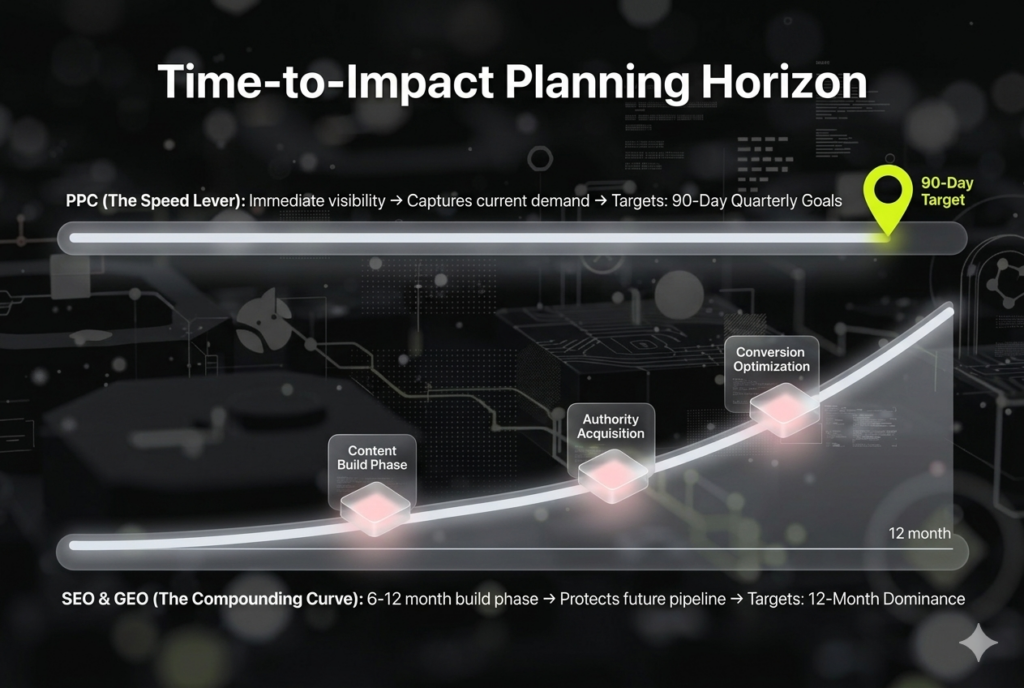
How much time remains before the board asks for a pipeline update? The primary friction point in the SEO vs PPC decision is the delta between time-to-first-lead and time-to-repeatable pipeline. PPC provides immediate visibility to high-intent buyers as a speed lever. If you need qualified demos by next week, PPC is the only tactical choice to fill that gap.
SEO and GEO operate on a compounding curve rather than a linear spend model. This build phase requires a 6 to 12 month runway before cost-per-acquisition (CAC) begins its downward trend. For B2B firms with long sales cycles, organic visibility creates a strategic moat that protects future pipeline from rising ad costs. Align your channel selection with your planning horizon to manage board expectations effectively.
Use this practical rule for channel allocation:
- PPC: Captures current demand to hit 90-day quarterly targets.
- SEO and GEO: Engineering a sustainable scaling lever for 12-month dominance.
Choose the channel that matches your runway.
2. Cost Dynamics: Variable Spend vs. Fixed Asset Investment
B2B leaders often treat SEO and PPC as interchangeable, but they represent fundamentally different financial models. PPC is a variable cost where lead volume scales linearly with spend. This keeps your CAC permanently tethered to auction volatility and competitor bidding. To double results, you must double your budget.
SEO is a fixed or step-cost investment. You front-load capital into technical architecture, entity authority, and content engineered for AI citations. Once you cross the visibility threshold, the marginal cost of each incremental lead drops. While high LTV can justify aggressive PPC spend, this only remains viable if conversion and sales efficiency are strictly proven.
Brands pay a hidden PPC tax through learning budgets, landing page mismatches, and wasted queries. Conversely, the hidden SEO tax is delayed ROI and maintenance for technical debt and content refreshes. Evaluate channels by CAC payback period and long-term pipeline equity rather than CPL. PPC is a recurring rental fee. SEO is a compounding asset.
3. Scalability and Asset Value: Building a Compounding Search Moat
Scalability is defined by what grows without a proportional increase in spend. In the seo vs ppc tradeoff, PPC is strictly tethered to auction economics. Maintaining lead volume requires continuous funding, creating a linear relationship where acquisition costs remain vulnerable to competitor bidding. Visibility vanishes the moment you stop paying for access.
SEO functions as a balance sheet asset rather than a recurring expense. It creates compounding distribution through:
- Topical authority and backlink profiles
- Knowledge graph ownership and brand entity signals
- Evergreen pages and internal link equity
- Structured data for AI-search retrieval
These assets work long after the initial production costs are cleared. While PPC provides valuable query data, it creates no lasting distribution. SEO builds a defensible acquisition moat that competitors cannot simply outspend. For B2B leaders, owned search presence is now the prerequisite for AI citations in LLMs like ChatGPT and Perplexity. Investing in search authority builds the infrastructure that drives revenue while your marginal acquisition costs decrease over time.
4. Risk Mitigation: Managing Volatility in SEO and PPC
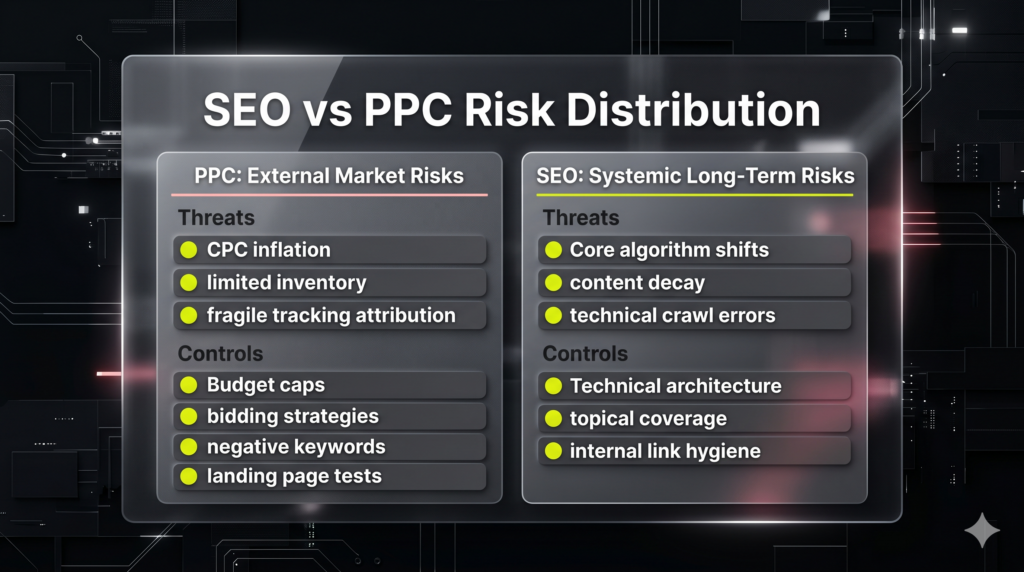
Search acquisition is a matter of risk distribution rather than luck. Both channels carry distinct threats to pipeline stability that require specific management strategies.
PPC risks are market-driven and external:
- CPC inflation and competitor bidding
- Limited inventory on high-intent terms
- Tracking and attribution fragility
SEO risks are systemic and long-term:
- Core algorithm shifts and content updates
- Content decay and link profile risk
- Technical indexation and crawl issues
Control depends on your team’s capability. PPC control relies on budgets, bidding, negatives, and landing page tests. SEO control involves technical architecture, topical coverage, internal linking, and content quality.
In the SEO vs PPC debate, prioritize the risk your team is equipped to manage. If you lack bandwidth for technical maintenance, PPC's variable costs are easier to contain. For instance, high-compliance verticals require a dedicated cybersecurity SEO strategy to mitigate technical and content risks simultaneously. If you can invest in authority, SEO builds a defensible moat where you own the search surface rather than renting it.
| Dimension | PPC | SEO and GEO |
|---|---|---|
| Time to impact | Leads within days | 6 to 12 month build phase |
| Cost model | Variable, scales linearly with spend | Fixed or step-cost, marginal cost falls over time |
| Asset value | Stops when spend stops | Compounding balance-sheet asset |
| Primary risk | CPC inflation and auction volatility | Algorithm shifts and content decay |
5. Intent Layers: Capturing Demand vs. Creating the Answer
B2B market leaders win by mapping seo vs ppc to specific buyer intent layers. PPC serves as a high-velocity demand capture engine. Use it to harvest high-intent prospects searching for transactional terms or to test new offers at speed. This is the most efficient tool for securing immediate visibility for bottom-funnel queries.
SEO and GEO function as your demand generation and education infrastructure. These channels provide full-funnel coverage from the problem-aware stage to final vendor comparisons. Because B2B buying committees research over six to 12 weeks, relying solely on PPC forces you to pay for every touchpoint in a complex journey.
An integrated SEO and GEO strategy earns repeated touches without incremental costs. This architecture ensures your brand is the cited authority in AI-generated answers across ChatGPT and Perplexity. Use PPC to capture immediate demand, but use SEO to win the comparison phase. PPC rents the click. SEO builds the entity authority required to be the answer.
6. Data Integration: Using PPC as a Research Engine for SEO
Dominant B2B brands use PPC as a high-speed research engine to de-risk organic investment. Conversion data inside your paid search account is a superior signal to raw keyword volume. This synergy transforms seo vs ppc from a budget battle into a strategic feedback loop. PPC generates immediate feedback while SEO converts those winners into compounding revenue assets.
Search term reports reveal exactly which queries drive the pipeline. Analyzing ad copy performance and landing page conversion rates identifies specific phrases that overcome buyer objections and friction. This intelligence builds an SEO roadmap focused on conversion evidence rather than vanity traffic metrics. It moves your strategy from informational searching to commercial buying.
Prioritize high-value pages based on proven intent patterns. Use paid tests to validate CVR before building organic assets for:
- Competitor alternatives and comparison guides
- Pricing models and integration pages
- Bottom-of-funnel (BOFU) solution case studies
SEO without conversion evidence is a content factory, not a growth system. Engineering your organic pipeline requires data-backed prioritization, not editorial guesswork.
7. The GEO Evolution: Moving From Clicks to AI Citations
Search is fragmenting. The traditional model of ten blue links is shifting toward a zero-click reality where AI summaries resolve queries instantly. This shift changes the SEO vs PPC calculation. While PPC buys visibility, its impact is increasingly constrained by SERP layouts that prioritize AI-generated answers over traditional ad placements.
To remain relevant, your strategy must win the answer layer. Winning here requires moving beyond keywords toward building structured content that generative engines can extract and cite. This is the core of Generative Engine Optimization (GEO), targeting:
- ChatGPT
- Gemini
- Perplexity
GEO ensures your brand is cited as the authoritative source in generative results. For brands navigating the SEO vs PPC debate, SEO alone is no longer enough. You need a dual-track strategy that integrates technical SEO and GEO to own the answer layer. Incorporating a robust AI search marketing strategy ensures your business remains visible across all generative ecosystems. Explore NUOPTIMA’s GEO services to see how we engineer brands for the answer engine era.
8. The Hybrid Transition: Phasing From Paid Rental to Organic Ownership
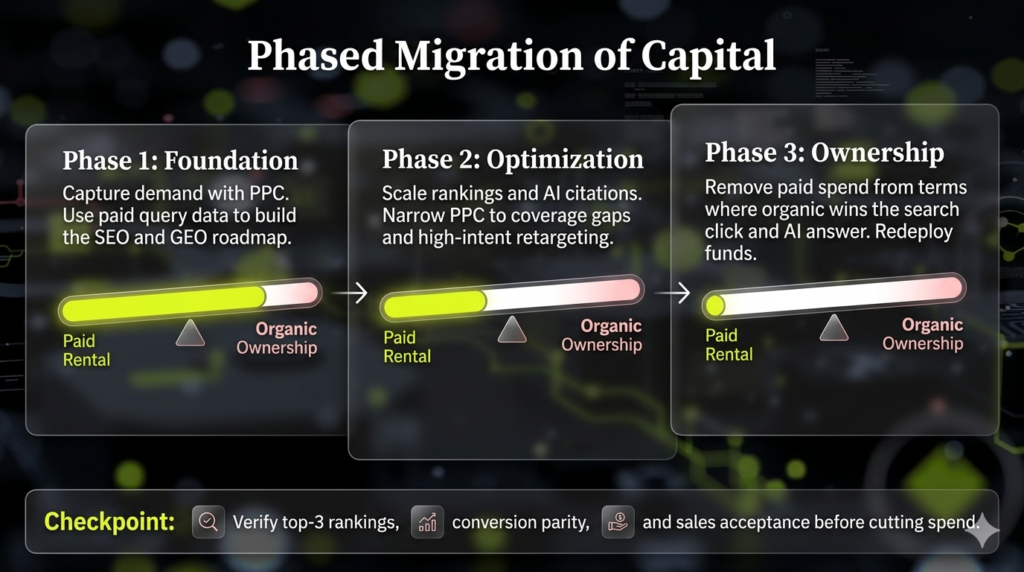
Transitioning from seo vs ppc is not a light switch. It is a phased migration of capital. In B2B, the hybrid approach is the default standard. PPC acts as the sprinter capturing immediate demand, while SEO serves as the marathon runner building long-term entity authority. Use this three-phase model to reduce paid dependency without creating a lead-flow cliff.
- Phase 1: Capture demand with PPC while building your SEO and GEO foundation. Use paid query data to identify high-converting clusters for your organic roadmap.
- Phase 2: As rankings and AI citations scale, narrow PPC to experimental keywords, coverage gaps, and high-intent retargeting.
- Phase 3: Remove spend from keywords where organic content consistently wins both the search click and the AI answer. Redeploy those funds to test new markets.
Before cutting spend, verify that SEO meets a three-part decision checkpoint: top-three rankings, conversion parity with paid benchmarks, and high sales acceptance. This framework ensures you never sacrifice pipeline for efficiency. It systematically lowers your blended CAC by replacing expensive rented traffic with sustainable organic ownership.
Get Your SEO and GEO Roadmap
Getting your channel allocation right is a CFO-level decision. Book a strategy call with NUOPTIMA to develop a custom plan for SEO, PPC, and GEO readiness. Visit Nuoptima or explore our GEO services page to start building your search moat.