Stop treating content freshness seo as a publishing treadmill. Changing a timestamp without adding value wastes crawl budget and erodes ranking signals. Freshness is a maintenance system for relevance, QDF, and AI citations. This playbook details 8 tactics to engineer information gain and technical date handling without “fake updates.” As the AI-native authority, NUOPTIMA scales these citation systems through GEO services at nuoptima.com. Start with tactic one.
Key Takeaways
- Content freshness is a maintenance system for relevance, QDF, and AI citations, not a publishing treadmill, and changing a timestamp without adding value wastes crawl budget and erodes ranking signals.
- Classify every page as Query Deserves Freshness (intent shifts fast) or Evergreen Decay (intent is stable but competitors improve), then apply the right update scope to each.
- Google and generative engines prioritize Information Gain over rewrite volume: a 50% rewrite can tank rankings while a focused 5% update with new data can trigger a surge.
- Replace age-based refresh schedules with decay triggers, moving a page to the backlog when a high-value URL loses 15% of clicks over six weeks.
- Keep all four date signals aligned (visible date, datePublished and dateModified schema, sitemap lastmod, and context) since fake-fresh updates cause long-term trust loss with algorithms.
1. Classify Intent: QDF vs. Evergreen Decay
Most content freshness SEO strategies fail by treating all decay as equal. To optimize effectively, perform rigorous keyword mapping and apply a binary classification to your inventory: Query Deserves Freshness (QDF) or Evergreen Decay.
Use this classification to drive update scope:
- QDF: Intent shifts rapidly. Examples include “best SaaS tools 2026” or pricing regulations. Prioritize recency, new data blocks, and timely angles to maintain relevance for Google and LLM citations.
- Evergreen Decay: Intent remains stable, but competitors improve their evidence, entities, or UX. Focus updates on Information Gain, trust signals, and consolidating topic coverage to build authority.
Add a “Class” tag to your content inventory. This prevents wasting resources by applying the wrong freshness strategy to the wrong query type.
2. Prioritize Information Gain Over Rewrite Quotas
A 50% rewrite can tank rankings while a 5% update triggers a surge. Google and generative engines prioritize Information Gain over sentence counts. This creates a measurable standard for updates that avoids busywork and supports ranking stability.
To capture content freshness seo, integrate benchmarks, original datasets, or frameworks missing from current top results. Replace outdated claims to sharpen entity authority and align with user intent.
Fast QA Checklist:
- What does the reader learn here that was unavailable last month?
- What specific claim can an AI engine cite as unique to your brand?
- Does this update provide a measurable improvement over the current SERP?
3. Pivot to Decay Triggers for Prioritization
Stop refreshing content based on age. A calendar reminder is not a strategic signal. To scale content freshness SEO, replace the “last updated” metric with data-driven decay triggers.
Monitor these signals to build a signal-based prioritization queue:
- Rank Slip: Primary keywords dropping from page 1 to page 2.
- CTR Drop: Declining click rates at stable positions caused by snippet mismatch or SERP changes.
- Impression Decline: Evidence of shifting search demand or lost topical relevance.
Operationalize this system with hard thresholds. If a high-value page loses 15% of clicks over six weeks, move it to the refresh backlog. This focuses your resources on recoverable revenue opportunities rather than chronological history.
4. Revive Historical “Sleeper” Pages
High-authority “sleeper” pages often sit on page two while specialists focus on new keywords. These URLs maintain internal authority but slipped due to content decay or intent shifts. Reviving these assets is the fastest route to improving content freshness seo and organic revenue.
Before editing, diagnose the gap:
- Identify intent mismatch against the current SERP.
- Audit missing subtopics competitors now cover.
- Verify link parity to ensure the page can realistically compete.
Update the content by tightening answer blocks for AI extractability and adding missing sections. Frontload citable data or proprietary frameworks to earn links and strengthen entity authority. Focusing on URLs with proven ability to win delivers faster ranking recovery than launching net-new content.
5. Align Technical Date Signals to Protect Trust
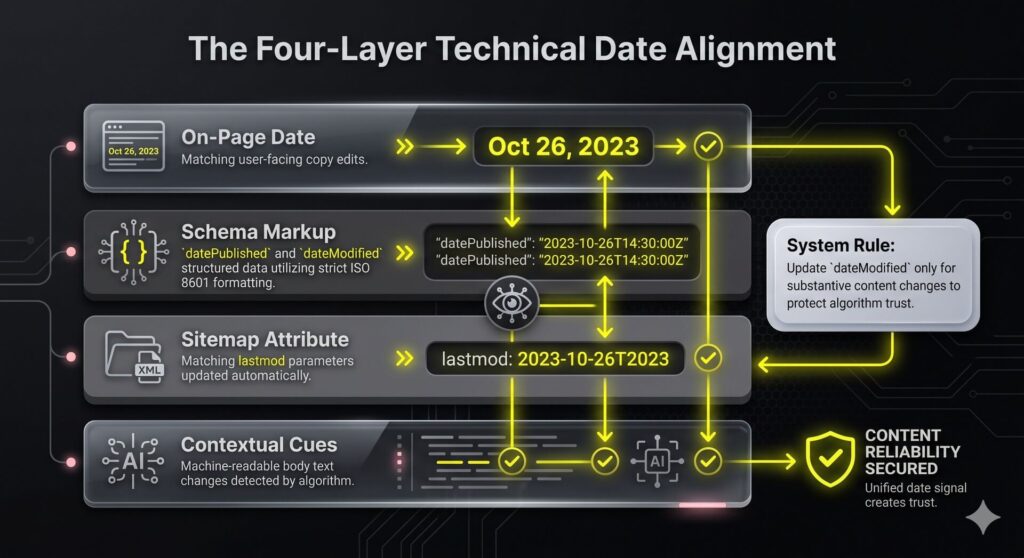
Google validates content freshness seo by cross-referencing four distinct signals: the visible on-page date, datePublished and dateModified structured data, the sitemap lastmod attribute, and contextual cues. Discrepancies between these layers flag your content as unreliable to Google and LLM crawlers like GPTBot.
Follow these implementation rules:
- Update dateModified only for substantive content changes.
- Maintain strict consistency between schema and visible timestamps.
- Use ISO 8601 formatting for all structured data.
“Fake fresh” updates create temporary CTR noise but cause long-term trust loss with algorithms. If date signals do not reflect material value additions, you risk losing snippet accuracy, AI citations, and search authority.
6. Engineer Discoverability for Crawler Reprocessing
Refreshing content is useless if Googlebot ignores changes for weeks. This latency stalls organic revenue and prevents LLM engines from citing new data. To force re-evaluation, make updates legible to traditional crawlers and generative engines by optimizing structural nodes.
Focus on high-weight elements that signal a shift in topical meaning:
- Update headings, summary blocks, and entity references.
- Strengthen internal links from high-crawl pages like the homepage to the refreshed URL.
- Add jump links and scannable answer blocks to capture engagement signals that trigger reprocessing.
Always preserve the URL slug during a refresh unless architecture demands a redirect. Retaining the original URL maintains historical equity and prevents indexing delays.
7. Deploy a Verifiable AI Refresh Workflow
AI-driven updates often create “rephrasing churn” with zero Information Gain. To maintain content freshness seo, use AI to identify missing questions or propose outlines, then apply a human layer for verifiable substance. This human layer must provide:
- Proprietary screenshots and data
- Direct expert inputs
- Specific risk checks
If an update is just a rewrite, it fails the freshness test. NUOPTIMA’s GEO framework requires structuring refreshed sections as extractable claims and sharp definitions. This formatting forces LLMs to recognize your brand as a citation-worthy source rather than a generic echo. Verifiable value turns a refresh into a long-term visibility asset across both Google and generative engines.
8. Systematize Content Freshness with an MVF Program
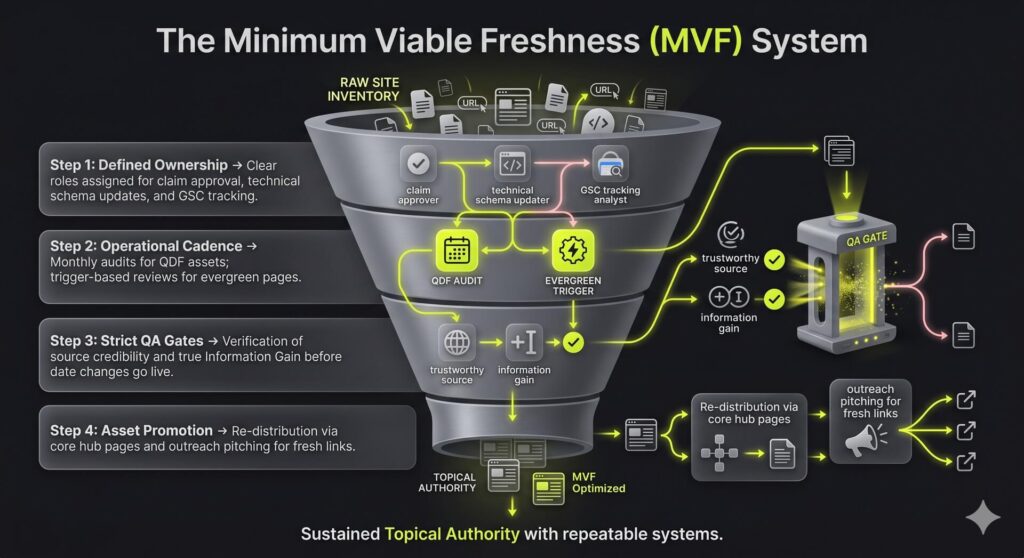
Reactive updates trigger ranking decay and lost AI citations. A Minimal Viable Freshness (MVF) program converts manual updates into a repeatable system that sustains topical authority.
- Ownership: Assign roles for claim approval, schema updates, and GSC impact monitoring.
- Cadence: Audit QDF pages monthly and evergreen assets based on specific decay triggers.
- QA Gates: Verify source credibility and Information Gain before any date signals go live.
- Promotion: Re-distribute via hub pages and pitch new data points for links.
This framework secures rankings and expands LLM visibility. For a refresh and GEO citation system, visit NUOPTIMA or our GEO services page.
Visit nuoptima.com and our generative engine optimization services page to learn how we build scalable refresh and GEO programs that drive measurable organic revenue.
Where this fits in your MSP growth system
This is one piece of how NUOPTIMA makes MSPs and cybersecurity firms the provider buyers find on Google and in AI search. See how it connects to MSP content marketing and MSP SEO, or get your free MSP lead forecast to see exactly where your firm shows up across ChatGPT, Gemini, and Perplexity today.