Technical density is a conversion killer for IT service providers. Firms use jargon to signal expertise, but it forces buyers to bounce. Treat readability content improvement seo as a revenue lever; clarity drives qualified enquiries. These 11 upgrades blend UX structure with GEO formatting to get your brand cited by AI engines, mirroring the client success detailed in our ROI-first SEO case study. Stop optimizing for scores and focus on buyer understanding. We begin with the highest-impact fix: an answer-first structure.
Key Takeaways
- Open every section with a direct one-sentence answer before the technical detail, which stops pogo-sticking and gives AI engines a clean block to extract and cite.
- Keep paragraphs to 1 to 3 sentences and sentences under 20 words, using active voice to signal accountability and reduce cognitive load for time-poor buyers.
- Expand every technical acronym at first mention (for example, Endpoint Detection and Response (EDR)) so executive buyers do not leave your page to search for a definition.
- Move spec-heavy content like SLAs and service tiers into skimmable tables, which speeds buyer comparison and simplifies extraction for AI search snippets.
- Run a 60-minute monthly readability and GEO sprint covering intent, answer-first structure, line editing, visuals, and GA4 measurement to keep high-intent pages performing.
1. Use Answer-First Content Structure for AI Citations
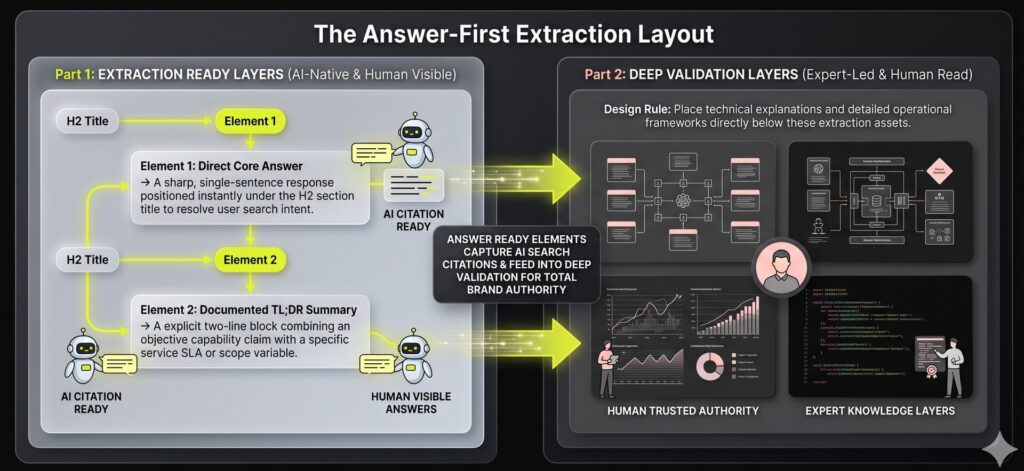
Open every section with a direct one-sentence answer before the technical explanation. This structure stops pogo-sticking by providing instant clarity and creates a clean summary block for AI engines to extract.
Implement a two-line TL;DR under each H2. Combine one clear claim with a concrete qualifier like scope or SLA. For example: "We provide 24/7 remote support with a 15-minute response for priority tickets. Here is how escalation works." This formatting improves readability and secures your brand as the cited authority.
2. Structure Your Page as a Visible Decision-Making Outline
Burying solutions in generic text forces time-poor buyers to scroll, increasing bounce rates. Convert your page into a visible outline using descriptive H2s and H3s to turn passive scanning into active decision-making.
- H2s: Pose decision questions like “Remote vs On-Site Support” or “Response Times & SLAs.”
- H3s: Detail specific proof like tools supported or “What Happens During Onboarding.”
This hierarchy eliminates scrolling fatigue and strengthens readability content improvement seo. It provides search engines a clear topical map while ensuring prospects find answers without friction.
3. Dissolve Walls of Text with Micro-Paragraphs
Dense text blocks trigger a "too long, won't read" reaction that kills engagement and enquiry rates. Large paragraphs signal poor clarity and erode buyer trust. Effective readability and content improvement requires shorter paragraphs and breathing room around lists.
Stick to 1 to 3 sentences per paragraph to reduce cognitive load and increase perceived reading speed, which is a core tenet of zero-click SEO for IT services. For an IT support page, break a generic "Services Included" section into specific micro-blocks:
- Helpdesk
- Device management
- Backups
- Security
- Procurement
- Cloud migration
- Network audits
4. Use Active Voice to Prove Accountability
Passive phrasing kills trust in B2B contracts. Vague claims like "systems are monitored" lack an actor, creating ambiguity that stalls deals. Swap to active voice to signal direct ownership. Instead of "Tickets are responded to within one hour," use "Our team responds within 60 minutes."
This readability content improvement seo strategy ensures technical promises land immediately:
- Keep sentences under 20 words to eliminate rereads.
- Use high-impact verbs like patch, escalate, and secure.
- Replace passive descriptions with active accountability.
Unambiguous copy accelerates the buyer’s journey by proving you deliver.
5. Deploy Progressive Disclosure for Complex Technical Claims
Demonstrating technical depth without alienating the C-suite requires progressive disclosure. This strategy ensures readability content improvement seo satisfies both technical practitioners and executive buyers by earning trust without overwhelming non-technical stakeholders. Lead with a plain-language outcome, then provide a specialized expansion.
- Define concepts simply: describe MDR as a 24/7 security watchman.
- Insert a "For IT teams" section detailing vendor stacks like CrowdStrike or SentinelOne.
- Detail specific alert handling, triage, and escalation protocols.
This framework builds authority through concrete technical examples while maintaining the speed of the executive decision-making process.
6. Expand Technical Acronyms to Prevent Buyer Friction
Technical shorthand stalls B2B pipeline growth. While SIEM or MDM are clear to engineers, undefined terms create friction for executive buyers. If a prospect leaves your site to search for a definition, you lose the conversion.
Expand acronyms at first mention: Endpoint Detection and Response (EDR). This readability content improvement seo strategy builds transparency for both technical and economic buyers. Include a glossary for high-frequency terms:
- Multi-Factor Authentication (MFA)
- Single Sign-On (SSO)
- Service Level Agreement (SLA)
7. Swap Specification Paragraphs for Skimmable Tables
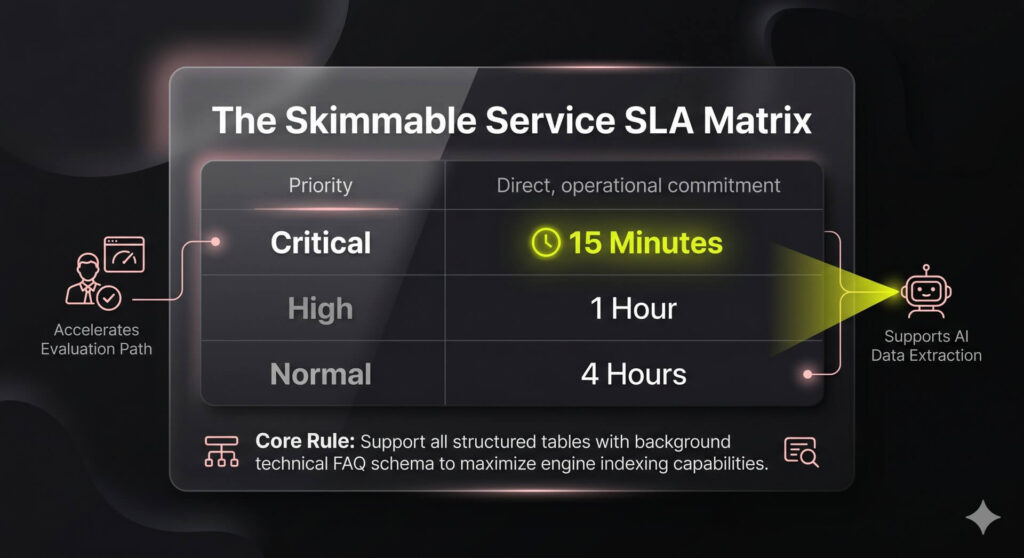
B2B buyers prioritize speed when comparing providers. Move spec-heavy content like SLAs and service tiers into bullet lists or comparison tables to facilitate faster scanning and simplify data extraction for AI search snippets.
Turn service inclusions into grouped bullets and use tables for plan differences, and pair these adjustments with technical FAQ schema SEO implementation. For example, document response times by priority. This strategy improves readability content improvement seo and establishes entity authority, reducing the friction that blocks conversions.
| Priority | Response Time |
| Critical | 15 Minutes |
| High | 1 Hour |
| Normal | 4 Hours |
8. Replace Decorative Imagery with Functional Process Diagrams
Stock photos of smiling technicians provide zero value. High-impact readability content improvement seo treats visuals as functional guides, not decoration. Diagrams clarify complex IT service delivery faster than text, building the trust required for high-value service signatures.
Implement one diagram per complex section:
- 5-step onboarding timeline (discovery to QBR cadence)
- Escalation ladders
- Security stack architecture
Use descriptive captions that restate the primary takeaway. This approach demystifies technical processes, improving reader comprehension and demonstrating operational maturity to prospective buyers.
9. Treat Typography and Spacing as Conversion Design
Readability is a design failure that costs leads, not just a copy issue. UX friction causes buyers to abandon pages immediately. High-performance readability content improvement seo requires effortless legibility across all devices:
- Use 16px+ font sizes.
- Set line-height to 1.5.
- Limit line length to 75 characters.
- Ensure high contrast (avoid light gray on white).
For IT service pages with dense feature lists, improve legibility before rewriting copy. This ensures technical expertise is accessible rather than exhausting.
10. Design Navigation Paths to Prove Credibility and Drive Action
Effective readability content improvement seo requires navigable proof points. Dead-end pages stall the B2B funnel and weaken E-E-A-T signals. Guide the journey by linking claims, like incident response processes, to dedicated evidence pages instead of generic contact forms. This transforms static content into a guided evaluation path.
- Evidence links: Security standards, vendor documentation, and case studies.
- Internal links: Glossaries, pricing explainers, and onboarding guides.
- CTA clarity: One primary action per section, such as Request Assessment or Book a Call.
These navigation paths convert passive pageviews into qualified pipelines.
11. Refine Content with a Multi-Stage AI-Proof Workflow
AI-generated text often fails because LLMs prioritize patterns over persuasion, creating robotic prose that signals low expertise. High-performance readability content improvement seo requires a strategic score-to-verify pipeline:
- Score: Use Hemingway or Grammarly to flag complexity and passive voice.
- Revise: Inject specificity with proof lines, such as ticket volumes, tooling supported, or escalation ownership.
- Verify: Audit for brand voice and LLM-friendliness using automated pipelines like n8n.
This replaces generic filler with the authoritative evidence required to secure AI citations and B2B pipeline.
How to Implement a Monthly Readability and GEO Sprint
Execute this 60-minute workflow monthly to ensure high-value pages dominate Google and AI search results. This process converts technical documentation into a revenue-generating asset.
Step 1 (10 min): Audit Intent and Select Your Target
Pick a high-intent page mapping to a specific buyer query like "managed IT support for small business." Defining the core question ensures content serves human intent and LLM training data.
Step 2 (10 min): Structure Pass for AI Extraction
Rewrite H2 headings as decision-focused questions. Insert a two-sentence answer-first block below each header to create clear information extraction points for AI engines like Perplexity and ChatGPT.
Step 3 (20 min): Line Edit for Clarity and SEO
Apply active voice and break text into micro-paragraphs. Define all acronyms and move technical specifications into skimmable tables. This formatting directly supports readability content improvement seo and improves semantic clarity for search crawlers.
Step 4 (10 min): Visual and Functional Audit
Ensure font size is at least 16px. Add a custom functional diagram, such as a security escalation map, to increase dwell time and reinforce topical authority.
Step 5 (10 min): Measurement and Iteration
Track scroll depth and form CTR in GA4. Identify the highest exit-rate section and update it first during your next sprint. Strong engagement signals to search engines that your content provides definitive answers.
For readability and AI visibility engineered together, visit nuoptima.com or explore our Generative Engine Optimization (GEO) services.
For brands seeking to turn search into a compounding revenue engine, visit nuoptima.com to learn how our GEO strategies secure definitive answers.