Page one rankings are no longer the ultimate metric. Success now depends on being selected and cited within generative answers. AI engines no longer merely list links. They retrieve specific entities to synthesize a definitive response. For SEO professionals optimizing for AI Overviews and RAG engines, these seven AI search ranking factors provide a practical framework for entity clarity and citation-worthiness. Each includes do and don't guidance you can audit this week to ensure your brand is winning the answer layer.
It starts with eligibility.
Key Takeaways
- AI engines cite passages, not whole pages, so each block must start with its conclusion and stand alone without preceding context.
- The seven AI search ranking factors are technical accessibility, intent alignment, entity consistency, verifiability, chunk-level formatting, content freshness, and external entity signals.
- If your robots.txt blocks bots like GPTBot or OAI-SearchBot, your content is ineligible for AI citation entirely, no matter how strong it is.
- Place a two-sentence best-answer block directly under the H1 and use explicit "is" statements so LLMs can attribute expertise to your brand.
- Track 20 to 50 high-intent prompts monthly across ChatGPT, Gemini, and Perplexity to measure your AI search market share.
AI search ranking factors are the signals that determine whether a generative engine retrieves, trusts, and cites your content as the direct answer, covering accessibility, entity clarity, verifiability, formatting, freshness, and off-page consistency.
1. Technical Accessibility and Indexing
AI engines cannot cite what their retrievers cannot access. Invisibility in ChatGPT or Perplexity often stems from blocking the bots that power AI citations. Generative engines use Retrieval-Augmented Generation (RAG) to pull real-time data. If your technical architecture prevents crawling, your expertise is excluded from the answer layer entirely.
Audit robots.txt to ensure you are not blocking user-agents like GPTBot or OAI-SearchBot. Paywalls, login requirements, and "noindex" tags are instant disqualifiers for citation eligibility. Avoid JavaScript rendering traps where critical content only exists post-interaction. If primary answers are not in the server-side HTML, AI crawlers will fail to index them.
The Audit Checklist:
- Do: Maintain indexability in Google and Bing; keep primary answer content in the DOM.
- Don’t: Block crawlers by default; hide definitions or specs behind tabs that require client-side execution.
Confirm status via Search Console or "site:" queries. If a URL is not indexed, it is ineligible for retrieval. This technical foundation is the fastest way to gain or lose AI visibility.
2. Intent Alignment and Task Completion
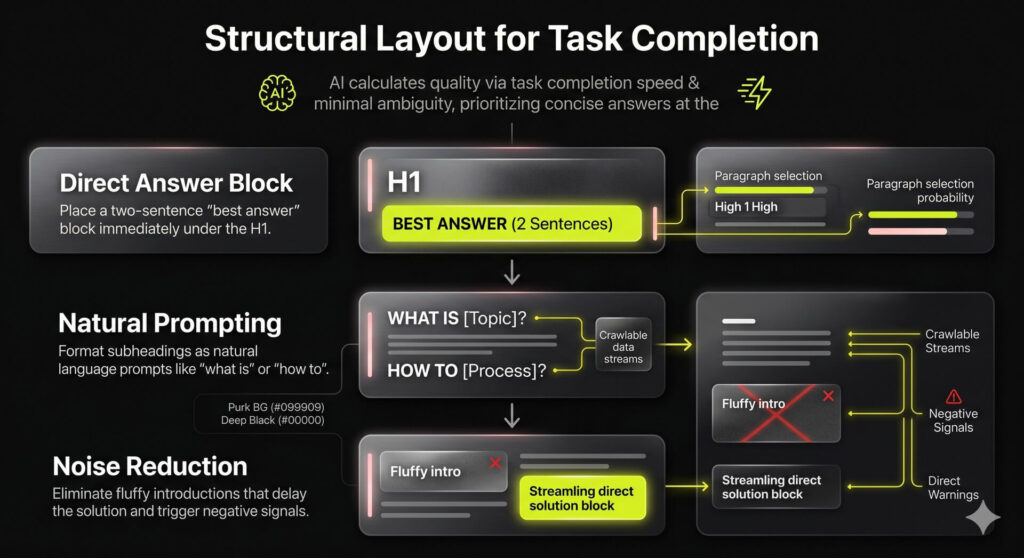
Why does a 2,000-word guide lose citations to a three-sentence summary? AI engines define quality through task completion speed and minimal ambiguity. Helpfulness is a mathematical calculation of intent alignment and query completeness, two critical ai search ranking factors.
Intent alignment requires delivering direct answers first and supporting context second. Leading AI responses prioritize pages that anticipate query fan-out by addressing common follow-up questions. Use these tactical moves to increase selection probability:
- Place a two-sentence "best answer" block immediately under the H1.
- Format subheadings as natural language prompts (e.g., "what is," "how to," "best").
- Eliminate fluffy introductions that delay the solution.
Burying the answer below hero modules or keyword-stuffed copy triggers negative ranking signals. This prevents content from being relevant but unusable for the answer layer. Measure success by whether AI search engines pull your summary lines as the definitive citation. If they do not, iterate on your specific answer blocks until they are the most concise response in the index.
3. Entity Consistency and Contextual Disambiguation
AI engines resolve and rank sources by mapping your pages to specific entities. If your brand identity is vague, LLMs cannot reliably attribute expertise to your organization. Precise entity clarity is a primary AI search ranking factor for establishing knowledge graph ownership and increasing citation probability.
Optimize for recognition with on-page disambiguation:
- Use explicit “is” statements, such as “NUOPTIMA is an AI-native SEO and GEO agency.”
- Provide tight definitions for proprietary tools, frameworks, and standards.
- Eliminate hedging language that creates semantic noise for crawlers.
Structured data validates these relationships technically. Deploy Organization, Article, and FAQ schema to confirm your credentials. Pair these with robust author bios to map trust directly to subject matter experts. Maintain factual consistency across LinkedIn and industry directories to avoid signaling unreliability to LLM retrievers.
Measure entity authority through branded prompts like “best [category] + [brand name]” and check for entity-panel results. Precise architecture reduces misattribution and ensures your brand becomes the default cited answer in generative environments.
4. Verifiability and Citation-Worthy Data
AI engines prioritize statements they can justify with reliable sources to minimize hallucination risks. This makes verifiability one of the most critical ai search ranking factors for high-stakes queries. Citable content differs from standard content by prioritizing evidence over narrative flow. Generative models favor technical precision because the data is easier for LLMs to validate.
Apply these standards to transform content into a citable asset:
- Anchor assertions in primary references like industry standards or research.
- Provide concrete context such as dates, scope, and specific definitions.
- State exactly who provided the information and its origin.
- Use short, standalone declarative sentences.
Avoid exclusion triggers such as anonymous statistics, unsourced claims, or absolute statements without methodology. AI retrievers flag these as high-risk, often omitting them from generative answers. Track which paragraphs earn citations and expand those sections into mini reference blocks. This strategy converts your site into a safe-to-repeat source, compounding your brand authority and organic pipeline.
5. Formatting and Chunk-Level Optimization
AI engines rank snippets, not pages. In GEO, you compete passage against passage rather than website against website. LLMs use retrieval systems to extract self-contained blocks that are easy to ground and cite. If your answer is buried in a wall of text, it remains invisible to the retriever.
To win this chunk competition, treat every paragraph as a standalone asset by starting with your conclusion and limiting each block to one idea. Use descriptive subheadings that define the following section’s specific content. Avoid labels like "Overview" or "Introduction" which provide zero context for an LLM mapping content to a query. These structural choices are critical AI search ranking factors for block-level visibility.
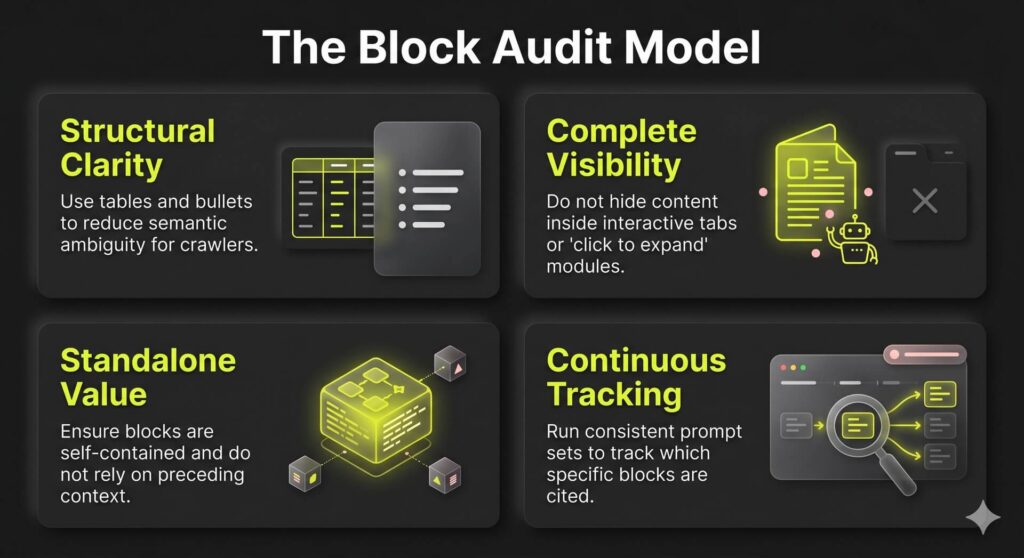
The Block Audit
- Prioritize clarity: Use tables and bullets to reduce semantic ambiguity for crawlers.
- Avoid hidden text: Do not hide content in interactive tabs or "click to expand" modules.
- Optimize for extraction: Ensure blocks are self-contained and do not rely on preceding context.
- Measure impact: Run consistent prompt sets to track which specific blocks are cited.
6. Content Freshness and Maintenance Cadence
For evolving topics, LLMs prioritize recently maintained sources to mitigate the risk of providing obsolete data. Temporal relevance acts as a critical AI search ranking factors signal. High-frequency updates ensure your domain remains the safest retrieval target for fast-moving subjects like software features or regulatory shifts.
Focus refresh cycles on high-ROI volatile data:
- Industry statistics and data benchmarks
- Software tool features and pricing
- Process steps and technical documentation
- UI screenshots and SERP descriptions
Include a visible "last updated" timestamp and a meaningful change log to build authority with both users and AI retrievers. Prioritize refreshing above-the-fold answer blocks first. These sections are high-probability extraction targets for generative summaries and featured citations.
Avoid "fake" updates where dates change without substantive text revisions. This creates semantic contradictions that damage entity trust across your site. Measure performance by monitoring AI citations on a controlled prompt set before and after the refresh. This validates your visibility gains and ensures your content does not age out of the answer layer.
7. External Entity Signals and Brand Consistency
AI engines triangulate authority by analyzing unlinked mentions and brand descriptors across the web. Unlike traditional SEO prioritizing backlink volume, LLMs build entity confidence through repeated third-party references. If credible publications describe your brand inconsistently or fail to mention you in category research, your citation probability for "best" or "recommended" prompts drops.
Off-page narrative control is among the critical AI search ranking factors for B2B authority:
- Secure unlinked mentions on authoritative industry sites.
- Cultivate reputation signals on category-specific review platforms like Clutch or G2.
- Maintain identical brand descriptors (service offering and ICP) across all digital profiles.
Avoid spammy paid mentions and mismatched positioning. Inconsistent naming conventions or conflicting service descriptions confuse retrievers and damage entity trust. Track brand share of voice for category prompts and audit third-party citations in your niche. High-integrity narrative consistency ensures your brand becomes the default recommendation for trust-based queries. This increases your probability of being recommended when the query is comparative or trust-based.
How to Build a GEO Strategy: A Tactical Execution Roadmap
Operationalize AI search ranking factors by transitioning from broad content production to a structured decision workflow. This tactical plan closes the competitor gap by matching your output to specific engines weight retrieval, freshness, and authority.
Step 1: Classify the Target Search Surface
Identify which platform your audience uses to research solutions. Google AI Overviews rely on tight coupling with traditional search systems and the Knowledge Graph. RAG-first engines like Perplexity prioritize snippet retrievability and real-time freshness. Choose your primary surface to determine which technical signals to prioritize first.
Step 2: Run the 4-Step GEO Triage
Apply this audit hierarchy to your top revenue-generating pages to ensure they are citation-ready:
- Eligibility: Verify that all AI bots can crawl and render your content. Fix indexation and rendering gaps to ensure the engine sees your latest updates.
- Extractability: Rewrite answer blocks to be concise and standalone. Logical chunking helps LLMs isolate your brand as the best response.
- Verifiability: Add primary sources and tighten all claims. Use Schema markup to provide absolute entity and author clarity for the model.
- Authority: Execute a targeted mention strategy on authoritative third-party sites. This reinforces your reputation across the model’s training data.
Step 3: Minimal Measurement Setup
Choose 20 to 50 high-intent prompts and standardize the wording. Track your citations monthly across ChatGPT, Gemini, and Perplexity. You will gain a clear map of your AI search market share and identify which clusters require further optimization.
Build a defensible search moat with professional Generative Engine Optimization (GEO) services.
For teams that require specialized measurement and remediation, NUOPTIMA provides done-for-you Generative Engine Optimization (GEO) services. Visit nuoptima.com to book a strategic advisory call.