MSP buying guide

Best AI Service Desk Agents for MSPs (2026)

Four models, sixteen vendor entries, every fact checked against the vendor's own live site on 15 September 2026.

16  vendors 4  models Verified 15 Sep 2026

Your level 1 (L1) desk costs the same every month whether the tickets are hard or trivial. Password resets, mailbox permissions, a printer that dropped off the network. Work a technician clears in minutes, absorbed by a full salary. Sixteen vendors now sell artificial intelligence (AI) or automation tools aimed at some part of that work, and most of them publish a percentage to prove it.

The percentages are not comparable. Vendors use them for five measures: tickets resolved end to end, tickets never created, escalations avoided, technician capacity or productivity gained, and service requests automated. Scope is a separate problem: some numbers describe all customers, while others come from one case study.

So this page splits the market into four models and labels every entry. Resolution agents close level 1 and level 2 (L2) tickets end to end inside the professional services automation (PSA) platform you already run. Platform copilots are the AI already sitting inside the PSA or remote monitoring and management (RMM) product you pay for. Intake and voice layers gather and enrich request details through chat, portals or voice; some hand the ticket to a person, others also advertise automated handling. Automation platforms are workflows you build, not an agent you switch on.

This is for the owner of a managed service provider (MSP) with roughly 10 to 200 seats and a desk cost that stopped being a rounding error. Not for enterprise information technology (IT) departments buying a service desk, and not a list of every AI product with an MSP page. If you want people rather than software, read the outsourced help desk page. For the wider view of AI across the stack, read best AI and automation tools for MSPs.

Where our money comes from

We do not sell any of these products, take commissions from any vendor on this page, or accept payment for placement. Four entries carry a disclosure at the top of their own entry.

Comparison

At a glance

The table abbreviates Kaseya Business Management Solution (BMS), Virtual System Administrator (VSA), information technology service management (ITSM) and hours (hrs).

AI service desk agents for MSPs, verified 15 September 2026
VendorModelWorks insideHeadline numberWhat kind of numberPublished price
SquashResolution agentConnectWise, Autotask, HaloPSA, Kaseya BMS, Syncro, N-able; Datto RMM, NinjaOne"Over 70% L1/L2 Resolution"End-to-end resolution rateNot published
MizoResolution agentConnectWise, Autotask, HaloPSA; NinjaOne, Datto RMM"26% Average increased capacity per technician"Capacity or productivity gainNot published
Neels AIResolution agentAutotask, ConnectWise, HaloPSA, TOPdesk, ServiceNow; Datto RMM, NinjaOne"Resolve 40%+ of service desk tickets end to end within 4 weeks"End-to-end resolution rateNot published
SuperITResolution agentConnectWise, Autotask, HaloPSA, Syncro, SuperOps, Atera; Datto RMM, NinjaOneNone published; target agreed per pilotNone publishedUS$595 per month minimum
ThreadResolution agentConnectWise Manage, Autotask, HaloPSA"15-25% of tickets are resolved end-to-end"End-to-end resolution rate$19 and $34 per managed customer per month
Neo AgentResolution agentConnectWise, Autotask, HaloPSA, Syncro; NinjaOne, Datto RMM"150+ hrs saved every month on manual triage"Capacity or productivity gain, one customer$500, $1,300 and $2,340 per month
Atera RobinResolution agentNot published; requests from Teams, Slack, email, third-party ITSM tools"Resolve 92% of technical issues autonomously"End-to-end resolution rateNot published
ConnectWise AI Agents and SidekickPlatform copilotAI Agents: ConnectWise PSA workflows; Sidekick: ConnectWise PSA, RMM, Automate and Microsoft TeamsAI Agents: "80+% reduction in escalations"; Sidekick: "5 minutes saved on every service ticket"Escalation reduction; capacity or productivity gainNot published, quote only
SuperOps Monica AIPlatform copilotSuperOps only"Up to 80% reduction in tickets created"Ticket volume reductionFrom $89 per technician per month
HaloPSA, Halo AIPlatform copilotHaloPSA only; Automate, ConnectWise RMM, Datto RMMNot publishedNone published, case studies only£66 per agent per month, billed annually, plus onboarding
Kaseya Cooper Copilot and Kaseya AssistPlatform copilotKaseya BMS (Cooper Copilot); VSA 10 (Kaseya Assist)Not publishedNone publishedNot published, quote only
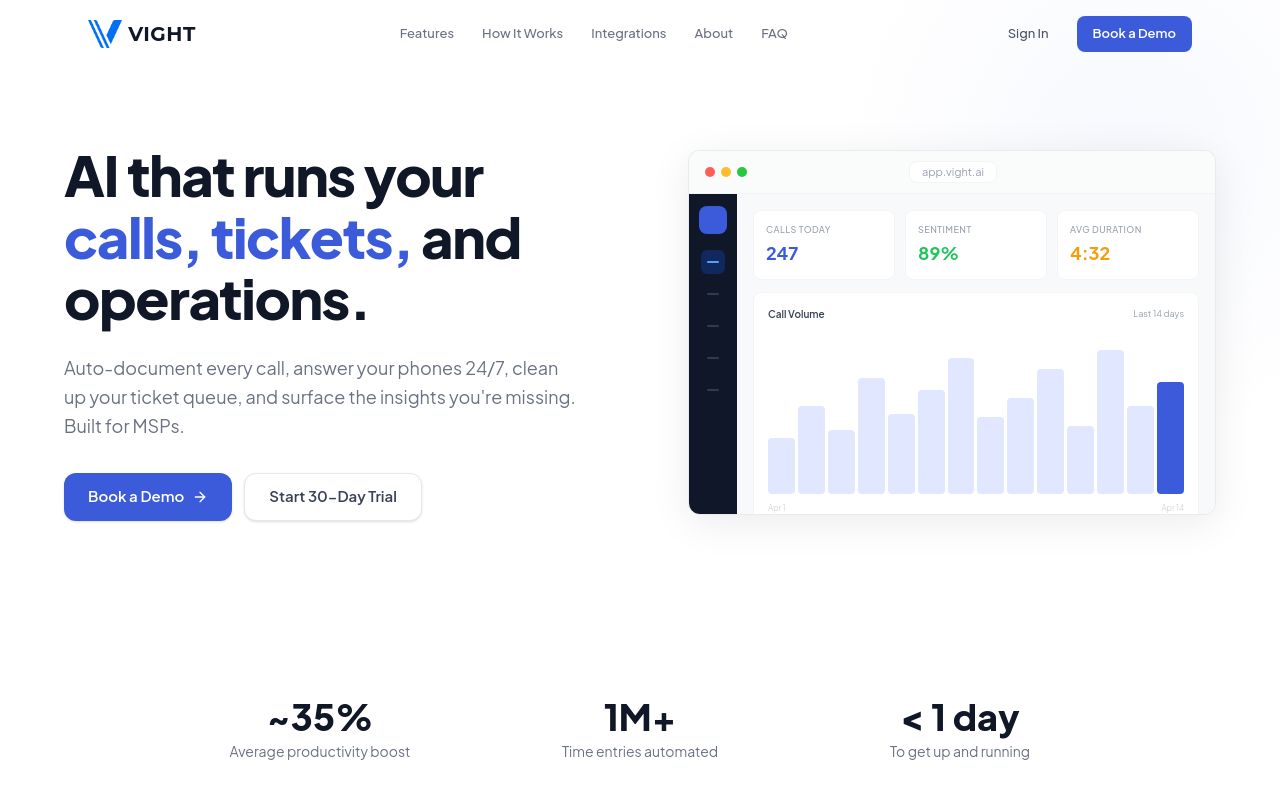
VightIntake and voiceConnectWise, Autotask, HaloPSA; seven phone systems"~35% Average productivity boost"Capacity or productivity gain$250 to $1,650 per month
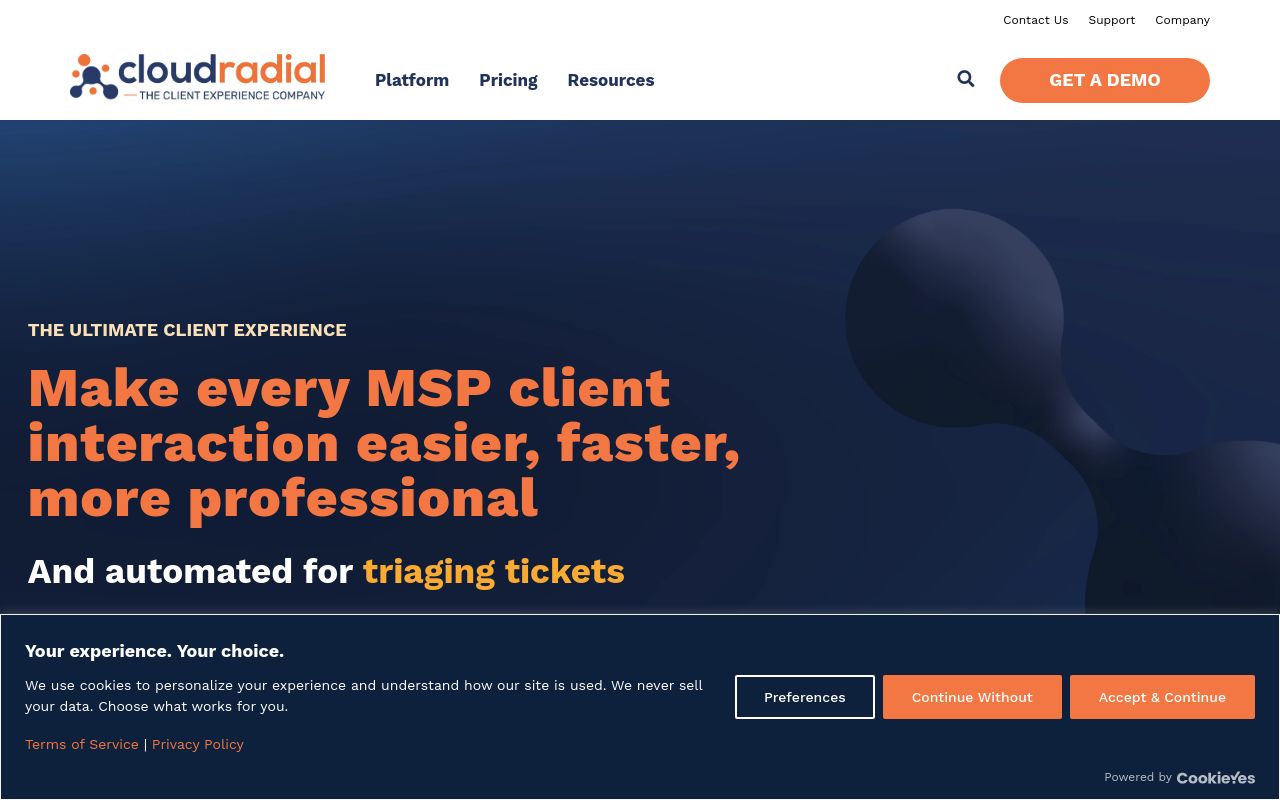
CloudRadialIntake and voiceConnectWise, Autotask, Kaseya BMS, HaloPSA, Syncro; Zendesk"Team productivity up by 40% or more"Capacity or productivity gainServiceAI from $295 per month, annual commitment
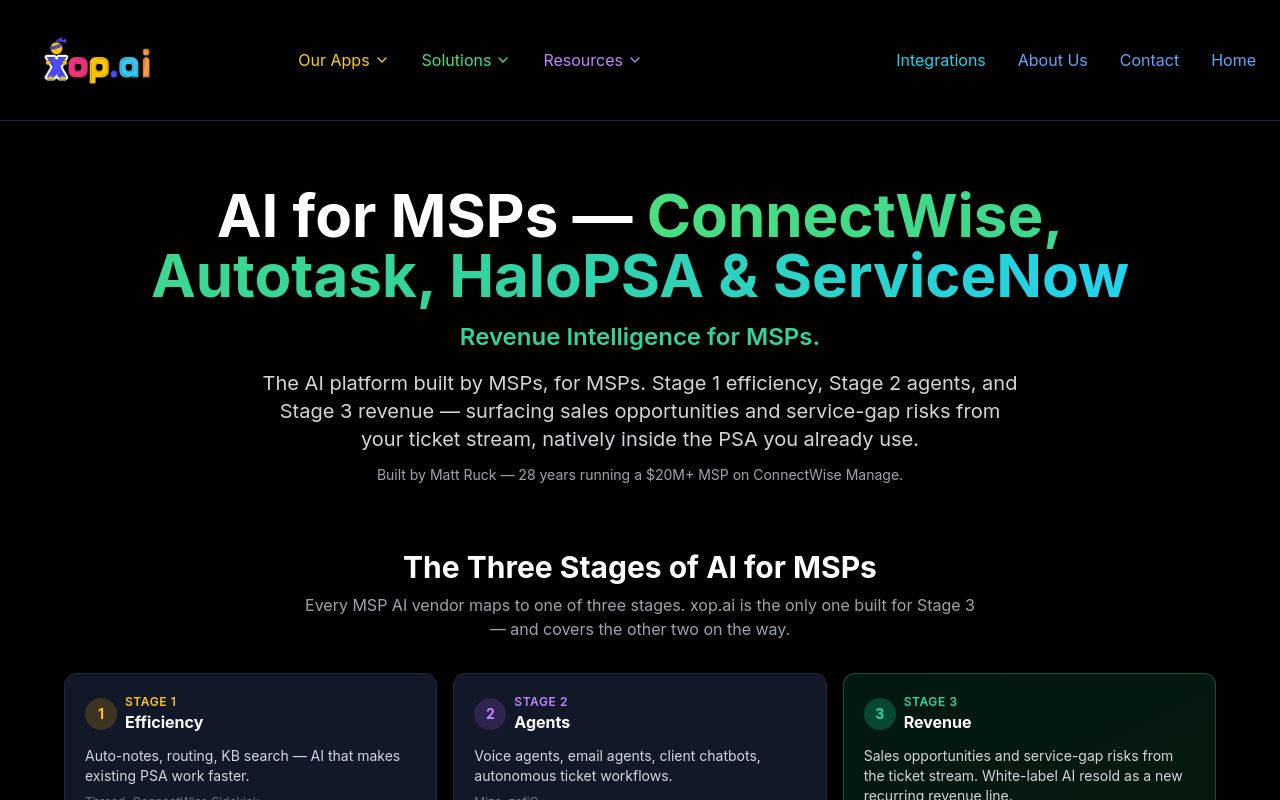
xop.aiIntake and voiceConnectWise, Autotask, HaloPSA, ServiceNow; ConnectWise Automate"Chat assistants deflect 30%+ of L1 tickets"Ticket volume reduction$55 per engineer per month
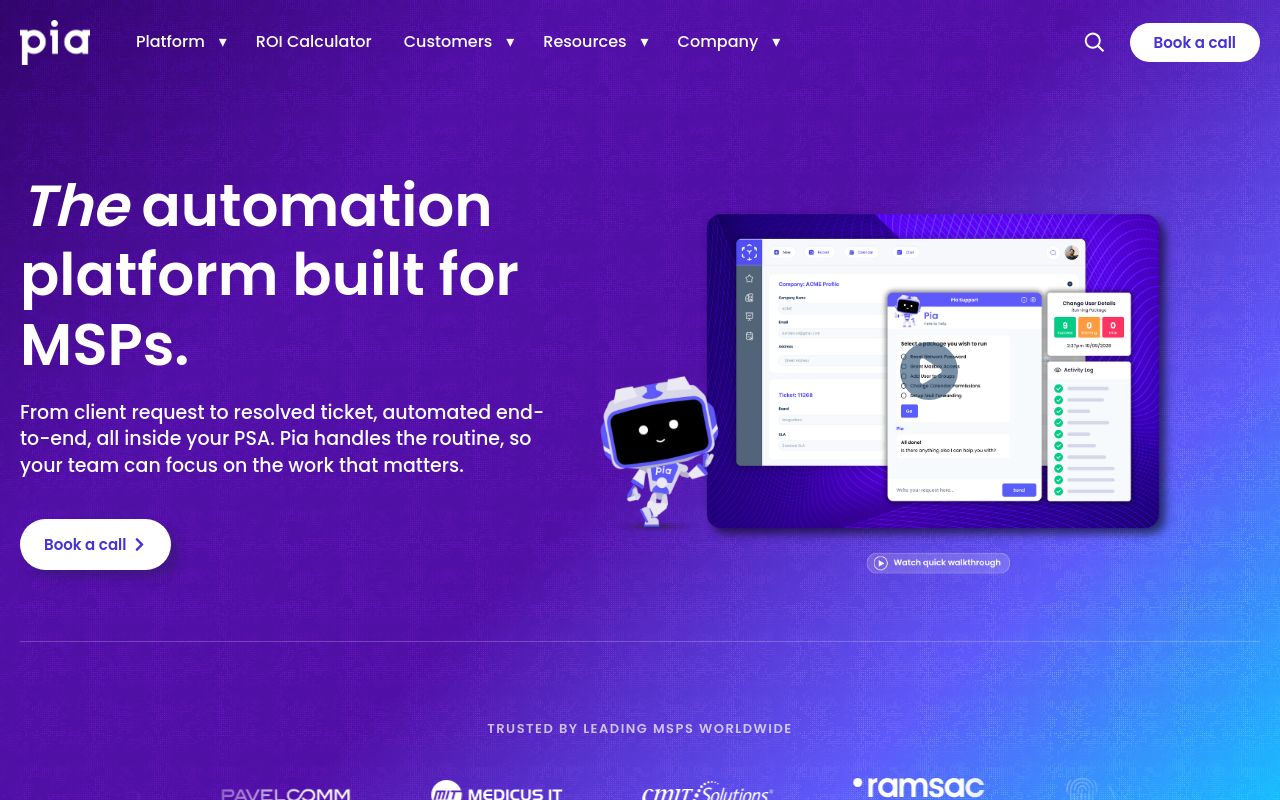
PiaAutomation platformConnectWise, Autotask, HaloPSA"60% Service requests automated"Automation coveragePia Chat US$10 per client per month, add-on; platform rate not published
RewstAutomation platformConnectWise, Autotask, HaloPSA, Kaseya BMS, SuperOps; six RMM platforms"15+ million hours saved across MSPs"Capacity or productivity gainNot published, usage or user based

Model and metric labels are our classifications. "Not published" means we could not find the figure on the vendor pages we reviewed, not that it does not exist. Every headline number is vendor-published; none of the vendor pages we read identifies an independent audit of the figure.

The shortlist

The entries

Resolution agents

Seven products built around an end-to-end resolution workflow; how much a technician has to approve varies by product. Autonomous resolution is central to this group. The published end-to-end figures run from Thread's 10% homepage lower bound to Atera Robin's 92%; SuperIT publishes no figure and agrees one per pilot.

01

Squash

An AI technician scoped to identity and Microsoft 365 work.

Resolution agent No rate card found
Model
resolution agent
Works inside
Autotask, Kaseya BMS, HaloPSA, ConnectWise Manage, Syncro, N-able; Datto RMM, NinjaOne, Kaseya VSA, ConnectWise Automate
Headline number
"Over 70% L1/L2 Resolution" [End-to-end resolution rate]
Published pricing
none. "No lock-in. No upfront costs", free implementation, no minimum commitments
Backing
its careers page says Squash is seed-stage, backed by Lightspeed Venture Partners
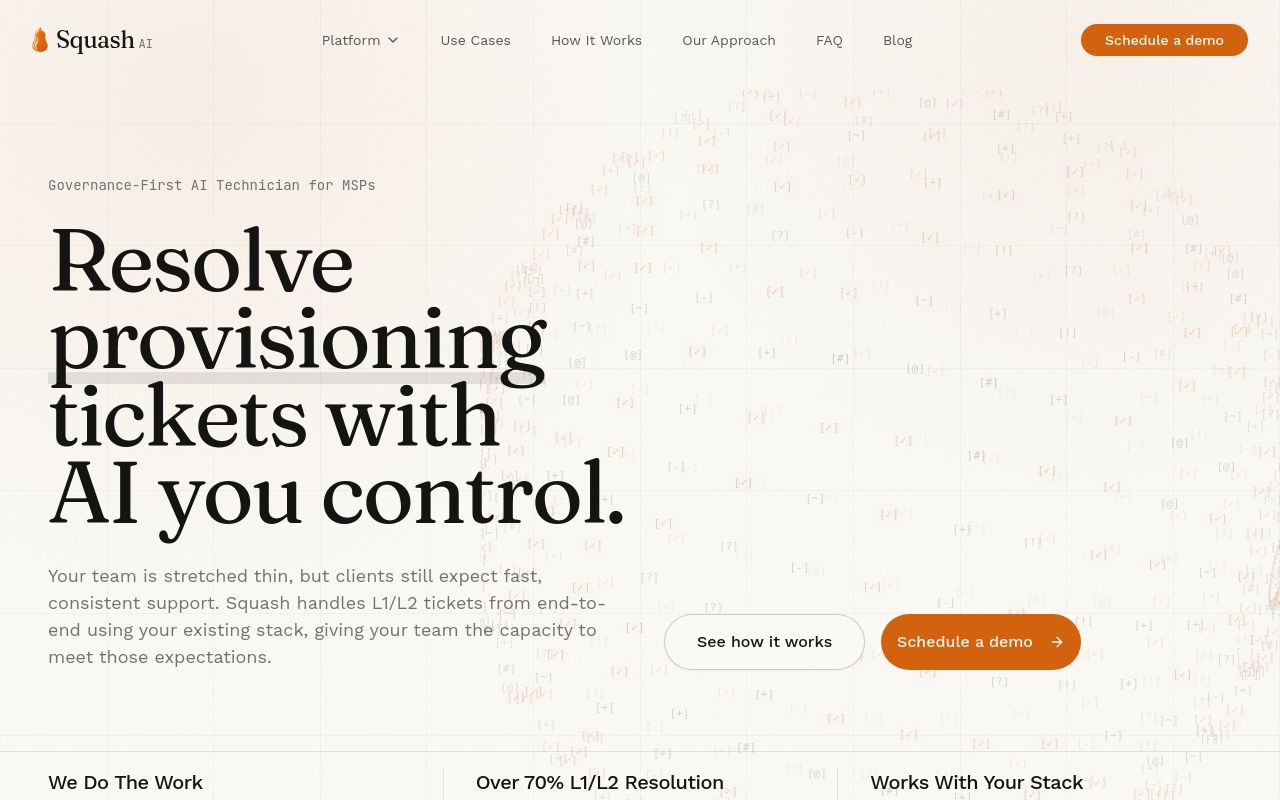
Squash homepage promising to resolve identity tickets with AI you control
squash.ai, captured 15 September 2026

Squash scopes itself narrowly: identity, provisioning, Microsoft 365, endpoint and access work. It gathers context, plans the work, carries out approved actions, writes notes back to the PSA, and escalates with its working attached when confidence is low. Governance is per action: always allow, require human approval, or block.

Squash publishes two versions of its resolution claim. The homepage prints "Over 70% L1/L2 Resolution". Its frequently asked questions (FAQ) page says autonomous resolution of 70-80% of that volume is realistic "with the right scope, integrations, and guardrails". Both are published and they are not the same promise. Take the second into your pilot, because scope and guardrails are what you will be negotiating. Security certifications are listed as in progress rather than held.

Best fit:identity and Microsoft 365 tickets are your repetitive volume, and you want an approval switch on every action.

Think twice if:you need a number to budget against. We found no rate and no billing unit on the site, only free implementation.
02

Mizo

Resolution agents that run the whole path inside your PSA.

Resolution agent No rate card found Free trial
Disclosure: the founder is a NUOPTIMA contact. No commercial relationship exists.
Model
resolution agent
Works inside
ConnectWise Manage, Autotask, HaloPSA; NinjaOne and Datto RMM, with ConnectWise Automate and N-central marked "Coming Soon"
Headline number
"26% Average increased capacity per technician" [Capacity or productivity gain], with "30% Less escalations" [Escalation reduction]
Published pricing
none found
Trial
"Get a 14-day free trial", plus a guided demo and three-month pilot programs
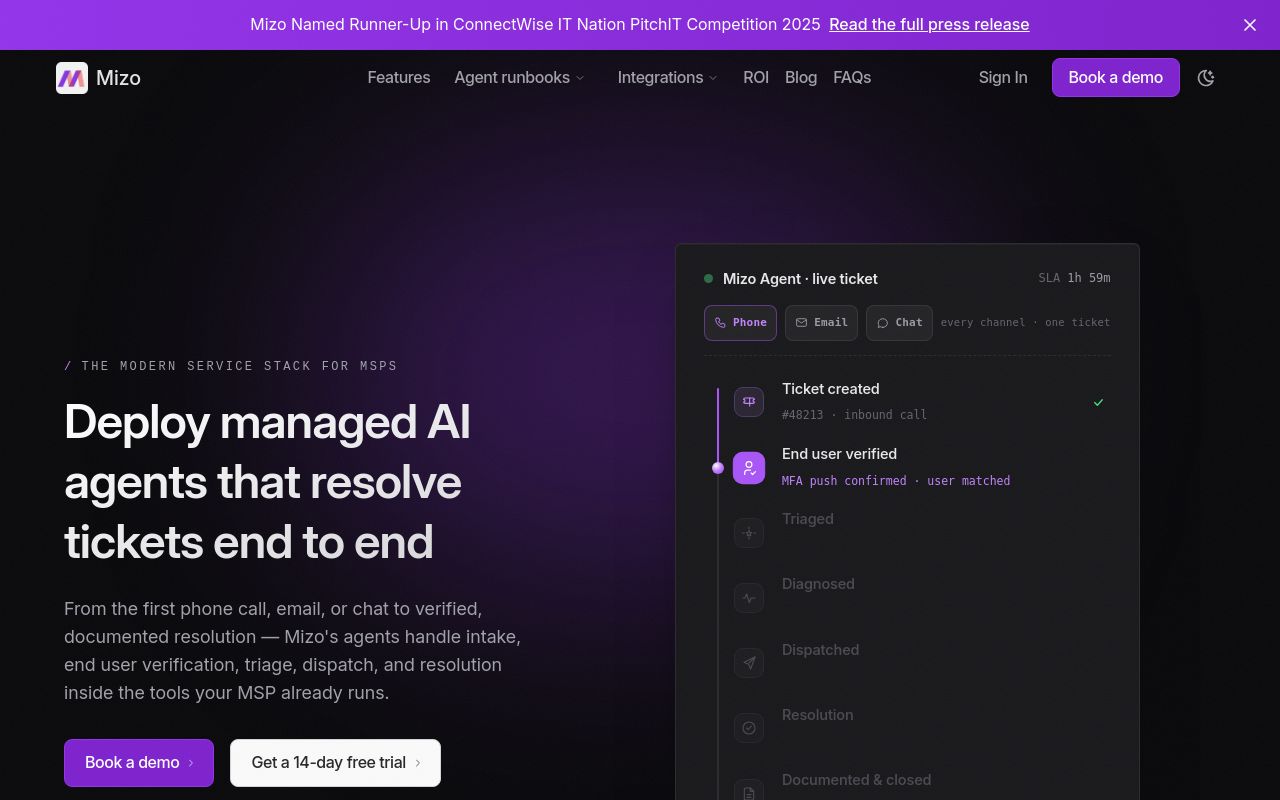
Mizo homepage offering to resolve every ticket end to end without adding headcount
mizo.tech, captured 15 September 2026

Mizo covers capture to closure without leaving the PSA: phone, email, chat or portal intake, requester verification, triage, dispatch, resolution and documentation. Two agents execute, one for Microsoft 365 and one for your RMM, at whatever approval level you set. When a ticket matches no known resolution case, the site says the agent proposes no writes at all.

What it publishes is capacity, not resolution. Neither figure tells you how many tickets close with nobody touching them, so ask for that one separately and ask how it was measured. Two named customers stand behind it, Patrick Racine at Commandare Technologies and Laurence St-Yves at Nexxo Technologies. The core service runs in Microsoft Azure data centres in Canada, and the site lists System and Organization Controls 2 (SOC 2) as in progress rather than held.

Best fit:you run ConnectWise, Autotask or HaloPSA and want triage, dispatch and resolution in one agent instead of three tools.

Think twice if:the case you must make internally is a resolution percentage. The published figures are capacity and escalation, so that number has to come from your pilot.

03

Neels AI

Pay nothing until it is resolving a fifth of your tickets.

Resolution agent Pay-on-results No rate card found
Disclosure: the founder is a NUOPTIMA contact. No commercial relationship exists.
Model
resolution agent
Works inside
Autotask, ConnectWise, HaloPSA, TOPdesk, ServiceNow, Freshservice; Datto RMM, NinjaOne
Headline number
"Resolve 40%+ of service desk tickets end to end within 4 weeks" [End-to-end resolution rate]
Published pricing
none. The site is a single page and the pricing path returns a 404
Commercial model
"You pay nothing until Neels is resolving 20% of your service desk tickets (14 days)"
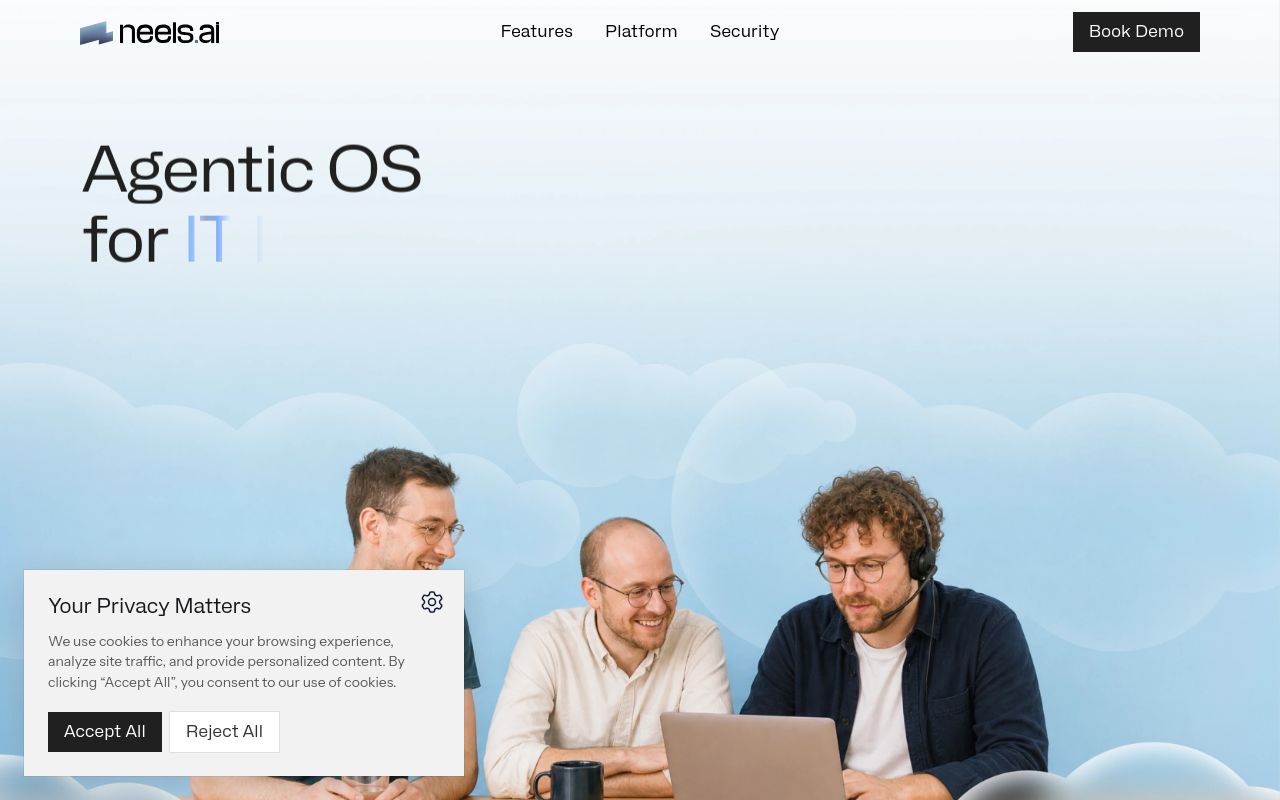
Neels AI homepage describing an agentic operating system for IT MSPs that resolves service desk tickets end to end
neels.ai, captured 15 September 2026

Neels says it will not invoice until it is resolving 20% of your tickets, which ties payment to a published result. Data can be hosted in the European Union, the United Kingdom or the United States, and the site says an independent vulnerability assessment and penetration test has been completed.

Read the autonomy claim carefully, because two sentences sit on the same page. One says tickets resolve end to end. The other says "Nothing runs without a human saying yes", with the agent proposing the fix and an engineer approving it. Both can be true if approval is a click, so ask what end to end covers on your ticket types. The stated target is large, acquisition-led MSP platforms. We found no named customer on the site, which says it is working with a select group of MSPs. The site also lists a London headquarters, more than 100 prebuilt workflows and International Organization for Standardization 27001 (ISO 27001) certification.

Best fit:you have enough level 1 volume that 40% is real money and you want the vendor carrying the proof burden before you pay.

Think twice if:you are small. The stated target is large, acquisition-led platforms, so at low ticket volume, work out what the 20% payment threshold is worth in cash.

04

SuperIT

A pilot with agreed success criteria and money back if they are missed.

Resolution agent Rate card published
Disclosure: the founder is a NUOPTIMA contact. No commercial relationship exists.
Model
resolution agent
Works inside
ConnectWise PSA, Autotask, HaloPSA, Syncro, SuperOps, Atera, Freshservice, ServiceNow and others; ConnectWise Automate, Datto RMM, NinjaOne, Kaseya VSA
Headline number
none published; the resolution target is agreed per pilot [None published]
Published pricing
"US$595/month minimum spend. Not per seat, not per device", with usage above the minimum billed at per-outcome rates
Evaluation
30 to 90 days; 90-day money-back guarantee against success criteria agreed before the pilot starts
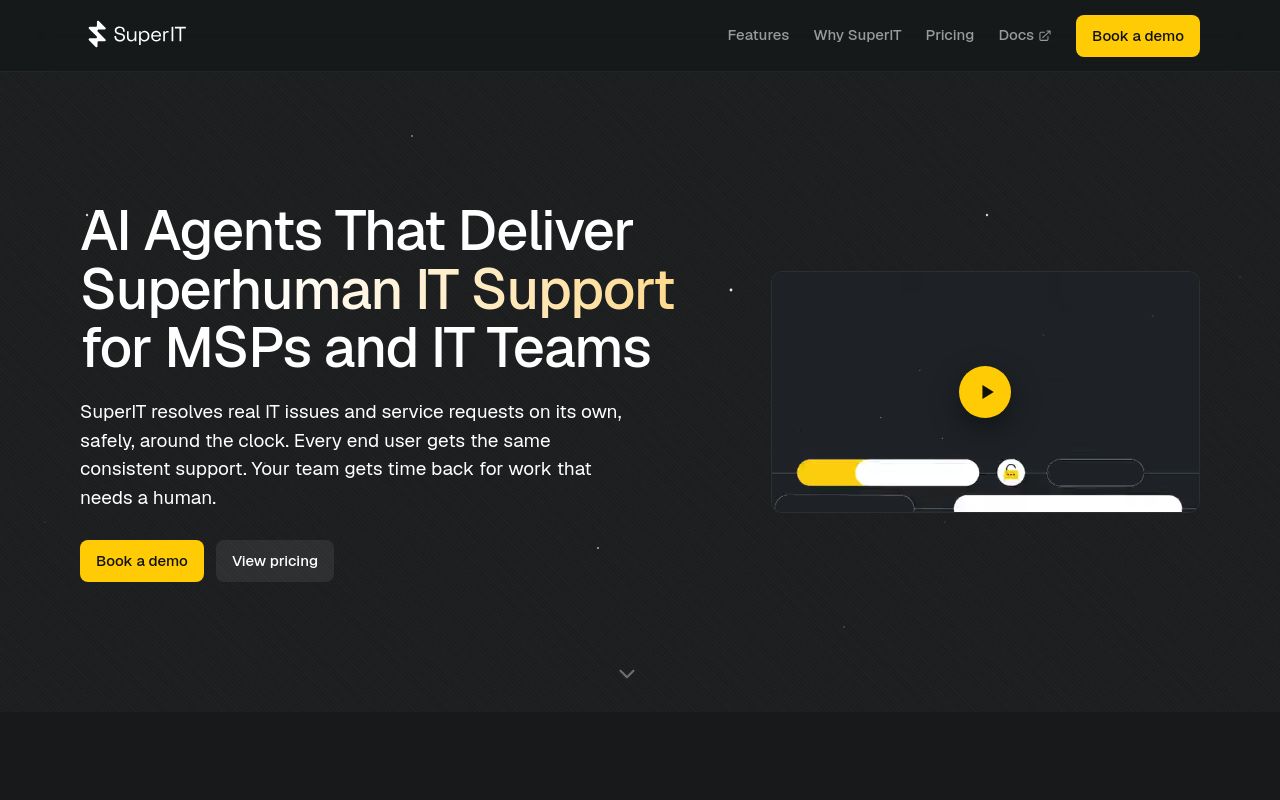
SuperIT homepage stating it resolves real IT issues and service requests on its own, around the clock
superit.ai, captured 15 September 2026

SuperIT publishes no resolution percentage. What it publishes instead is a pilot framework. The autonomous-resolution target is "agreed for the pilot scope and measured ticket by ticket, with full audit visibility", against five stated measures that include "80%+ of the agreed users and devices onboarded within the first month" and "SuperIT processes 75%+ of suitable tickets for the deployed users". Ask every other vendor on this page to match that structure.

The refund is tied to the same criteria: a "90-day money-back guarantee" if SuperIT "does not deliver against the measurable success criteria we agreed before the pilot starts". Pilots start read-only, with diagnostics, internal notes and the engineer driving. Sensitive actions need explicit sign-off, and anything unrecognised fails safe to "needs approval" rather than running. Pricing is per outcome rather than per seat or device. Stated fit is MSPs of roughly 30 to 150 staff, and the site says it is working toward ISO 27001 and SOC 2 rather than holding them today.

Best fit:you want success criteria agreed and written down before the pilot starts, with money back if they are missed.

Think twice if:you want a published resolution rate to compare vendors on paper; SuperIT sets its target per pilot, and at low volume, the US$595 monthly minimum raises the effective cost per processed ticket.

05

Thread

Intake in every channel, with a slice resolved end to end.

Resolution agent Rate card published
Model
resolution agent with a full intake layer in front of it
Works inside
ConnectWise Manage, Autotask, HaloPSA; chat, email, Microsoft Teams, Slack, desktop and voice
Headline number
"15-25% of tickets are resolved end-to-end" [End-to-end resolution rate], the rest sent prepped to a technician
Published pricing
$19 and $34 per managed customer per month, chat $5 per customer, voice AI $15 per customer as a Pro add-on
Guarantee
60-day money back
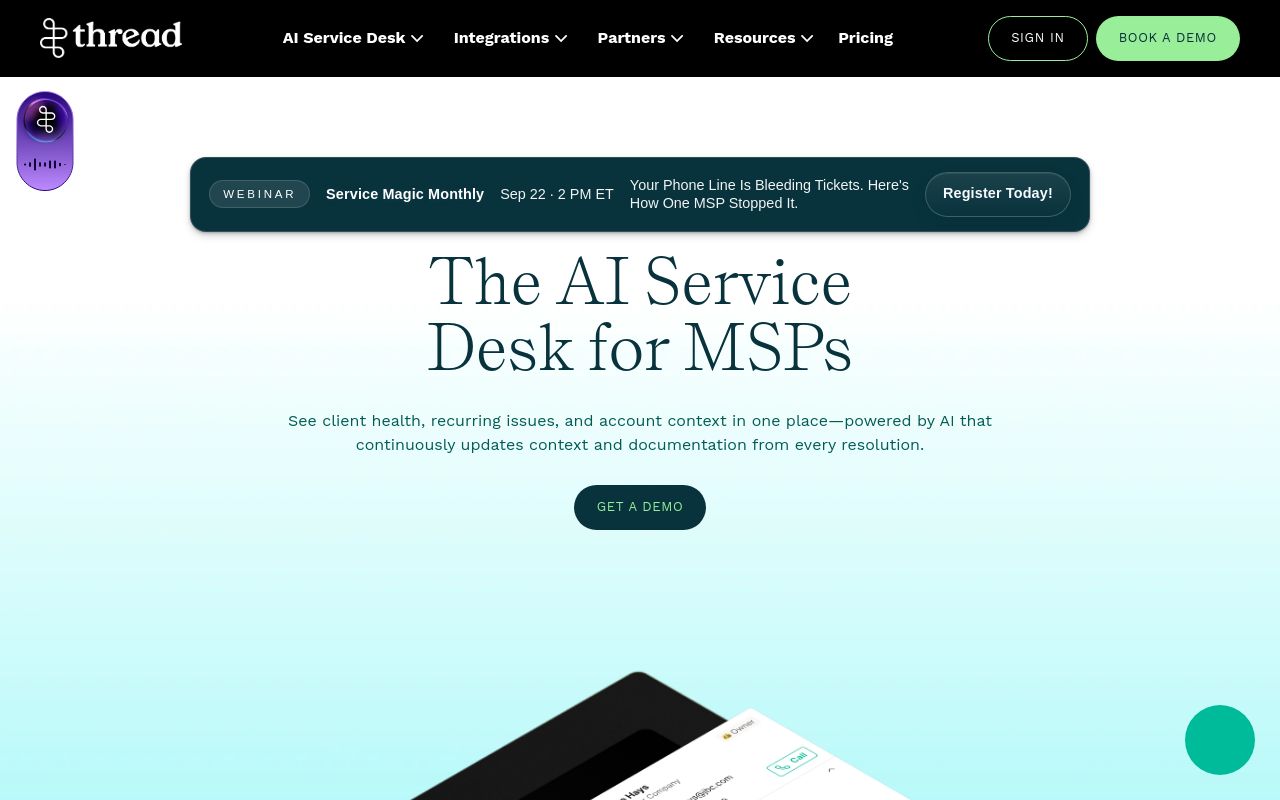
Thread homepage presenting an AI service desk for MSPs with chat, email, Teams and voice intake
getthread.com, captured 15 September 2026

This entry sits between two models. Thread takes requests from chat, email, Teams, Slack, desktop and voice, triages them, gathers context and pushes them into the PSA workflow. A stated slice closes end to end. Everything else reaches a technician already categorised, prioritised and written up. Writes are gated: Super Magic hands every write back for a one-tap confirmation.

The range differs by page. The homepage says agents resolve up to 10-25% of issues with no technician involvement, the agent product page says 15-25%, so model the lower bound. Billing runs per managed customer rather than per seat or technician, so the cost tracks your client count, not your headcount. Run that against your own client list before comparing it with a per-technician tool.

Best fit:your ticket quality problem starts at intake and you want one agent covering chat, email, Teams and voice.

Think twice if:your client count is high relative to your ticket volume. Per managed customer billing works against you there.

06

Neo Agent

Reads your ticket history and tells you what to automate.

Resolution agent Rate card published Free trial
Model
resolution agent
Works inside
ConnectWise PSA, Autotask, HaloPSA, Syncro, ServiceNow; NinjaOne, Datto RMM, N-central, ConnectWise Automate, Kaseya VSA X
Headline number
none company-wide. The figures are customer cases, led by "150+ hrs saved every month on manual triage" (hours) at Digacore [Capacity or productivity gain, one customer]
Published pricing
Pilot $500 per month, Starter $1,300, Growth $2,340, with 2,500, 10,000 and 20,000 monthly credits; phone agent add-on $300 per month
Trial
"14-day free trial, no credit card", month to month
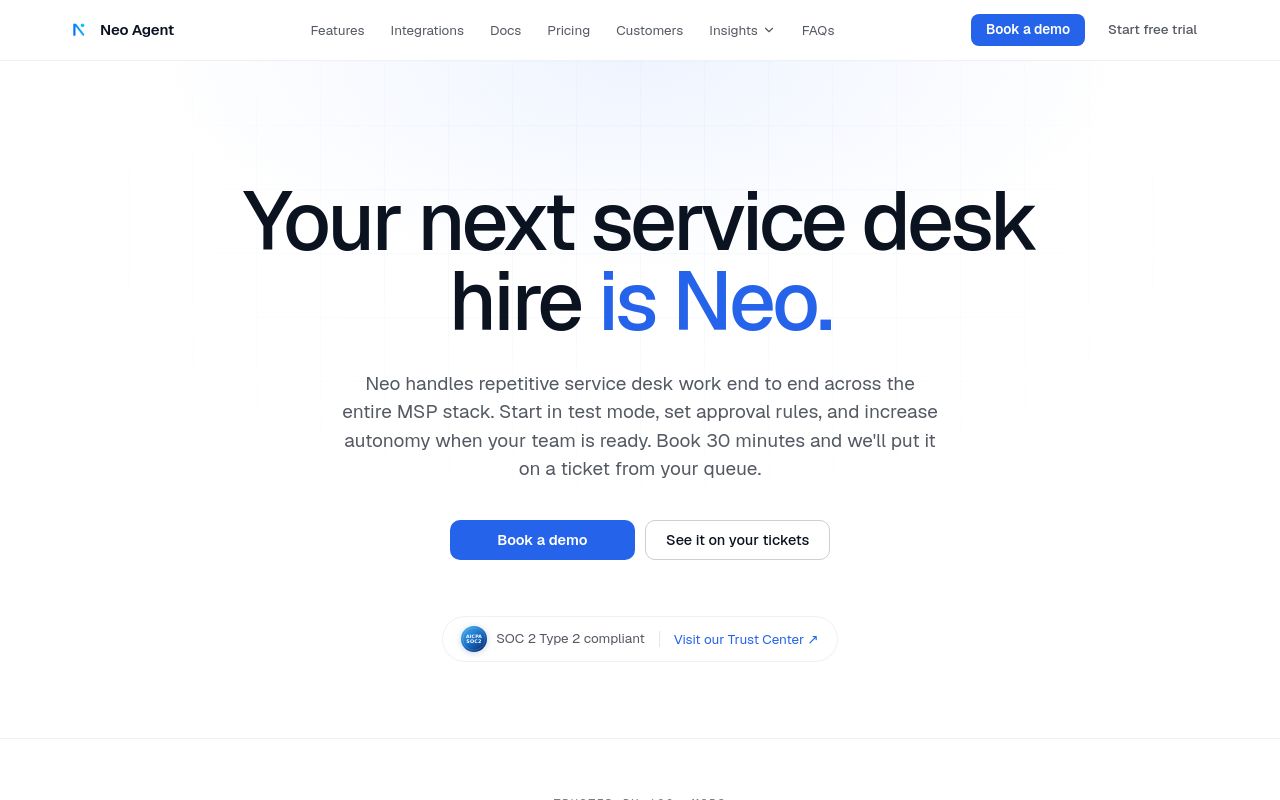
Neo Agent homepage inviting MSPs to let Neo identify what to automate from PSA ticket history
neoagent.io, captured 15 September 2026

Neo Agent starts from your data rather than a feature list. It ingests PSA ticket history to identify what is worth automating, then reads tickets, documentation and playbooks to run the workflow and close the loop inside the PSA. For an owner who cannot say which ticket types dominate their level 1 mix, that sequencing is the pitch.

No company-wide resolution rate is published. Instead, the site names four customers with roles attached: Digacore, Excellent Networks, ITNS and CIO Solutions, whose deployments a buyer can ask about. Neo Agent publishes conservative safety defaults: test mode runs everything as notes first, sensitive actions gate on technician approval, every action is logged. SOC 2 Type 2, and no training on MSP or client data.

Best fit:you want to see what the agent would have done, written as notes, before it is allowed to do anything.

Think twice if:you need a published resolution rate to get the spend signed off. The headline figure is one customer's, and the site says so.

07

Atera Robin

The highest published end-to-end resolution percentage here, and a standalone purchase.

Resolution agent No rate card found
Model
resolution agent
Works inside
no PSA or RMM integrations published. Requests arrive from Microsoft Teams, Slack, email, the Atera Customer Portal and third-party ITSM tools
Headline number
"Resolve 92% of technical issues autonomously" [End-to-end resolution rate], with the FAQ adding "in under 120 seconds on average"
Published pricing
none for Robin, which the FAQ calls "a standalone product, purchased separately from Atera's IT Essentials suite"
Trial
Atera publishes a 30-day free trial with no credit card required, and the page does not state whether Robin is included
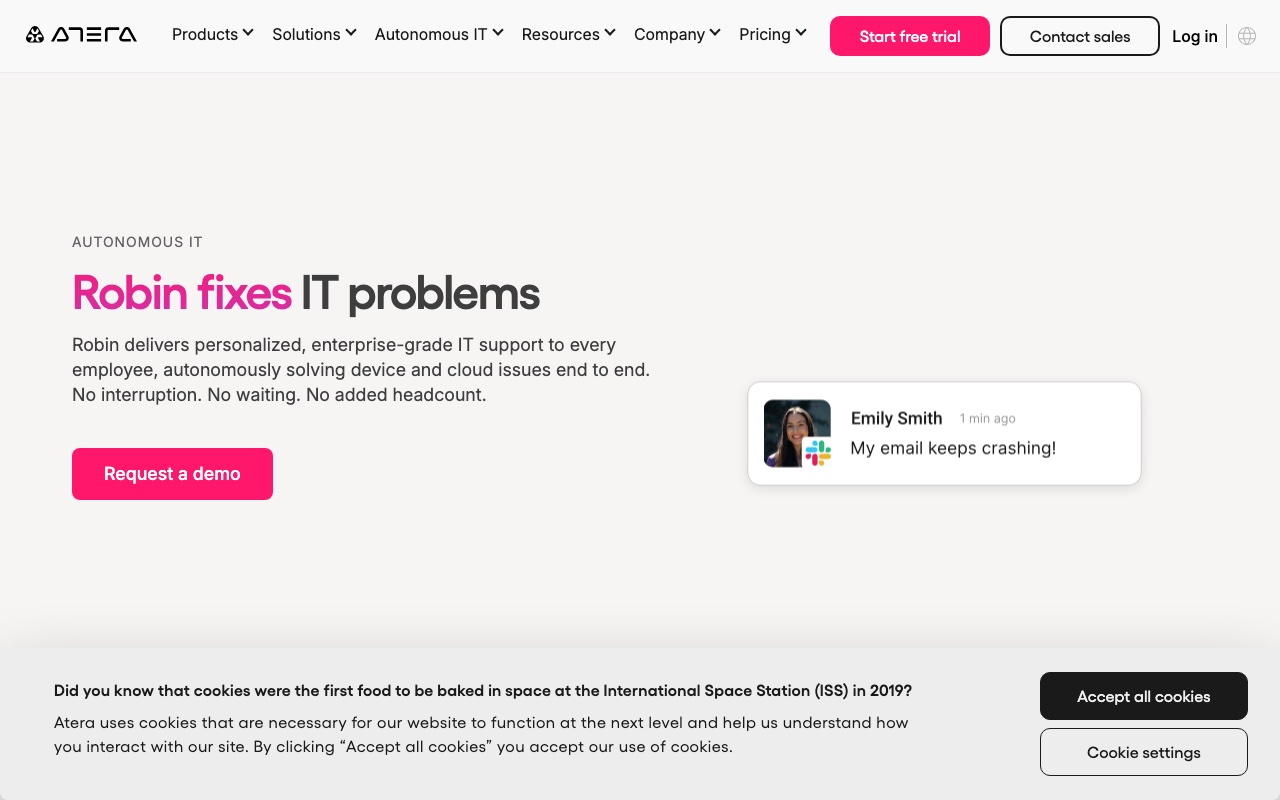
Atera Robin product page stating that Robin fixes IT problems and resolves tier 1 and tier 2 incidents autonomously
atera.com, captured 15 September 2026

Interrogate the 92% because it is printed unqualified on a pricing page, while comparable vendors qualify theirs by ticket type, scope or time window. Ask what population it is measured over, ask whether issues and tickets mean the same thing, and ask for the method in writing.

Then ask who it worked for. The customer quotes on the Robin pages we read come from in-house IT leaders, including a chief information officer at Repacorp saying "Robin resolves 85% of our help desk tickets". We found no MSP named among them, so ask for an MSP reference your size before you model anything. Atera says MSP plans add multi-tenant client management and white-labeling. Robin verifies the requester through Okta, Azure Active Directory or Google before it acts, and Atera says customer inputs and outputs are not used to train its models.

Best fit:you already run Atera, where Robin is an add-on decision rather than a platform decision.

Think twice if:you are not on Atera. Robin is bought separately, its price is not published, and no PSA or RMM integrations are named, so ask exactly what has to be installed.

Platform copilots

These four products are tied to platforms you may already use. Their features range from technician assistance to execution, so check what your current licence includes.

08

ConnectWise AI Agents and Sidekick

Two things with one name, inside one platform.

Platform copilot No rate card found
Model
platform copilot (Sidekick) with an autonomous agents layer (AI Agents)
Works inside
AI Agents: ConnectWise PSA workflows; Sidekick: ConnectWise PSA, RMM, Automate and Microsoft Teams
Headline number
AI Agents: "80+% reduction in escalations" [escalation reduction]; Sidekick: "5 minutes saved on every service ticket" [capacity or productivity gain]
Published pricing
none. The pricing page asks you to fill in a form for a quote
Acquisition
ConnectWise announced it had acquired zofiQ on 20 January 2026, and zofiq.ai now redirects to the AI agents page
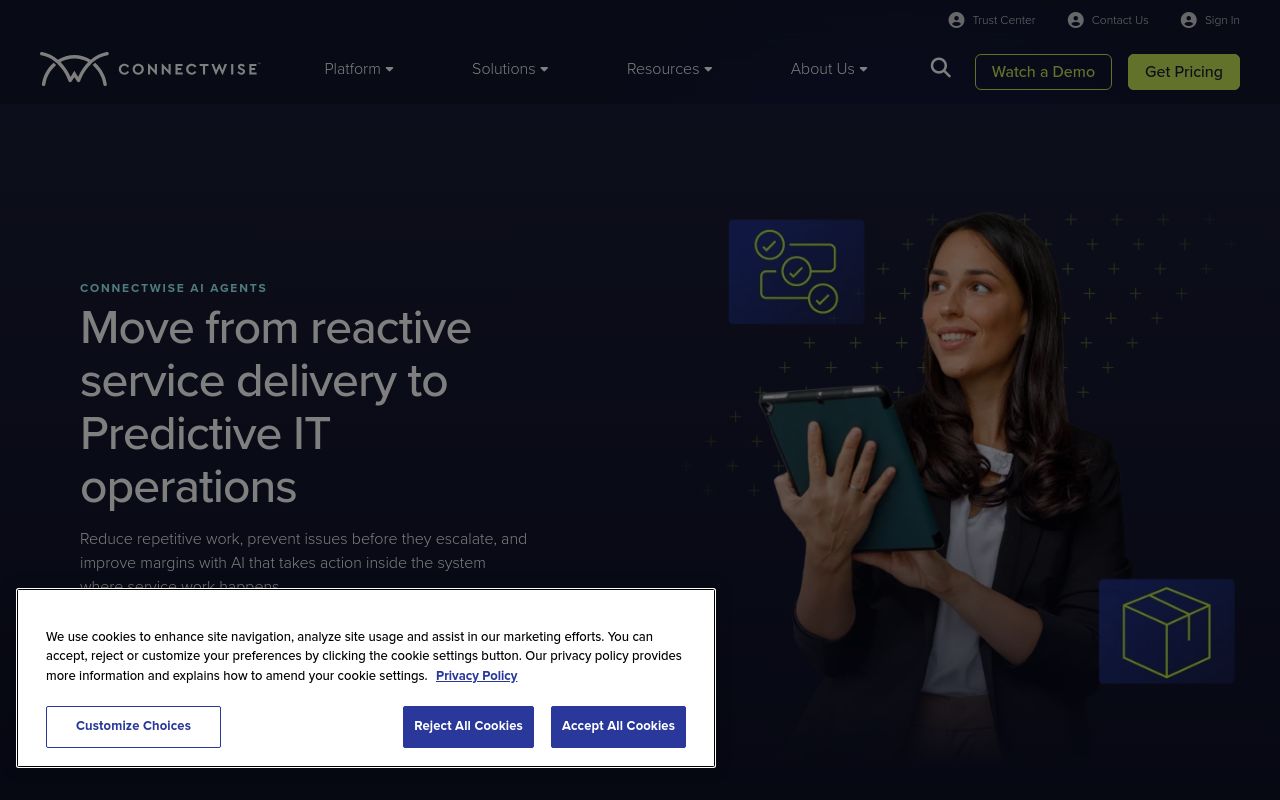
ConnectWise AI Agents page describing agents that interpret requests, make decisions and execute actions in the platform
connectwise.com, captured 15 September 2026

Separate the two products before evaluating either. Sidekick is technician-facing assistance: summaries, ticket triage, generated replies and scripting, and AI-generated scripts always require approval. AI Agents are the layer ConnectWise says can interpret requests, make operational decisions and execute actions. If you were talking to zofiQ, that conversation now happens with ConnectWise.

ConnectWise publishes an 80+% escalation-reduction figure with no method beside it on the page we read. Ask how it was measured, over which tickets and what period, and whether it came from zofiQ deployments or ConnectWise customers. The same page carries named customer quotes worth chasing for that answer: Dan Olson, chief executive at Peak Global Solutions, Mike Pearlstein, founder and chief executive at Fusion Computing, and Sam Gridley, chief executive at Intech Hawaii. For Sidekick, ConnectWise publishes "5 minutes saved on every service ticket" and "$1,042/month cost savings per tech". Oversight is described as monitoring and reviewing AI-driven actions inside service workflows rather than a per-action approval switch.

Best fit:you run ConnectWise PSA and want the AI your platform already sells before you add another vendor.

Think twice if:you are on another PSA. This is platform-locked by design, and the price only arrives after a form.

09

SuperOps Monica AI

Ticket reduction inside an AI-native platform.

Platform copilot Rate card published Free trial
Model
platform copilot
Works inside
SuperOps only. Listed integrations include Splashtop, TeamViewer, ConnectWise Control, Pax8, Xero and QuickBooks
Headline number
"Up to 80% reduction in tickets created" [Ticket volume reduction]
Published pricing
from $89 per technician per month for PSA only, $149 per technician per month for the unified PSA and RMM platform, supporting up to 150 endpoints per technician
Company
founded 2020, headquarters Claymont, Delaware
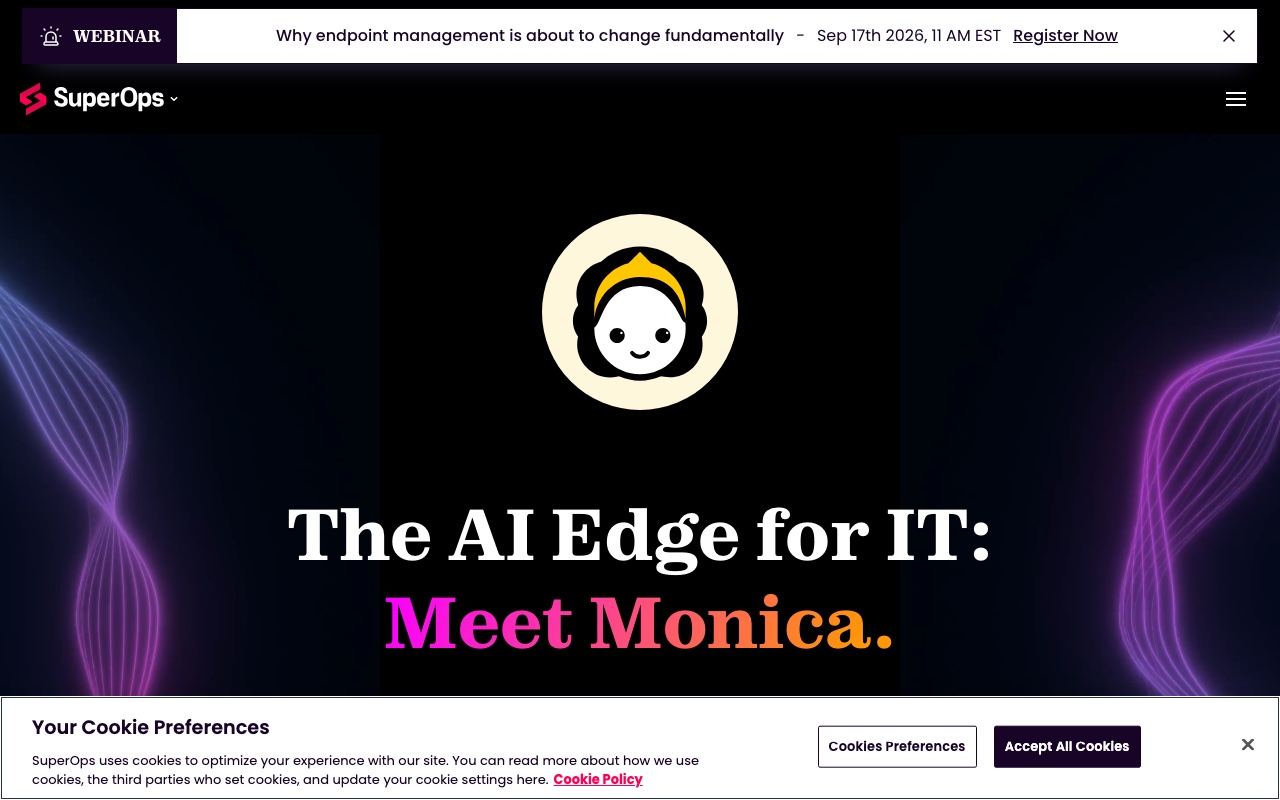
SuperOps Monica AI page presenting AI agents that act on policies and resolve incidents inside SuperOps
superops.com, captured 15 September 2026

Read the headline as written: tickets that never get created, not tickets closed by an agent. Deflection at the front door is a genuine saving and it is measured differently from resolution, so do not put the two in the same spreadsheet column.

Monica covers ticket and worklog summaries, reports, script generation, deflection and recommended solutions, and SuperOps describes it moving from assistance to execution on routine tasks under your supervision, with an audit trail behind each action. Evaluating Monica means evaluating a move to SuperOps, so price it as a platform migration. The security page lists SOC 2 Type 2 and ISO 27001 compliance, and the one named customer voice on the Monica page is Sam Godfrey, co-founder and director at TaskGroup.

Best fit:you are already considering a platform move and want the AI included rather than bolted on.

Think twice if:your PSA is settled. The site presents Monica as built into SuperOps and names no other supported PSA, so assess the platform migration cost before evaluating Monica.

10

HaloPSA, Halo AI

AI included in the seat price, with no company-wide number.

Platform copilot Rate card published
Model
platform copilot
Works inside
HaloPSA only, with RMM connections listed for ConnectWise Automate, ConnectWise RMM and Datto RMM
Headline number
none published company-wide. Customer story figures only, including 15 to 20 hours saved per week on the service desk and "75% faster resolution for medium-severity issues" at Magna5 [None published, case studies only]
Published pricing
"£66 per agent, per month (billed annually)" in the displayed United Kingdom (UK) configuration, with AI Agents listed under "Included as standard", plus a required onboarding package priced by scope
Headquarters
the Willis Building in Ipswich becomes Halo's global headquarters during 2026
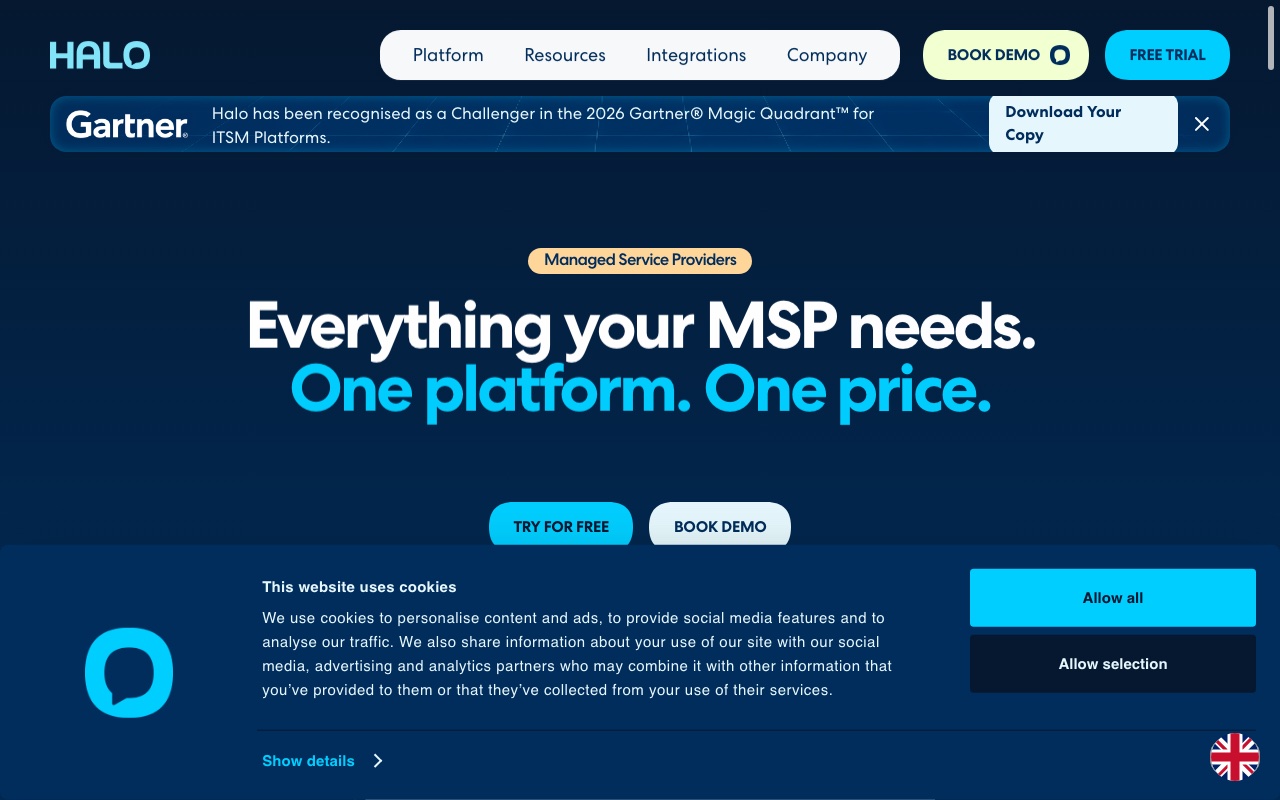
Halo managed services page headed "Intelligent automation. Real outcomes." showing its AI capabilities for MSPs
usehalo.com, captured 15 September 2026

Halo says it has "no tiers, editions or add-ons" and lists AI Agents as included as standard for every agent. If you already run Halo, the AI sits inside a bill you are paying, and Halo lists no separate AI add-on charge for existing customers.

An agent authorises with a Halo application, which fixes its identity and permissions, and it can be called as a step inside a runbook, with ImmyBot and Pax8 shown as configured examples. Ticket clustering groups similar tickets and assigns a generated description and resolution. Controls include redaction of personally identifiable information (PII), admin-level kill switches and full audit logging. We found no company-wide resolution rate; Halo publishes customer stories instead, and Magna5's is the one we read.

Best fit:you are on Halo already, where the AI is a configuration exercise rather than a purchase.

Think twice if:you want evidence before you build. There is no published company-wide rate to benchmark against, only customer stories.

11

Kaseya Cooper Copilot and Kaseya Assist

Assistive features in BMS, plus workflow generation in VSA 10.

Platform copilot No rate card found
Model
platform copilot
Works inside
Kaseya BMS (Cooper Copilot) and VSA 10 (Kaseya Assist), with Cooper Bots automating event-triggered tasks across Kaseya modules
Headline number
none published
Published pricing
none. The platform page says "Request a quote"
Company
founded 2000, headquarters in Miami
Kaseya Cooper Copilot page describing AI ticket management, communication and documentation tools in Kaseya BMS
kaseya.com, captured 15 September 2026

Kaseya publishes three BMS assistant features: Smart Ticket Summary, Smart Writing Assistant and Smart Resolution Summary. In VSA 10 the workflow generator now runs under the Kaseya Assist name, after a June 2026 rebrand of Cooper Copilot for Workflows. Cooper insights analyses how you use Kaseya modules and recommends actions, and Cooper Bots automate repetitive processes across them.

AI-generated content should be reviewed before use, Kaseya's documentation says. The three BMS features are on by default but an administrator can switch them off, and information fed to the model is processed by a third party Kaseya says it has directed not to train on it. We found no resolution figure and no price on Kaseya's pages, and several public paths would not load for us.

Best fit:you run Kaseya BMS and want technician time back from summaries, replies and resolution notes.

Think twice if:you want an agent that closes tickets. Nothing we read on Kaseya's own pages claims that, and there is no number to test it against.

Intake and voice layers

Three products focused on intake and service desk workflow. Vight publishes a productivity figure, CloudRadial a productivity figure plus a zero-touch resolution claim, and xop.ai a ticket volume reduction figure.

12

Vight

Answers the phone, turns the call into a ticket and a time entry.

Intake and voice Rate card published
Disclosure: the founder is a NUOPTIMA contact. No commercial relationship exists.
Model
intake and voice layer
Works inside
ConnectWise, Autotask, HaloPSA; phone systems 3CX, VitalPBX, RingCentral, Microsoft Teams, Zoom Phone, Dialpad and 8x8
Headline number
"~35% Average productivity boost" [Capacity or productivity gain], alongside "1M+ Time entries automated"
Published pricing
Starter $250 a month for 3,000 credits, "Around 2,000 tickets per month", up to Scale at $1,650 a month; unlimited users, month to month, first month free
Security
Advanced Encryption Standard with a 256-bit key (AES-256), single sign-on with two-factor authentication and SOC 2 listed on the site
Vight homepage describing an AI agent that answers the phone, asks the right questions and creates the ticket
vight.ai, captured 15 September 2026

An agent answers the call, asks the questions a technician would, captures the detail and creates the ticket. Afterwards it transcribes the call, extracts the troubleshooting steps and the resolution, and posts a structured summary and time entry back to the PSA.

Seven phone systems are named on the site, 3CX, VitalPBX, RingCentral, Microsoft Teams, Zoom Phone, Dialpad and 8x8, so check yours is on the list before the demo. Beyond the call, Vight captures work sessions and turns them into documentation, and its assistant searches calls, tickets, client configurations, assets and notes when a technician needs context. Tickets are categorised and deduplicated with missing information gathered before a technician opens one, and the site says critical situations fire an alert to your escalation channel. Pricing runs on credits that map to ticket volume, so compare it against your monthly ticket count rather than your headcount. Plans are month to month, users are unlimited on every tier, and the first month is free.

Best fit:calls arrive with missing detail or never make it into a time entry.

Think twice if:you are buying ticket resolution. The published number is a productivity figure, and the product is built to capture and hand off.

13

CloudRadial

Client portal, chat and service desk AI in one suite.

Intake and voice Rate card published
Model
intake and voice layer, sold as ChatAI, ServiceAI and AutomationAI
Works inside
native to ConnectWise, Autotask, Kaseya BMS, HaloPSA and Syncro, standalone for Zendesk; Teams, Slack, web and text channels
Headline number
"Team productivity up by 40% or more" [Capacity or productivity gain]
Published pricing
ServiceAI from $295 a month on an annual commitment, with a 60-day money-back guarantee and unlimited agents for the first 90 days; Professional Suite from $795 a month plus a $795 setup fee
Company
founded 2018, with regional hosting in the United States, Canada, Australia and the European Union or United Kingdom
CloudRadial ServiceAI page headed "AI Built for the MSP Service Desk" showing ticket categorisation and routing
cloudradial.com, captured 15 September 2026

Two sentences on CloudRadial's own site need reconciling, and they are the question to settle on the call. ServiceAI "can automatically move to zero-touch resolution". ChatAI says "Your agents still own escalation and resolution". Both are published and they describe different products in the same suite, so ask which ticket types actually go zero-touch and which always land on a person.

ChatAI interviews the client and creates a structured PSA ticket; ServiceAI categorises, prioritises, routes, scores technician interactions and surfaces resolutions from your own ticket history. The site claims more than 1,000 MSPs and names customers including Carl de Prado, founder at A2Z Business IT, and Joe Svoboda at The Miller Group. ServiceAI carries a 60-day money-back guarantee with unlimited agents for the first 90 days, on an annual commitment.

Best fit:you want the client-facing portal and chat layer fixed at the same time as triage.

Think twice if:your headline requirement is autonomous resolution. Ask for the zero-touch ticket list in writing, because the site describes both automatic resolution and human-owned resolution.

14

xop.ai

Built around revenue signals, with a service desk layer underneath.

Intake and voice Rate card published
Model
intake and voice layer
Works inside
ConnectWise, Autotask, HaloPSA and ServiceNow natively; ConnectWise Automate for auto-remediation; IT Glue, Hudu, SharePoint and Confluence
Headline number
"Chat assistants deflect 30%+ of L1 tickets" [Ticket volume reduction]
Published pricing
$55 per engineer per month as a starting price, month to month with no annual commitment, AI tokens included and the manager app free for six months
Company
founded 2021, based in Myrtle Beach, South Carolina
xop.ai homepage headed "Revenue Intelligence for MSPs" showing ticket stream analysis for sales opportunities and service gaps
xop.ai, captured 15 September 2026

The headline positioning is "Revenue Intelligence for MSPs": the product reads your ticket stream for sales opportunities and service-gap risks inside the PSA you already use. The service desk pieces sit underneath that and they are real: chat assistants, voice answering and triage, email ticket routing, automatic notes and knowledge base search.

The deflection figure is a chat number, which is why the table calls it a volume reduction rather than a resolution rate. It counts conversations that never became tickets. At $55 per engineer per month with no annual commitment, AI tokens included and the manager app free for six months, this is one of the lower published starting rates here. We found no human-approval wording published, so ask what the agents may do unattended and get the answer into the order form.

Best fit:you want chat deflection and better routing, and the account growth signals are a bonus you would not otherwise buy.

Think twice if:approval controls are your first question. We found none published, so that conversation has to happen on the call.

Automation platforms

Two platforms where you configure workflows rather than switching on an agent. Both are here because MSPs genuinely use them instead of a resolution agent.

15

Pia

The automation platform closest to an agent.

Automation platform No rate card found
Model
automation platform
Works inside
ConnectWise, Autotask, HaloPSA; Microsoft Teams, Slack, IT Glue, SharePoint, Exchange Online, Azure Active Directory, CloudRadial, Pax8
Headline number
"60% Service requests automated" [Automation coverage], with "90% Faster ticket resolution" [Capacity or productivity gain]
Published pricing
Pia Chat US$10 per client per month, added to a Pia Platform subscription, language model usage included; no platform rate found
Security
SOC 2 Type II annually audited, ISO 27001, running inside your isolated MSP tenant by default, with infrastructure provisionable in your clients' own country or continent
Pia homepage headed "Turn Conversations into resolutions" showing service request automation figures for MSPs
pia.ai, captured 15 September 2026

Pia Chat classifies the request, acts on it and closes the loop before a technician sees the ticket, with pre-built automations covering tier 1 and tier 2 requests inside the PSA and audit logs written into ticket notes. Approval rules decide which automations need a human first.

Abbey DeWitt, chief executive at Accellis, says 35 to 40% of their tickets per day are touched by Pia automation, a coverage figure attributed to a named person at a named firm. Pia has been on the Pax8 marketplace since March 2026. We could not find a pricing page on Pia's site, though the Pia Chat page publishes an add-on price of US$10 per client per month on top of a Pia Platform subscription, with language model usage included. Ask what year one costs including the build.

Best fit:you want tier 1 and tier 2 requests handled inside ConnectWise, Autotask or Halo, with approval rules you control.

Think twice if:you need the full number to budget against. The platform rate is not published, and the headline is a coverage figure rather than a resolution rate.

16

Rewst

Workflow plumbing for repeatable level 1 work.

Automation platform No rate card found
Model
automation platform
Works inside
ConnectWise PSA, Autotask, HaloPSA, Kaseya BMS, SuperOps; ConnectWise Automate, Datto RMM, ImmyBot, Kaseya VSA X, N-able N-central and NinjaOne
Headline number
"15+ million hours saved across MSPs" [Capacity or productivity gain]
Published pricing
none. "Choose between a usage- or user-based pricing model", with no rate or minimum published
Trial
none. "Because each tenant requires setup and configuration to work effectively, we don't offer a trial period"
Rewst homepage headed "Stop doing the work that slows you down" showing multi-tenant automation workflows for MSPs
rewst.io, captured 15 September 2026

We found no claim on Rewst's pages that it closes service desk tickets, and you should not shortlist it expecting that. Rewst turns repeatable work such as onboarding, offboarding, billing reconciliation, documentation sync and security alerts into workflows across the systems it connects. RoboRewsty builds or edits a workflow from a plain-language description, including the triggers, transitions and forms.

The hours figure is an aggregate across all customers. It shows the scale Rewst claims across its customer base, but says nothing about your desk. The customer stories are narrower: Nucleus Networks cut quarterly business review preparation from 6 hours to minutes and cut the staff needed to deliver them by 80%. The absence of a trial is deliberate and stated, so budget the build, not just the subscription.

Best fit:your problem is inconsistency rather than volume, and you have someone who will own the workflows.

Think twice if:you want something switched on this quarter. No trial by design, no published rate, and the value arrives after the configuration work.

Sizing

Which model actually fits you

01

Under about 25 seats.

Start with your monthly ticket volume and work out the cost per ticket at each vendor's billing unit. If you test software, xop.ai at $55 per engineer per month and Thread at $19 per managed customer are two low-commitment published options.

02

25 to 75 seats.

If intake is where time leaks, test it before autonomous resolution. Vight starts at $250 a month with a free first month; CloudRadial's ServiceAI starts at $295 a month on an annual commitment, with a 60-day money-back guarantee. Use your ticket data to check whether repetitive level 1 volume is large enough for a measurable pilot.

03

75 seats and up.

This is where a resolution percentage becomes real money and where the vendors say they want you. SuperIT states a fit of roughly 30 to 150 staff and agrees its resolution target per pilot. Neels AI targets large, acquisition-led platforms and will not invoice until it is resolving 20%. Run both as pilots on the same ticket types and compare the commercial terms before launch.

04

Already on a platform with a native copilot.

Check what you own before buying anything. Halo lists AI Agents as included as standard at £66 per agent per month, billed annually, plus a required onboarding package priced by scope. SuperOps includes Monica from $89 per technician per month. ConnectWise and Kaseya quote rather than publish, so ask your account manager what is already in the contract. If the copilot is already included, price and test it before adding another vendor.

On the call

Questions to ask on every call

One founder on this page, who also runs an MSP, put it plainly on a call with us: level 1 automation is crowded and the products overlap, so what separates them is onboarding, enablement, how often it breaks and how much time it takes to keep working. In his words, it is not about what you do, it is about how you execute.

  • What is your resolution rate, how do you define resolved, and what method produced the number? Ask for it in writing, with the ticket population it was measured over.
  • Will you run a paid pilot on agreed ticket types, with a number we both sign up to before it starts?
  • What happens when the agent is wrong? What can it do unattended, and who approves an action that changes something in a client tenant?
  • How long is onboarding, and after go-live, how many hours a week does keeping it working cost us?
  • Can I speak to two MSPs my size who left you, not two who stayed?
Watch for

Red flags

  • A percentage with no kind and no method behind it. Reduction in what, measured how, across which tickets, over what period.
  • A number that turns out to be one customer's case study, printed where a company-wide figure belongs. Several vendor pages identify a number as a customer case; check the scope of each claim.
  • No published pricing and no pilot. Either alone is survivable. Both together means you are buying on the demo.
  • An agent that needs its own console. If technicians have to work somewhere other than the PSA they already live in, adoption is the project, not the AI.
Excluded

Vendors we did not rank

Flamingo and OpenFrame publish a direct reason for their exclusion: "OpenFrame isn't built to plug into your stack. It replaces it." At $1.00 per device per month it is priced to be considered, but a full-stack replacement is a platform decision rather than an agent decision, and it belongs in a different comparison.

DeskDay's Helena AI is a copilot inside DeskDay's own PSA, priced at $79 per technician per month billed monthly or $59 billed annually, with a 14-day free trial. The site says Helena "assists, never overrides" and that every suggestion needs a technician's confirmation. Choosing it means choosing the PSA first.

Acronis Service Desk is in early access, free to Acronis service provider partners on a commitment contract, with pay-as-you-go partners not eligible at this stage. Acronis's own announcement says triage, enrichment and autonomous resolution are planned for later, so there is nothing to compare on resolution today.

MSP Process and MSPbots are excluded under our naming rule, which is about our own positioning and says nothing about their products.

Rezolve.ai and Moveworks are enterprise IT service management vendors we did not assess for this page.

NUOPTIMA

How we fit

NUOPTIMA is not a service desk vendor. We work on the other half of the problem, whether an MSP buyer can find you, in search and in AI assistants; that work starts on the homepage. If AI tool selection and governance is the problem, our MSP AI advisory work is where we fit.

FAQ

Frequently asked questions

What is the difference between a resolution agent and a platform copilot?

A resolution agent works alongside the PSA you already run and claims to close tickets end to end. Thread publishes 10% to 25% on its homepage and 15% to 25% on its agent page; the other cited rates run through Neels AI at 40%+, Squash at over 70% and Atera Robin at 92%. A platform copilot sits inside software you already own and may assist or act, depending on the product.

What does a deflection rate actually mean?

On its own, a deflection rate should tell you how many requests never reached a technician. The percentages on this page measure five different things: end-to-end resolution, ticket volume reduction, escalation reduction, capacity or productivity gain, and automation coverage. Ask which measure you are being quoted, what ticket population it covers, and how it was calculated.

What do AI service desk agents cost for an MSP?

Published monthly rates are: xop.ai $55 per engineer, SuperOps from $89 per technician, Halo £66 per agent (billed annually, plus onboarding), Thread $19 or $34 per managed customer, Vight $250 to $1,650, CloudRadial ServiceAI from $295 on an annual commitment, Neo Agent $500 to $2,340, SuperIT a $595 minimum, and Pia Chat US$10 per client as an add-on. Mizo, Squash, Neels AI, Atera Robin, ConnectWise, Kaseya and Rewst publish no rate on the pages we reviewed.

Can AI replace a level 1 desk?

We found no 100% end-to-end resolution claim on the vendor pages we reviewed. Thread publishes 10% to 25% on its homepage and 15% to 25% on its agent page. Neels AI publishes 40%+, Squash over 70%, and Atera Robin 92%. Treat each figure as a pilot target to verify on agreed ticket types, not as a budget assumption.

What approval controls should an AI service desk agent have?

Look for read-only test modes, per-action permissions, technician approval for sensitive changes, audit logs and a kill switch. Squash publishes allow, approve or block controls by action; SuperIT and Neo Agent describe read-only starts; Halo lists an administrator kill switch. Put the permitted actions and escalation path in the pilot terms before the agent touches a client tenant.

How do you run a pilot on one of these?

Agree the ticket types first, then the number that counts as success, in writing, before anything is installed. Start read-only where the vendor supports it: SuperIT says pilots begin with read-only diagnostics, and Neo Agent's test mode runs everything as notes. Use the published windows: 14-day trials at Mizo and Neo Agent, 60-day money-back at Thread and CloudRadial, and a 90-day money-back guarantee at SuperIT.

Method

How this list was built

  1. Live site verification. We checked each vendor claim in the entries and comparison table against the vendor's live site on 15 September 2026, including pricing, security and frequently asked questions (FAQ) pages. Where a page would not load for us, we say we could not verify it. A blocked page is never written up as something the vendor lacks. Screenshots were captured from each vendor's live site on the same date.
  2. Model clarity first. Every entry is labelled resolution agent, platform copilot, intake and voice layer, or automation platform. A page that compares an autonomous agent with a voice notetaker on the same criteria helps nobody choose.
  3. How the percentages are classified. The table places each published headline number beside our own classification, one of five metric labels, and says when the figure comes from one customer. Where we found no figure, it says so.
  4. Numbering is navigational and grouped by model. Resolution agents first, then platform copilots, then intake and voice, then the automation platforms.
  5. Disqualifiers. Products with "MSP" in the name are excluded under our own naming rule, which is about our positioning and nothing else. Enterprise information technology service management vendors not assessed for this MSP-specific page are named separately, not ranked. A vendor whose official page we could not read is named at the end, not ranked.
  6. What we could not check. Every headline number is vendor-published; none of the vendor pages we read identifies an independent audit of the figure.

Numbering is navigational, not hierarchical

The order groups products by model so you compare like with like. Inside a group, position says nothing about quality.

Screenshots captured from each vendor's live site on 15 September 2026.

More in this series: the MSP tech stack, best outsourced help desk for MSPs, best AI and automation tools for MSPs, best PSA software for MSPs, and best RMM software for MSPs.