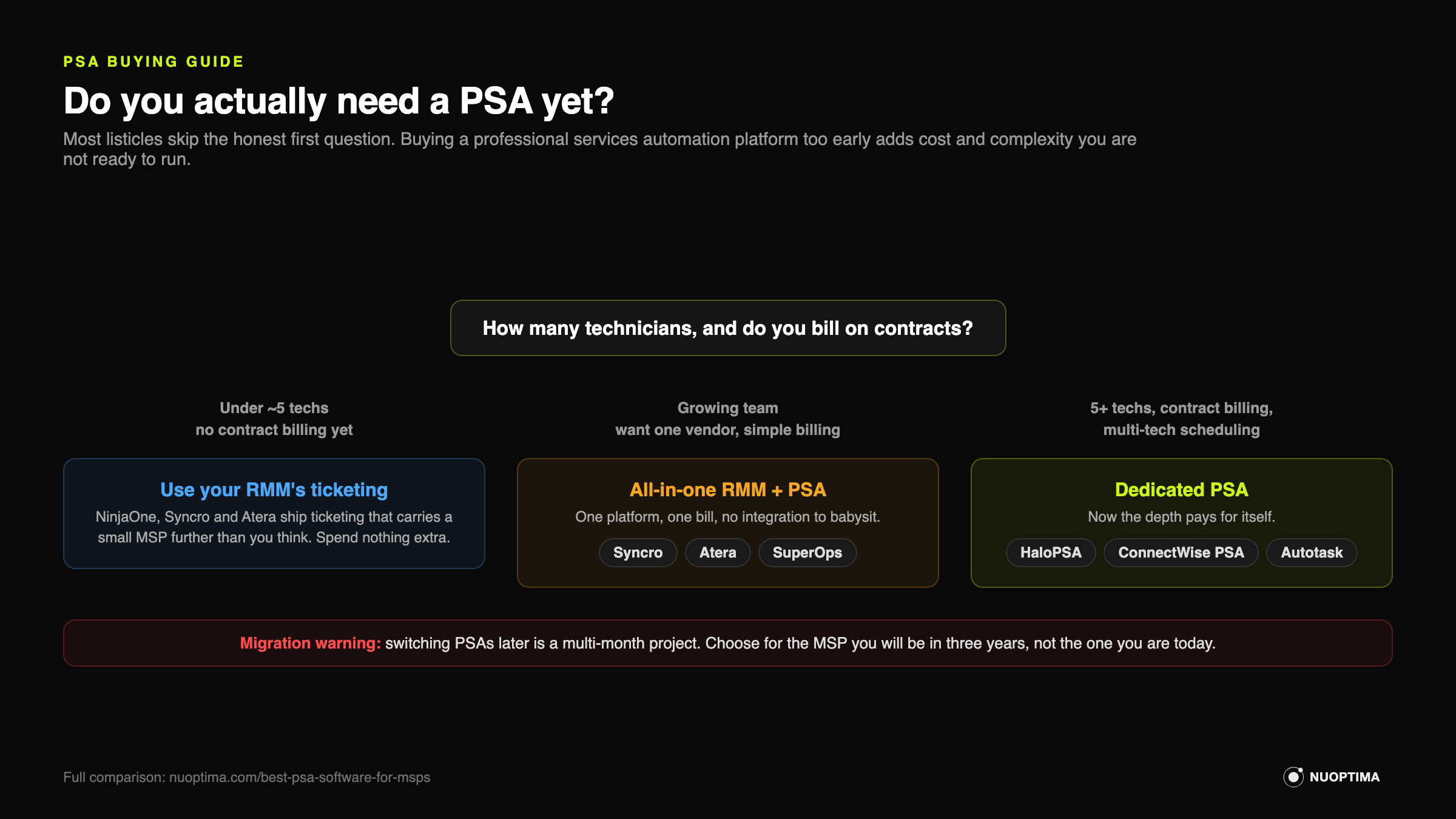
PSA (professional services automation) software is the system that runs an MSP's back office: ticketing, time tracking, contracts, project work, and the billing that ties it all together. The modern favorite is HaloPSA, prized for how far you can configure it without paying for a suite you don't use. ConnectWise PSA is still the incumbent, with the deepest feature set and the largest integration ecosystem, though you pay for that depth in cost and complexity. Here is the take most listicles skip: if you run a small MSP (under roughly five technicians), you probably shouldn't buy a standalone PSA yet. The ticketing built into your RMM will carry you further than you think, and buying a full PSA too early just adds cost and setup drag.
This guide compares 10 PSA options across pricing model, best-fit MSP size, and where each one falls short. We separate the MSP-billing-native platforms (Halo, ConnectWise, Autotask, SuperOps, Syncro) from general ITSM help desks that struggle with contract billing, and we flag the switching cost that quietly sinks PSA migrations.
We don't sell, resell, or take commissions on any tool in this guide, and no vendor paid to be here. Our business is helping MSPs get found by buyers, which only works if lists like this are actually right.
Key Takeaways
- Modern favorite: HaloPSA. Highly configurable, strong value, self-host or cloud, mature automation.
- Incumbent: ConnectWise PSA (Manage). Deepest features and the biggest integration ecosystem, but complex and costly.
- Best all-in-one for small MSPs: Syncro or SuperOps. RMM and PSA in one tool, priced per technician.
- Best free / open-source: ITFlow. Free if you self-host and support it yourself.
- The honest caveat: don't buy a standalone PSA before you need contract billing and multi-tech scheduling. Migration off an existing PSA is a multi-month project, so weigh switching cost, not just the license price.
PSA Comparison Table
| Tool | Best for | Pricing model | Standout | Watch-out |
|---|---|---|---|---|
| HaloPSA | Growing MSPs wanting depth without suite bloat | Per-agent, cloud or self-host | Configurability and value | Real setup time to do it right |
| ConnectWise PSA | Established MSPs needing the full ecosystem | Per-user, quote-based | Feature depth, integrations | Complex, dated, costly, lock-in |
| Datto Autotask | MSPs paired with Datto RMM | Per-user, quote-based | Reliability, RMM pairing | Older feel, less flexible |
| SuperOps | Modern MSPs wanting unified RMM + PSA | Per-technician tiers | AI-forward, clean UI | Newer, smaller ecosystem |
| Syncro | Small and growing MSPs | Flat per-technician, unlimited endpoints | Simple pricing, all-in-one | Less deep at scale |
| Atera PSA | Small MSPs on Atera RMM | Per-technician | Simplicity, bundled | Weak on complex contract billing |
| DeskDay | MSPs wanting a chat-first service desk | Per-technician | Conversational, mobile-first | New entrant, small footprint |
| NinjaOne PSA | MSPs already on NinjaOne RMM | Up to 3 free licenses, then quote-based | Tight one-vendor pairing | Early, still building depth |
| ITFlow | Very small or budget-conscious MSPs | Free, open-source, self-hosted | Zero license cost | You self-host and support it |
| Freshservice | IT teams needing polished ITSM | Per-agent tiers | Clean UX, ITSM maturity | Not MSP-billing-native |
 HaloPSA: the modern favorite
HaloPSA is the platform most MSPs moving off legacy tools land on, and for good reason. It gives you deep PSA function (ticketing, contracts, billing, projects, reporting) with a level of configurability that lets you shape workflows to how you actually operate, rather than bending your process to fit the tool. You can run it in the cloud or self-host it, and the automation engine is genuinely mature.
The trade is time. Halo rewards the MSPs that invest in setting it up well, and punishes the ones expecting to be live in an afternoon. Practitioners consistently favor it once configured, but the honest version is that you get out what you put into the initial build.
Strengths
- Highly configurable across tickets, contracts, and workflows
- Strong price-to-capability ratio versus the incumbents
- Cloud or self-hosted deployment
- Mature automation and reporting
Where it falls short
- Steeper initial configuration; you invest real time up front
- Depth can overwhelm a very small team that doesn't need it yet
Best for: growing MSPs (roughly 5 technicians and up) that want serious depth and contract billing without paying incumbent prices.
 ConnectWise PSA (Manage): the market incumbent
ConnectWise PSA, still widely called Manage, is the platform the MSP industry was largely built on. It has the deepest feature set of anything here and the largest integration ecosystem, so whatever tool you run alongside it, an integration almost certainly exists. For established MSPs with complex operations, that breadth is the argument.
The cost is complexity. The interface feels dated in places, total cost of ownership runs high once you add modules and seats, and the migration lock-in is real: once your contracts, history, and integrations live inside ConnectWise, leaving is a project measured in months. That lock-in is a feature for ConnectWise and a switching cost for you.
Strengths
- Deepest feature set in the category
- Largest integration ecosystem
- Proven at scale in large, complex MSPs
Where it falls short
- Steep learning curve and dated UI in parts
- Higher total cost of ownership
- Migration lock-in makes leaving expensive
Best for: established MSPs that need maximum depth and integration breadth and can absorb the cost and complexity.
 Datto Autotask: the mature workhorse
Datto Autotask is a mature, reliable PSA that has run MSP operations for years, and it pairs especially well with Datto RMM for shops that want both from one stack. If you value stability and a proven track record over the newest interface, Autotask holds up.
Now under Kaseya ownership, the platform draws mixed feelings tied as much to Kaseya's pricing and account practices as to the software itself. The interface feels older than Halo or SuperOps, and it is less flexible to reconfigure once you're running.
Strengths
- Mature and reliable, proven over years
- Deep pairing with Datto RMM
- Solid contract and billing handling
Where it falls short
- Kaseya ownership brings pricing and account-management concerns for some
- Interface feels dated
- Less flexible than Halo
Best for: MSPs already committed to the Datto or Kaseya stack that want a proven PSA paired with their RMM.
 SuperOps: the modern unified challenger
SuperOps is one of the strongest modern entrants, built as a unified RMM plus PSA with a clean interface and an AI-forward roadmap. For MSPs that want one modern tool instead of stitching an RMM to a separate PSA, it is a genuine contender, and the UX is a real step up from the legacy platforms.
Being newer, it doesn't yet match the feature depth or ecosystem of ConnectWise or Autotask. Some advanced contract-billing and reporting scenarios are still maturing, so pressure-test it against your specific edge cases before committing.
Strengths
- Modern, unified RMM + PSA
- Clean, current UI
- AI-forward feature direction
Where it falls short
- Newer platform with a smaller ecosystem
- Depth still maturing for complex scenarios
Best for: modern small-to-mid MSPs that want one unified tool and value UX and momentum over legacy depth.
 Syncro: the all-in-one for small MSPs
Syncro combines RMM and PSA in a single platform with pricing that small MSPs love: flat per-technician, with unlimited endpoints. That model means your bill scales with headcount, not with how many devices you manage, which is friendly to MSPs growing their endpoint count faster than their team.
The trade is depth. Syncro covers the core well, but at real scale or with complex contract structures, dedicated PSAs like Halo or ConnectWise go further. For most small and growing shops, that ceiling is far enough away not to matter yet.
Strengths
- RMM and PSA in one tool
- Flat per-technician pricing, unlimited endpoints
- Fast to stand up
Where it falls short
- Less depth than dedicated PSAs at scale
- Fewer advanced contract and reporting options
Best for: small and growing MSPs that want predictable all-in-one pricing and value simplicity over maximum depth.
 Atera PSA: bundled and simple
Atera bundles a PSA with its RMM and prices per technician, which keeps things simple and predictable for smaller shops. If you're already running Atera's RMM, the built-in PSA gives you ticketing and basic billing without adding another vendor.
The limits show up in complex contract billing. Atera is built for straightforward operations, so MSPs with layered agreements, blended rates, or intricate billing rules will feel the constraints. For simple books, that simplicity is the point.
Strengths
- Bundled with the RMM, one vendor
- Simple per-technician pricing
- Quick to adopt for small teams
Where it falls short
- Limited for complex contract and agreement billing
- Less configurable than dedicated PSAs
Best for: small MSPs on Atera's RMM with straightforward billing needs.
 DeskDay: the conversational challenger
DeskDay is a modern, chat-first IT service desk that rethinks the ticketing experience around conversation and mobile. Instead of the classic email-to-ticket queue, it leans into real-time chat and a mobile-first design, which can lift both technician speed and end-user satisfaction.
It is a newer entrant with a smaller footprint, so the ecosystem and integration options are thinner than the established players. If a modern service-desk experience matters more to you than a long integration list, it's worth a look.
Strengths
- Conversational, chat-first service desk
- Strong mobile experience
- Modern, current interface
Where it falls short
- Newer entrant with a smaller footprint
- Fewer integrations and less proven at scale
Best for: MSPs that prioritize a modern, chat-first service-desk experience and end-user satisfaction.
 NinjaOne PSA: the one-vendor bet
NinjaOne PSA is a newer product that pairs tightly with NinjaOne's well-regarded RMM, aimed at MSPs that want ticketing, billing, and endpoint management from a single vendor. For shops already happy on NinjaOne RMM, keeping the PSA under the same roof is an appealing way to cut integration friction.
Because it's early, the PSA doesn't yet carry the depth of the veterans. Treat it as promising rather than proven, and validate that it covers your billing and workflow needs today, not just on the roadmap.
Strengths
- Tight pairing with NinjaOne RMM
- Single-vendor simplicity
- Backed by a strong RMM reputation
Where it falls short
- Early product, still building depth
- Smaller track record as a standalone PSA
Best for: MSPs already on NinjaOne RMM that want to consolidate to one vendor and can accept an early-stage PSA.
 ITFlow: the free, open-source option
ITFlow is an open-source, free PSA and documentation tool for very small or budget-conscious MSPs. It covers the lean essentials (clients, tickets, invoicing, documentation) at zero license cost, which makes it attractive when cash is tight and the team is small.
The catch is that free means you own the operation. You self-host it, maintain it, secure it, and support it yourself. Free self-hosters rely mainly on community and docs (paid support and managed hosting exist), so factor your own time and hosting into the true cost before calling it free.
Strengths
- No license cost
- Open-source and self-hosted, full control
- Covers core PSA plus documentation
Where it falls short
- You self-host, secure, and support it yourself
- Leaner feature set than commercial PSAs
- No vendor support line
Best for: very small or budget-conscious MSPs with the technical comfort to run their own stack.
 Freshservice: the caveat pick
Freshservice is a polished, mature ITSM help desk, and it belongs on this list mainly as a caution. It's excellent at internal IT service management, with clean UX and strong ticketing, so MSPs sometimes reach for it. The problem is that it is not MSP-billing-native.
Freshservice was built for internal IT teams, not for billing multiple clients under separate agreements and contracts. The MSP-specific contract billing, per-client agreement structures, and margin reporting you need are weak or absent. It's a fine ITSM tool that isn't a true MSP PSA.
Strengths
- Polished, mature ITSM platform
- Clean UX and strong internal ticketing
- Broad general-purpose integrations
Where it falls short
- Not MSP-billing-native; weak on agreements and contract billing
- Built for internal IT, not multi-client managed services
Best for: internal IT departments, or MSPs that only need a help desk and bill clients through a separate system.
How to choose the right PSA for your MSP
Start with the question most vendors won't ask you: do you actually need a standalone PSA yet? For many MSPs, the answer is not now.
Under roughly 5 technicians, mostly break-fix or simple recurring work: don't rush into a dedicated PSA. The ticketing built into your RMM (NinjaOne, Atera, and others include it) will carry you well past where most owners expect. Buying a full PSA at this stage adds license cost, setup time, and admin overhead you don't yet need. We've seen small MSPs lose weeks configuring a platform built for a much bigger operation. Grow into the tool; don't buy ahead of the need.
When contract billing and multi-tech scheduling arrive, buy the PSA. The moment you're managing layered agreements, blended rates, project work across several technicians, and margin reporting, RMM ticketing stops being enough. That's the real trigger to move to HaloPSA or a dedicated platform. For all-in-one simplicity on the way there, Syncro or SuperOps bridge the gap.
Established MSPs with complex operations: HaloPSA for depth and value, ConnectWise if you need the full ecosystem and can carry the cost.
Weigh switching cost, not just license price. If you're already on a PSA, migrating off it (especially off ConnectWise) is a multi-month project involving data, contracts, history, and every integration you've wired in. A cheaper license does not offset a painful migration. Sometimes the right move is staying put and configuring your current tool better. Price the switch honestly before you commit.
Related guides
This guide is part of the Ultimate Guide to the MSP Tech Stack. Continue with the other layers of the stack:
- Best RMM Software for MSPs
- Best Microsoft 365 Management Tools for MSPs
- Best AI and Automation Tools for MSPs
- Best BCDR and Backup Tools for MSPs
About NUOPTIMA
NUOPTIMA is an AI-native growth agency for MSPs, MSSPs, and cybersecurity firms. We combine traditional SEO with GEO (generative engine optimization): getting your business cited and recommended by ChatGPT, Gemini, Claude, and Perplexity when buyers ask them which provider to choose. As search shifts from ten blue links to AI answers, the MSPs that win are the ones the models name.
Cortavo, a managed service provider, went from 261 organic visitors a month to 10,000 in 9 months, and ChatGPT now recommends them when a buyer asks for an MSP. If you want to see where your firm shows up (and where it doesn't) across AI search and traditional rankings, we run a visibility teardown that maps exactly that. No pitch, just the gaps and what to do about them.