AI and automation tools for MSPs are software that takes over the repetitive parts of running a managed service business: automating workflows across your PSA and RMM, triaging and resolving tickets, watching client security, and cleaning up billing and back-office tasks. There is no single "AI tool for MSPs," and any listicle that hands you one is selling something. You pick by function. In orchestration, Rewst is the clear leader. In the AI service desk, a swarm of newer vendors is fighting for the same job, and most of them are one funding round old.
This guide groups 10 tools by function: orchestration and automation, AI service desk and ticket triage, AI security, and back-office and billing. For each one you get honest strengths, where it falls short, and who it actually fits. We also flag the part most listicles skip: which of these vendors are likely to still exist in two years, and how to place your bets so a startup getting acquired or folding does not become your problem.
We don't sell, resell, or take commissions on any tool in this guide, and no vendor paid to be here. Our business is helping MSPs get found by buyers, which only works if lists like this are actually right.
Key Takeaways
- Best orchestration and automation: Rewst. It sits on top of your existing PSA and RMM and is the category leader by a wide margin.
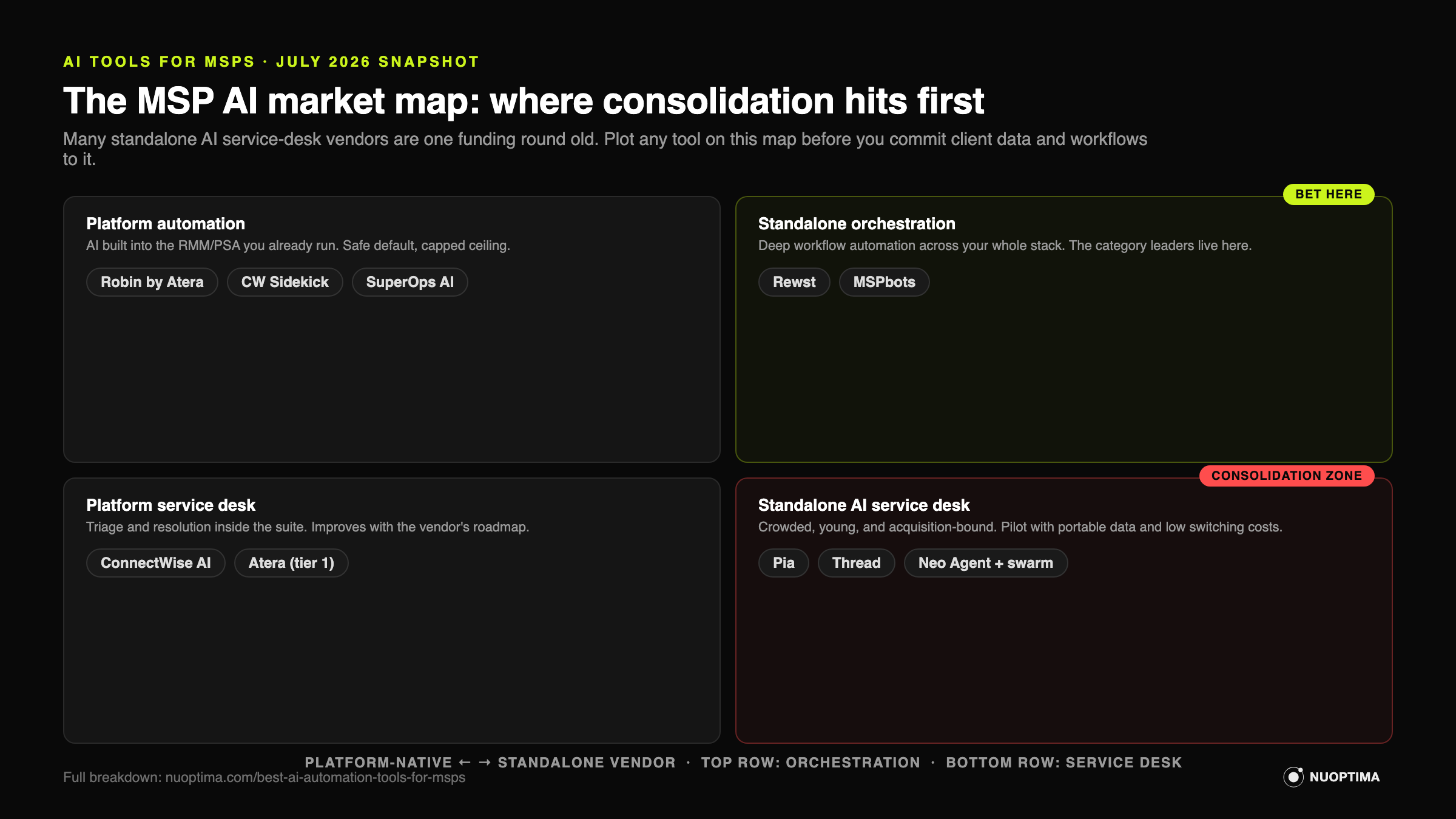
- The standalone AI service-desk field is young. Several newer entrants are a single funding round old, and the platform vendors (Atera, ConnectWise, SuperOps) ship the same ticket-deflection features natively. Heavy consolidation is coming, so buy with switching costs in mind, not features.
- Keep client data off public LLMs. Favor tools with private or closed models and clear no-training guarantees. Some MSPs run local models for anything client-facing.
- Bet on category leaders or keep switching costs low. If you adopt an early-stage AI service desk, keep your data portable so a vendor exit does not strand you.
AI automation tools for MSPs compared
| Tool | Function | Best for | Pricing model | Watch-out |
|---|---|---|---|---|
| Rewst | Orchestration and automation | MSPs standardizing workflows across PSA, RMM, and M365 | Quote-based, scales with usage | Real learning curve; you invest time to build |
| MSPbots | AI and BI automation | Dashboards, alerts, and bots across many tools | Tiered, per-feature | Setup effort; you configure the bots |
| Pia | AI service desk and ticket resolution | Automating common ticket types | Quote-based, per-tech or per-tenant | Still maturing as a category |
| Thread | AI-native ticketing in Teams | Teams-first shops wanting modern UX | Flat per managed customer/month | Newer and smaller vendor |
| Robin by Atera | Autonomous tier-1 inside Atera | MSPs already on Atera | Per-end-user add-on; AI Copilot bundled in plans | Tied to the Atera ecosystem |
| ConnectWise Sidekick | AI across the Asio platform | Existing ConnectWise shops | Bundled/add-on to ConnectWise | Evolving fast; feature set moving |
| SuperOps AI | AI native to SuperOps PSA/RMM | MSPs on or moving to SuperOps | Per-tech, part of platform | Depth still growing |
| Guardz | AI-driven unified SMB security | MSPs standardizing SMB security | Per-endpoint or per-seat | Not a full enterprise SOC |
| FlexPoint | AI billing and AR automation | Fixing cash flow and collections | Quote-based monthly subscription | Narrow scope by design |
| Hatz AI | Secure private AI workspace for clients | MSPs building AI services | Per-seat or per-tenant | Newer entrant |
Orchestration and automation
This is where you start. Orchestration tools do not replace your PSA or RMM. They connect the tools you already run and automate the handoffs between them, which is where most wasted technician time hides.
 Rewst
Rewst
Rewst is the leading automation and orchestration platform built specifically for MSPs, and it is the one tool on this list with a defensible lead. Think of it as robotic process automation for the MSP stack: it connects deeply to your PSA, RMM, and Microsoft 365, then runs the workflows that used to eat technician hours, like user onboarding, offboarding, alert triage, and cross-tool syncing.
Strengths: The integration depth is the real product. Rewst reaches into the tools MSPs actually use and automates across them rather than inside one. The community, organized into "Crews," is genuinely active, so you are rarely the first person to solve a given workflow. When it is dialed in, it removes a category of manual work most MSPs assume is just the cost of doing business.
Where it falls short: There is a real learning curve. Rewst is a platform you build on, not a switch you flip. You invest time upfront to design and test workflows, and thin teams sometimes stall because nobody owns the buildout. Budget for the ramp.
Best for: MSPs ready to standardize operations across their existing PSA, RMM, and M365, and willing to put in the buildout time to get compounding returns.
 MSPbots
MSPbots pairs automation with business intelligence. It pulls from 80-plus integrations across ConnectWise, Autotask, Halo, NinjaOne, Kaseya, and IT Glue, then drives dashboards, alerts, and bots off that data. Where Rewst automates workflows, MSPbots is strongest at turning your scattered tool data into visibility and nudges.
Strengths: Broad integration coverage and a strong reporting and dashboard layer. If your problem is that data lives in six systems and nobody has a single view, this is aimed squarely at you. The bots can enforce process, like flagging tickets that break SLA or nudging techs on stale work.
Where it falls short: It rewards configuration. The value is real but it is not out of the box; someone has to build the dashboards and tune the bots to your workflow. Expect setup effort before it earns its keep.
Best for: MSPs that want operational visibility and automated nudges across a messy multi-tool stack, and have someone to own the configuration.
AI service desk and ticket triage
This is the crowded part of the market, and you should walk in clear-eyed. Every vendor here is chasing the same outcome: deflect and resolve tier-1 tickets so your techs handle fewer of them. Most are seed or early growth stage. The technology is promising and moving fast, but the field is too crowded to stay this size. Expect consolidation. Pick with switching costs in mind.
 Pia
Pia
Pia focuses on AI-driven ticket resolution and service-desk automation. It ingests common ticket types, runs the standard resolution steps, and closes or escalates, with the goal of taking routine work off your first line.
Strengths: Purpose-built for MSP service-desk automation rather than a generic chatbot bolted on. Early deflection results are promising for the repetitive ticket categories that clog most queues.
Where it falls short: The whole category is still maturing, Pia included. Deflection quality depends heavily on your ticket hygiene and documentation, and results vary. Pilot and measure before you plan headcount around it.
Best for: MSPs with clean, well-categorized ticket data who want to automate high-volume, repetitive request types.
 Thread
Thread is AI-native ticketing and collaboration that lives inside Microsoft Teams. Instead of pushing clients to a portal, it meets them where they already work, and uses AI to structure conversations into tickets and speed responses.
Strengths: Modern UX and a Teams-first model that lowers friction for clients who live in Teams all day. The AI-native design shows in how naturally it turns messy chat into structured tickets.
Where it falls short: It is a newer and smaller vendor than the incumbents, so you are betting partly on the company, not just the product. If your clients are not Teams-centric, the core advantage shrinks.
Best for: Teams-first MSPs and their Teams-first clients who want a modern, low-friction intake experience.
Robin by Atera (formerly IT Autopilot)
Robin, Atera's autonomous AI agent (formerly IT Autopilot), adds autonomous tier-1 capabilities inside Atera's all-in-one platform, priced per end user as an add-on, while Atera's AI Copilot assistant is bundled into its plans. If you already run Atera, it extends what you have rather than adding another vendor to manage.
Strengths: Convenience and consolidation. The AI is native to a platform you already operate, so there is no new integration to stand up and one less contract to track.
Where it falls short: You are tied to the Atera ecosystem. The autonomy is only as useful as Atera is a fit for your business, and it does not help MSPs on other platforms.
Best for: MSPs already committed to Atera who want tier-1 automation without adding a separate tool.
 ConnectWise Sidekick
ConnectWise Sidekick brings AI assistance across the ConnectWise Asio platform, from ticket handling to documentation and workflow help. For the large installed base of ConnectWise shops, it is the path of least resistance.
Strengths: Deep fit for existing ConnectWise users and backing from a vendor that is not going anywhere. That stability matters in a category full of startups. The feature set spans the platform rather than one narrow task.
Where it falls short: It is evolving fast, which cuts both ways: capabilities are still moving, and what you evaluate today may look different in two quarters. Value is concentrated for those already all-in on ConnectWise.
Best for: MSPs already standardized on ConnectWise Asio who want AI woven through the platform they run.
 SuperOps AI
SuperOps AI layers AI features into the SuperOps RMM and PSA platform. The pitch is AI that is native to your core system rather than a separate tool you integrate and babysit.
Strengths: Native integration means the AI works against your live RMM and PSA data with no glue code. For MSPs who want AI inside their platform rather than alongside it, that is a clean model.
Where it falls short: The AI depth is still growing. It is a capable and modern platform, but the AI feature set is younger than some standalone specialists. Judge it on where it is today, not the roadmap.
Best for: MSPs on SuperOps, or moving to it, who want AI built into the platform rather than bolted on.
For contrast, enterprise-grade agents like Moveworks exist, but they are built for large corporate IT and most SMB-focused MSPs will not need or want that weight. And newer entrants like Neo Agent show how fast the swarm is still forming, which is exactly why you keep switching costs low.
AI security
 Guardz
Guardz is AI-driven unified security aimed at MSPs that serve small and mid-sized businesses. It pulls detection, response, and security posture into one platform, so instead of stitching together separate point tools you standardize SMB security on a single pane.
Strengths: Consolidation is the point. For MSPs building a repeatable SMB security offering, having detection, response, and posture in one place lowers operational overhead and makes the service easier to sell and deliver. The AI helps surface what actually matters instead of drowning techs in alerts.
Where it falls short: It is built for the SMB reality, not to replace a full enterprise security operations center. If you serve larger clients with heavy compliance or a dedicated SOC, Guardz complements that work rather than replacing it. Scope it as an SMB standardization play.
Best for: MSPs standardizing security across a book of SMB clients who want unified detection, response, and posture without assembling a stack of separate tools.
Back-office and billing
The service desk gets the attention, but back-office automation often has the faster payback because it touches cash directly.
 FlexPoint
FlexPoint applies AI to MSP billing and accounts-receivable automation. It is narrow on purpose: it goes after the invoicing and collections work that quietly drains time and delays cash.
Strengths: High-value focus. Getting paid faster and cutting manual AR work hits cash flow directly, which is often worth more than shaving minutes off a ticket. The narrow scope means it does one thing and does it well.
Where it falls short: It is a point solution, not a platform. It solves billing and AR and stays in its lane, so you are adding a dedicated tool for a specific job rather than consolidating.
Best for: MSPs whose real pain is slow collections and manual billing, and who want automation aimed straight at cash flow.
 Hatz AI
Hatz AI is a secure AI workspace that lets an MSP deliver private AI to its own clients. Rather than automating your internal desk, it gives you a platform to stand up governed, private AI services for the businesses you serve.
Strengths: It turns AI into something you can sell. For MSPs who want to offer AI enablement as a service, Hatz provides a secure, private workspace so client data does not leak into public models. That private-by-design posture is the right default for anything client-facing.
Where it falls short: It is a newer entrant, and it fits a specific strategy: MSPs actively building an AI services line. If you are not selling AI to clients yet, it solves a problem you may not have.
Best for: MSPs building a productized AI services offering who need a secure, private platform to deliver it on.
How to choose AI tools for your MSP without getting burned
The tools are moving faster than most MSPs can evaluate them. A simple sequence keeps you from overbuying or betting on a vendor that disappears.
Start with orchestration on the stack you already run. Before any AI service desk, get Rewst or a comparable orchestration layer working on your existing PSA and RMM. Automating the handoffs you already understand delivers value faster and with less risk than handing tickets to an AI.
Pilot one AI service-desk tool and measure deflection. Do not roll out three. Pick one, run it against a real slice of your queue, and measure actual ticket deflection and resolution quality over a few weeks. If it does not move the number, it does not matter how good the demo looked.
Demand data privacy and a private or closed model for anything touching client data. Ask directly: is our data used to train your models, and where does it live. Favor no-training guarantees and private or closed models. For sensitive client work, some MSPs run local or self-hosted models so nothing leaves their control.
Keep switching costs low, because the category is consolidating. The AI service-desk space is a seed-stage vendor swarm, and analysts expect heavy consolidation. Either bet on category leaders with staying power, like Rewst for orchestration and an established platform vendor for the desk, or keep your data portable and your contracts short so a vendor getting acquired or folding does not become your outage.
And if the blocker is not the tool but the rollout (nobody owns governance, the team never adopts, client data rules stay fuzzy), that is the gap our MSP AI advisory closes: a governed workspace, automations built on your actual workflows, and a team trained until it sticks.
Related guides
This guide is part of the Ultimate Guide to the MSP Tech Stack. Continue with the other layers of the stack:
- Best AI Service Desk Agents for MSPs
- Best RMM Software for MSPs
- Best PSA Software for MSPs
- Best Microsoft 365 Management Tools for MSPs
- Best BCDR and Backup Tools for MSPs
About NUOPTIMA
Everything above is about AI that runs your operations. There is a second, separate problem that automation does nothing for: whether buyers can find you at all. When a prospect asks ChatGPT, Gemini, Claude, or Perplexity to recommend an MSP, your service desk automation has zero influence on the answer. That is a different kind of AI visibility, and it is decided by how well your content is optimized for both search and generative engines.
NUOPTIMA is an AI-native growth agency built for MSPs. We combine traditional SEO with GEO, generative engine optimization, so you show up in Google and get cited by the AI tools buyers now ask first. Cortavo, a managed service provider, went from 261 organic visitors a month to 10,000 in 9 months, and ChatGPT now recommends them when a buyer asks for an MSP. If you want to see where you stand today, we can run a visibility teardown showing exactly how your MSP appears across Google and the major AI engines, and where the gaps are.