RMM (remote monitoring and management) is the software an MSP uses to watch, patch, and fix client endpoints at scale from one console, so a few technicians can support thousands of devices. If you want a single answer, NinjaOne is the most-recommended modern pick right now, mostly on technician experience and speed of deployment. But the right choice depends on two things most buyers skip: your pricing model and the size of your MSP. A four-tech shop consolidating tools has different math than a 40-tech operation running deep automation.
This guide compares 10 RMM platforms across pricing model, best-fit MSP size, standout strengths, and where each one falls short. We call out honest cons for the leaders, name the free and open-source options the vendor-sponsored lists tend to hide, and explain the one decision that quietly sets your bill for the next five years: whether you pay per endpoint or per technician.
We don't sell, resell, or take commissions on any tool in this guide, and no vendor paid to be here. Our business is helping MSPs get found by buyers, which only works if lists like this are actually right.
Key Takeaways
- Top overall pick: NinjaOne, best technician UX and fast cloud rollout, at a premium per-endpoint price.
- Best lean all-in-one: Syncro, flat per-technician pricing with unlimited endpoints, RMM and PSA in one tool.
- Best free tier: Action1 (free for your first 200 endpoints) and Tactical RMM (source-available, free to self-host).
- Best for large MSPs: N-able N-central for depth, with Datto RMM and ConnectWise RMM for teams already in those ecosystems.
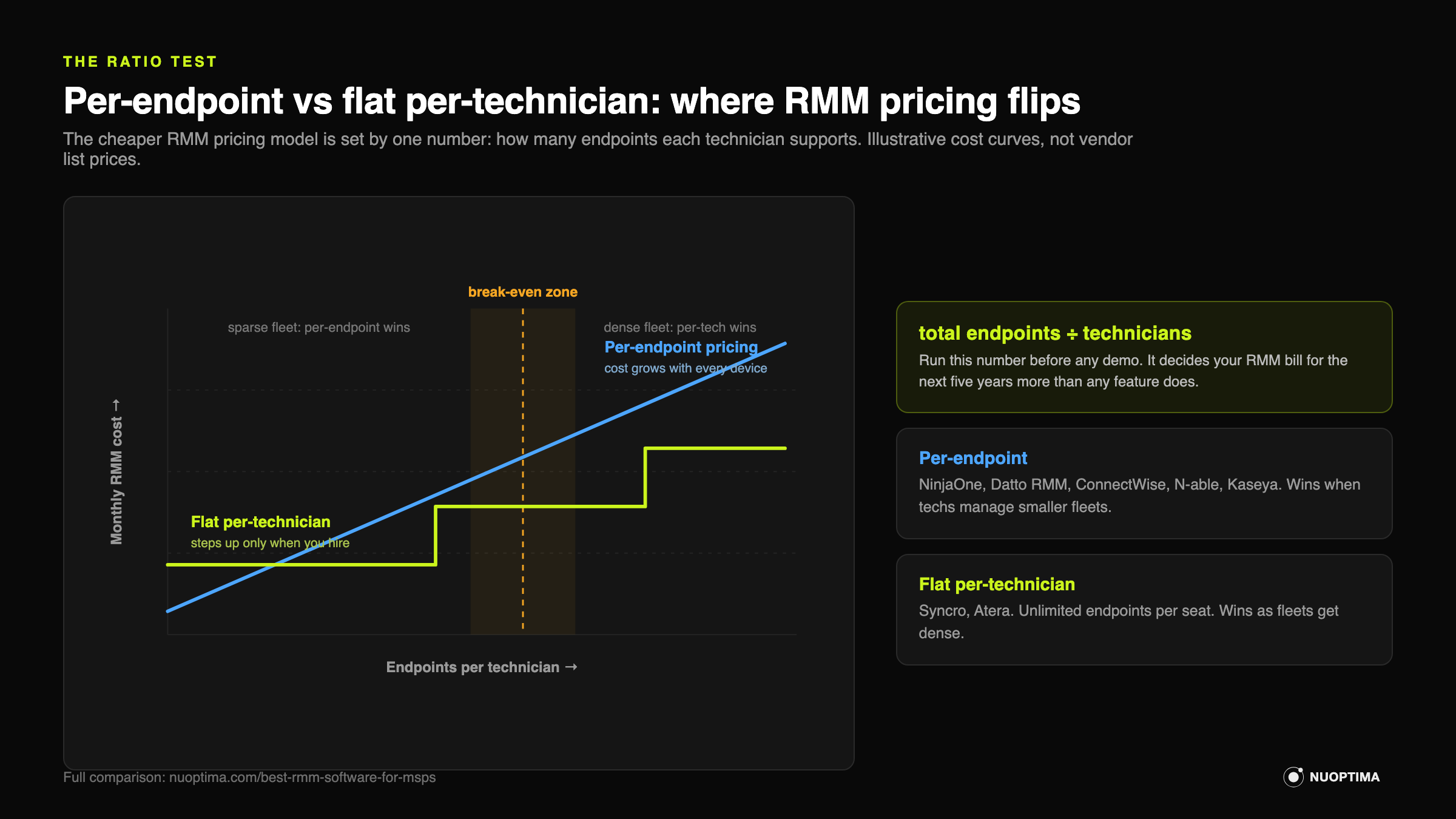
- The ratio test: total endpoints divided by technicians. That one number, not the feature list, decides which platform is cheaper for the next five years. Dense environments favor flat per-tech pricing; sparse ones favor per-endpoint. Run it before any demo.
Best RMM software for MSPs compared
| Tool | Best for | Pricing model | Standout | Watch-out |
|---|---|---|---|---|
| NinjaOne | MSPs prioritizing technician experience | Per-endpoint, quote-based | Cleanest UX, fast patching | Premium price at scale |
| Datto RMM | Autotask-based classic MSP ops | Per-endpoint, quote-based | Deep Autotask integration | Now Kaseya-owned |
| ConnectWise RMM | Teams already in ConnectWise | Per-endpoint, quote-based | Full ecosystem (Asio) | Complex to run well |
| N-able N-central | Larger and enterprise MSPs | Per-endpoint, quote-based | Very deep automation | Steep learning curve |
| Kaseya VSA | MSPs committed to the Kaseya stack | Per-endpoint, quote-based | Broad IT Complete bundle | Pricing and lock-in reputation |
| Syncro | Small and growing MSPs | Flat per-technician | Unlimited endpoints, PSA built in | Lighter enterprise depth |
| Atera | Small MSPs and lean IT teams | Per-technician | Disruptive pricing, AI Copilot included | Add-ons raise the bill |
| Level.io | Technical, scripting-forward teams | Per-endpoint | Lean, fast, modern UI | Smaller ecosystem |
| Action1 | Patching-led MSPs | Free to 200 endpoints, then per-device | Genuinely free entry, patch-first | Narrower than a full RMM |
| Tactical RMM | DIY technical MSPs | Free to self-host, source-available | No license cost, full control | No vendor support net |
 NinjaOne: the modern favorite
NinjaOne is a cloud-native RMM built around the daily technician workflow, and it is the platform practitioners name first when technician experience is the priority. It is a strong fit for MSPs of almost any size that want fast onboarding and low training overhead.
The console is clean, agents deploy quickly, and patching and automation work without a long ramp. New hires get productive in days, not weeks, which matters when you are hiring techs faster than you can train them.
Strengths: the cleanest interface in the category, quick cloud deployment, dependable patch management, wide integration list.
Where it falls short: pricing is per endpoint and quote-based, and it sits at the premium end. At a few thousand endpoints the bill is real, and some deep, niche automation still favors older enterprise platforms.
Best for: MSPs of any size that treat technician efficiency and onboarding speed as the top buying criterion and can absorb a premium per-endpoint rate.
 Datto RMM: classic MSP operations
Datto RMM is a mature, operations-focused platform best known for its tight pairing with Autotask PSA. It suits MSPs that want a proven, traditional stack rather than the newest interface.
The tool is stable, the feature set is broad, and the Autotask integration keeps tickets, billing, and monitoring in one flow. That end-to-end continuity is the main reason teams choose it.
Strengths: deep Autotask integration, mature and reliable, strong ransomware detection and monitoring depth.
Where it falls short: Datto is now owned by Kaseya, and some MSPs are cautious about roadmap and pricing direction under that ownership. The interface feels more traditional than NinjaOne or Level.
Best for: MSPs running Autotask that want classic, dependable operations and value integration continuity over a modern UI.
 ConnectWise RMM: the ecosystem play
ConnectWise RMM is the monitoring layer inside the broader ConnectWise ecosystem, delivered cloud-native on the ConnectWise Asio platform (a separate product from the on-prem ConnectWise Automate). It makes the most sense for MSPs already committed to ConnectWise PSA.
The platform is capable and scales, and when the wider stack is dialed in the integration across PSA, RMM, and quoting is genuinely useful. The value comes from the ecosystem, not the RMM alone.
Strengths: full ConnectWise integration, powerful automation, mature ecosystem with a large partner base.
Where it falls short: it is complex to configure and run well, the learning curve is steep, and standalone (outside the ConnectWise stack) it is harder to justify.
Best for: MSPs already standardized on ConnectWise PSA that want one vendor across the operational stack.
 N-able N-central: built for scale
N-able N-central is a deep, enterprise-grade RMM built for larger MSPs managing complex, high-volume environments. It targets teams that need granular automation and control over thousands of devices.
The automation engine and configuration depth are among the strongest available, which is exactly what a mature MSP with dedicated automation staff wants. That power comes with complexity.
Strengths: very deep automation, strong role-based control, engineered for large-scale fleets.
Where it falls short: the learning curve is steep and it can feel heavy for a small team. If you are under roughly 20 technicians, N-able N-sight is the lighter sibling built for smaller MSPs and is usually the better starting point.
Best for: larger and enterprise MSPs with the staff to exploit deep automation. Smaller shops should look at N-sight instead.
 Kaseya VSA: the bundled powerhouse
Kaseya VSA is a mature, capable RMM that anchors the wider Kaseya IT Complete bundle. It fits MSPs that want to consolidate RMM, PSA, backup, and security under one vendor relationship.
The platform is powerful and the bundle economics can work if you genuinely use most of the suite. The consolidation is the pitch: fewer vendors, one contract.
Strengths: broad, mature feature set, wide IT Complete bundle, strong automation and patching.
Where it falls short: Kaseya carries a well-known reputation among practitioners for aggressive pricing tactics and contract lock-in. Read the terms carefully and model the full commitment, not just year one.
Best for: MSPs committed to consolidating on the Kaseya stack that will use enough of the bundle to justify the relationship.
 Syncro: all-in-one on flat pricing
Syncro combines RMM and PSA in one platform on flat per-technician pricing with unlimited endpoints. That model makes it a standout for small and growing MSPs looking to consolidate tools and control cost.
Because you pay per tech and not per device, a dense environment (many endpoints per technician) gets very cost-effective. Ticketing, billing, and monitoring live in one place, which removes a second vendor and a second integration.
Strengths: flat per-technician pricing, unlimited endpoints, RMM and PSA combined, quick to stand up.
Where it falls short: enterprise-grade automation depth is lighter than N-central or ConnectWise, and very large MSPs may outgrow it.
Best for: small and growing MSPs (roughly 2 to 20 techs) consolidating tools, especially those managing many endpoints per technician.
 Atera: disruptive per-tech pricing
Atera is a cloud RMM and PSA on per-technician pricing that broke the traditional per-device model, which made it popular with small MSPs and internal IT teams. AI Copilot is included in its plans, and Robin, its autonomous AI agent, is sold as a separate add-on.
The pricing is the draw: unlimited devices per tech seat keeps costs predictable as you add endpoints. It is fast to deploy and easy to learn.
Strengths: per-technician pricing, unlimited devices per seat, built-in PSA, bundled AI Copilot, low ramp time.
Where it falls short: the base plan gets pricier once you add the modules that make it complete, and automation depth is lighter than NinjaOne for complex scripting.
Best for: small MSPs and lean IT teams that want predictable per-tech pricing and can live with lighter automation depth.
 Level.io: lean and scripting-forward
Level.io is a modern, lightweight RMM built for technical teams that want speed, a clean interface, and strong scripting. It suits smaller, capable teams that prefer a fast tool over a sprawling suite.
The interface is genuinely modern, remote access is quick, and the scripting model appeals to techs who want to automate without wrestling a legacy console. It is a newer entrant, which is both the appeal and the risk.
Strengths: clean modern UI, fast remote access, scripting-forward, responsive product velocity.
Where it falls short: the ecosystem and integration library are smaller than the established players, and enterprise-heavy MSPs may find gaps.
Best for: technically strong small and mid-size MSPs that value speed and scripting over a large partner ecosystem.
 Action1: patch-first and genuinely free
Action1 is a cloud-native platform built around patch management, and it is genuinely free for your first 200 endpoints. That makes it a real option for patching-led MSPs and a rare free tier the vendor-sponsored lists tend to skip.
The patching engine is the strength: fast, reliable, and cloud-delivered with no on-prem server to maintain. Above the free tier it moves to per-device pricing.
Strengths: free for the first 200 endpoints, excellent patch management, cloud-native with no server to run.
Where it falls short: it is patch-first and narrower than a full RMM. If you need deep scripting, PSA, and broad monitoring, it complements rather than replaces a primary RMM.
Best for: patching-led MSPs, and any team wanting a free, dependable patch layer for smaller environments.
 Tactical RMM: source-available and self-hosted
Tactical RMM is a source-available, self-hosted RMM that is free to run if you supply and maintain the infrastructure. Its license is not OSI open-source (it restricts commercial redistribution), and paid support and hosted tiers exist. It is built for technical, DIY-minded MSPs that want full control and no license fee.
You get real RMM capability (monitoring, scripting, remote access) with the source in your hands. The trade is operational: you run the server, the updates, and the security yourself.
Strengths: no license cost, full control and customization, active community.
Where it falls short: there is no vendor support safety net, you own uptime and patching of the platform itself, and setup demands genuine technical skill.
Best for: technically confident MSPs willing to trade vendor support for control and zero license cost.
Honorable mentions: Pulseway is worth a look for mobile-first monitoring and control from a phone, and Auvik is strong specifically for network monitoring and visibility alongside a primary RMM.
How to choose the right RMM for your MSP
Start with the pricing model, because it sets your bill more than any feature does. The real decision is per-technician flat pricing (Syncro, Atera) versus per-endpoint pricing (NinjaOne and most others), and which is cheaper flips on your endpoint-to-technician ratio.
- Dense environments (many endpoints per tech): flat per-technician pricing usually wins. If each tech supports 800-plus endpoints, unlimited-device per-seat models like Syncro or Atera get very cheap per device.
- Sparse environments (fewer endpoints per tech): per-endpoint pricing often wins, and you get access to the deeper per-endpoint platforms without overpaying.
- Run the ratio test: total endpoints divided by technicians. Then price both models against that ratio before you sign anything.
Then layer size and stack on top:
| MSP stage | Reasonable starting point |
|---|---|
| Solo or 2 to 5 techs, consolidating tools | Syncro or Atera (all-in-one, flat per-tech) |
| 5 to 20 techs, UX-led | NinjaOne, or Level.io if scripting-heavy |
| 20-plus techs, deep automation | N-able N-central, Datto RMM, or ConnectWise RMM |
| Already on Autotask or ConnectWise | Datto RMM or ConnectWise RMM (integration continuity) |
| Patching-led or budget-first | Action1 (free entry), or Tactical RMM if you self-host |
One more filter: your existing PSA. If you already run Autotask or ConnectWise, integration continuity is worth real money and usually points you at Datto RMM or ConnectWise RMM even if another tool tests slightly better in isolation.
Related guides
This guide is part of the Ultimate Guide to the MSP Tech Stack. Continue with the other layers of the stack:
- Best PSA Software for MSPs
- Best Microsoft 365 Management Tools for MSPs
- Best AI and Automation Tools for MSPs
- Best BCDR and Backup Tools for MSPs
About NUOPTIMA
NUOPTIMA is an AI-native growth agency built for MSPs, MSSPs, and cybersecurity firms. We combine traditional SEO with GEO, the work of getting your business cited by ChatGPT, Gemini, Claude, and Perplexity when a buyer asks them for a recommendation. That is where more MSP buying research now starts, and most MSPs are invisible there.
Cortavo, a managed service provider, went from 261 organic visitors a month to 10,000 in 9 months, and ChatGPT now recommends them when a buyer asks for an MSP. If you want to see where you stand today, we run a short visibility teardown that shows how you rank in search and whether the AI engines mention you at all. No pitch, just the gaps and what to fix first.