For a managed service provider (MSP), generative engine optimization (GEO) is sold three main ways. A monthly retainer pays for ongoing execution. A fixed project pays for one defined deliverable, such as an entity cleanup or a service page rebuild. Performance pricing ties the fee to measured visibility in artificial intelligence (AI) answers. You will also see audits that roll into retainers, software-only plans, hourly or per page work and base plus bonus deals.
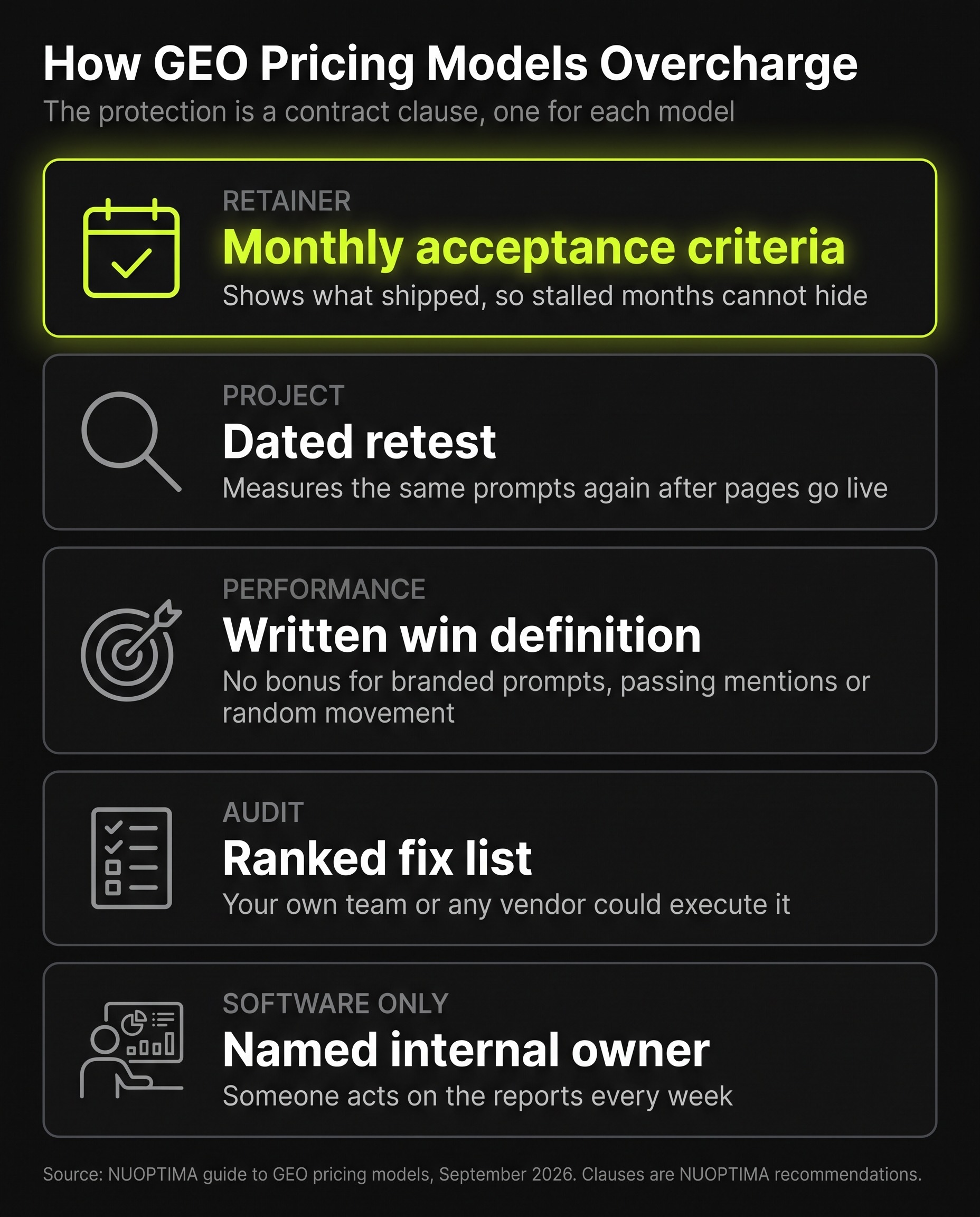
Each model can be fair, and each can work against you in its own way. Retainers bill through months when nothing ships. Projects end before anyone retests. Performance deals pay for easy or random wins. The protection is a contract clause, and this page names one for each model.
This page covers contract structure. For price ranges, read what GEO costs. For budgets by MSP size and payback, read budgets and payback for MSPs. For search engine optimization (SEO), see our SEO pricing models page. The GEO difference is measurement: AI answers change between runs, so a win needs a tighter written definition than a ranking report.
The Model Map
| Model | Best fit | How it works against you | Clause that protects you |
|---|---|---|---|
| Retainer | Ongoing work nobody in-house has time for | Bills through stalled months and keeps billing finished setup work | Monthly acceptance criteria, a blocker log and an exit right if criteria are missed |
| Fixed project | A known, contained problem | Ends before anyone retests AI answers | A dated retest, with "done" meaning live on your site |
| Performance | Buyers who want the fee tied to measured visibility | Pays for branded prompts, passing mentions and random movement | Fixed prompts, a written win definition, repeat checks and a bonus cap |
| Base plus bonus | Accountability without a pure bounty | A full retainer with a bonus on top | A base below the agency's normal retainer, and a capped bonus |
| Audit to retainer | Unknown problems that need a baseline | A static report, or findings sized to fit a retainer | A ranked fix list any vendor could execute, with any credit agreed in writing |
| Software only | Teams that already ship every week | Renews while nobody acts on it | A named internal owner |
| Hourly or per page | Specialist tasks or a set batch of pages | Slow work and filler pages | A cap and written acceptance rules |
Retainer Pricing
A GEO retainer pays for repeated execution: prompt tracking, technical and entity fixes, page rebuilds, outside mentions and reporting. It suits an MSP that wants AI visibility to compound and has nobody in-house to do that work every week.
NUOPTIMA sells GEO as a managed service, so hold us to the same tests. A retainer works against you in three ways.
It bills through stalls. The fee is the same whether pages ship or sit in your approval queue, your developer's backlog or the agency's strategy deck.
It keeps billing setup work. Schema cleanup and entity fixes are heavy in the first months and should shrink after. If the scope in month seven reads like month one, ask what is still being set up.
It gets sold to buyers who need one fix. A focused GEO retainer runs $3,000 to $7,500 a month (NUOPTIMA working estimate), or $36,000 to $90,000 a year. An audit that finds the single broken thing costs $1,500 to $7,500, one time (NUOPTIMA working estimate). If the problem is a broken page template or inconsistent company naming across directories, buy a project.
The protecting clause is monthly acceptance criteria in the statement of work (SOW): pages shipped, prompts checked, citations reviewed and fixes submitted. Add a blocker log that records who held each item up, so a thin month shows whose delay it was. If there is a minimum term, ask for the right to exit at the first checkpoint if the written criteria are missed.
Project Pricing
A fixed project buys a defined deliverable: an entity cleanup, a service page rewrite, a schema correction or a set of comparison pages. It is the clean buy when you already know what is broken.
GEO projects work against you by stopping too early. The vendor delivers the pages and schema, invoices and leaves before anyone checks whether AI answers changed. A quieter version counts the project done when drafts land in a shared folder, while publishing waits on your team for months.
The protecting clause has two parts. First, a retest on the same prompts once the changes go live, dated in the contract and compared with a baseline taken before work started. Second, a definition of done that means live on your site, with a named owner for publishing. A vendor that refuses the retest is selling production work with GEO language on top.
Performance Pricing
Performance pricing sounds like the cleanest deal: pay when the agency gets you cited or shortlisted. In GEO it is also the easiest model to game, because the score moves on its own.
A 2026 study of Google Search, Gemini and AI Overviews found that AI Overviews returned less consistent sources than regular Google results when the same query ran twice, and shifted more when the wording changed slightly. If the contract does not define the score before work starts, part of what you pay for is noise.
Performance deals work against you in four ways:
- Branded prompts. "Is [your MSP] a good provider?" is easy to win. It should not earn the same bonus as "best healthcare MSP for compliance support."
- Passing mentions. One line deep in a long answer is not a place on a shortlist of named providers.
- Agency-set baselines. If the agency picks the prompts, competitors and baseline date after seeing the data, it can pick where movement is likely.
- Paid volatility. If one run of one prompt triggers payment, random movement becomes billable progress.
A fair clause, agreed before work starts, names the prompt set, the AI assistants tested, the baseline date, the win threshold, the excluded branded prompts and the maximum bonus. "Named among the top three providers" is a cleaner win than "mentioned," and "a linked citation to a page you own" is cleaner than "brand appears in the answer." Count a win only when it holds on repeat checks, for example in two of three runs on separate days. If a vendor defines a win as "any mention," walk away.
Base Plus Bonus
Base plus bonus is the workable version of performance pricing: the base pays for labor and the bonus pays for defined wins. It works against you when the base is a normal retainer and the bonus sits on top. The agency then takes no risk, and you have bought an expensive retainer with a success tax.
The test is to ask the same agency for its straight retainer quote. The base should sit clearly below it, because the agency is asking for upside. Cap the bonus, fix the prompt set before the baseline is taken, and keep branded and low-intent prompts out of the bonus math.
Audit to Retainer
An audit to retainer starts with a paid baseline and rolls into monthly execution if you continue. A GEO audit or baseline runs $1,500 to $7,500, one time (NUOPTIMA working estimate). It should show where you appear in AI answers today, what stops you being cited and what to fix first.
It works against you in two ways. A static report of screenshots and generic advice leaves the real bottleneck with you: the writing, approvals, publishing and technical cleanup. And the agency running the audit hopes to sell the retainer, so its findings tend to come out retainer-sized.
Ask for a ranked fix list that your own team or any competent vendor could execute, each item marked one-time or ongoing. Keep the prompt list and the baseline. If part of the fee is credited toward execution, write the credit and a decision deadline into the contract before the audit starts.
Software Only
Software only is fair when your team already ships pages and technical fixes every week. It works against you when the subscription renews and nobody acts on what it shows: a dashboard can show that your MSP is missing from AI answers, but it will not write the page or fix the entity data. Name the person who owns weekly action before you buy. Current tool prices are in the GEO cost guide.
Hourly and Per Page Pricing
Hourly pricing suits a specialist task such as schema troubleshooting or analytics setup, but as the main GEO model it rewards slow work. Per page pricing suits a set batch, such as rewriting your core service pages, and goes wrong when page count becomes the goal. Cap both. For hourly work, cap the hours and name the output. For per page work, write the acceptance rules: live on your site, editable copy, internal links, sourced claims, the agreed schema and a retest date.
Terms That Change the Real Cost
Two proposals with the same model and the same fee can cost very different amounts. Read for setup fees, minimum terms, cancellation fees, automatic renewal, tool subscriptions passed through with or without markup, paid placement fees and developer hours billed outside the fee. Then ask who keeps the drafts, schema, prompt lists, tracking history, logins and source files when you leave. You should own all of it, in formats you can edit.
Reporting is a term too. A GEO report should show prompt-level visibility by AI assistant, cited pages, shipped work and open blockers. A report of traffic and impressions is an SEO report with a GEO label. For the measurement side, see how citations are tracked. For the wider vetting process, use the contract lock-in checklist.
Match the term to the job. A one-off cleanup needs no long commitment. A compounding program should not be judged on one week of citation movement, and how long GEO takes sets out what to expect when. If a vendor wants a long minimum, trade it for an exit right tied to written milestones.
Where NUOPTIMA Fits, Judged by the Same Test
NUOPTIMA sells GEO as a managed service. Our GEO program maps the questions buyers ask AI assistants, engineers what those assistants retrieve, tracks which prompts name you and defends the position over time. The service page puts your input at roughly thirty minutes a month.
Ask us for the acceptance criteria, blocker log, exit terms and ownership clause this page recommends, and judge the answers as you would anyone else's.
We are the wrong buy if you need one technical fix, one audit, a single batch of pages or a tool your own team will run. Buy that smaller piece of work instead. We are also the wrong buy if pages will wait weeks for your sign-off. Fix the approval path first, because slow approvals waste a managed program faster than any other model.
We fit when you want one accountable team running GEO alongside the rest of your growth work, without assembling tools, writers, technical fixes and reporting yourself. To check that fit before you commit, book a call.
Sources
- Grossman et al., "How Generative AI Disrupts Search: An Empirical Study of Google Search, Gemini, and AI Overviews," arXiv, April 30, 2026, https://arxiv.
org/ abs/ 2604. 27790, accessed September 28, 2026.