For a managed service provider (MSP) with a crawlable website and some search history, generative engine optimization (GEO) usually shows its first mentions in artificial intelligence (AI) answers within about 90 days. Citations then build across buyer questions from months 4 to 6, and steady, repeatable presence takes 6 to 12 months. Those ranges are NUOPTIMA's working estimate, not a promise. A new domain, a site that blocks crawlers or a crowded local market all push them out.
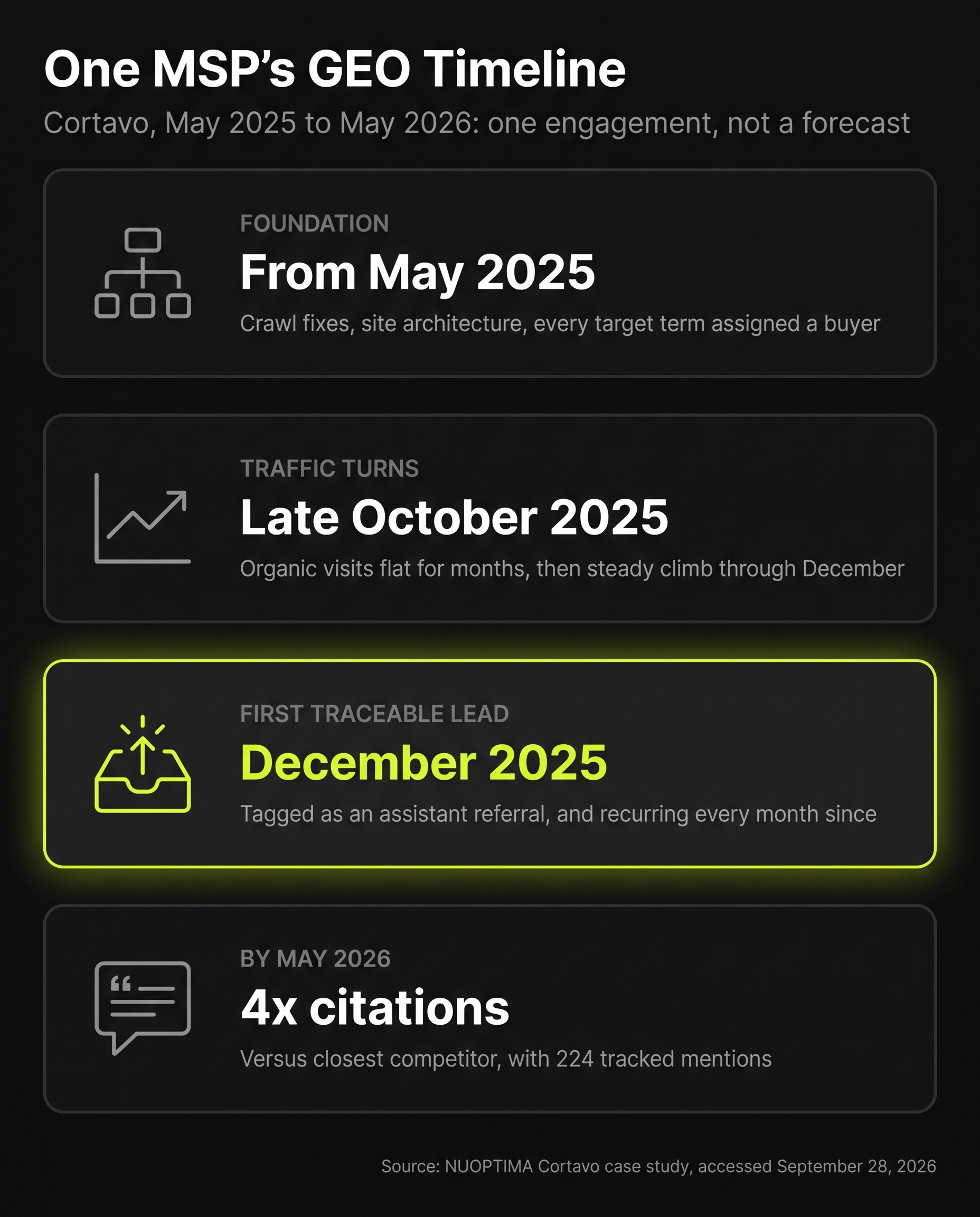
The only engagement where NUOPTIMA has published a dated AI search sequence is Cortavo, an MSP whose organic and AI search program ran from May 2025 to May 2026. Its organic traffic stayed flat through early October 2025 and inflected in late October. The first lead tagged as an AI-assistant referral reached its customer relationship management (CRM) system in December 2025.
For the classic Google version, read NUOPTIMA's guide to how long search engine optimization (SEO) takes. The rest of this page is about AI answers: when engines start using your pages, when citations stop being random, and what to demand from an agency at each point.
Your Starting Point Sets the Clock
The clock starts from where your visibility is today, not from the contract date. Be wary of any agency that quotes one timeline for every MSP.
| Starting point | NUOPTIMA working estimate | What has to happen first |
|---|---|---|
| Established site, clear services, some authority | First mentions possible in 30 to 90 days; citations build in months 4 to 6; steady presence in 6 to 12 months | Prompt baseline, crawl checks, rewrites of the priority service pages |
| New or low-authority domain | 9 to 18 months to durable shortlist presence | Service pages, proof assets, authority building |
| Technically blocked site | No useful timeline until it is fixed | Crawler access, indexing, rendering, consistent business facts |
The blocked row deserves a check before anything else, especially if your site sits behind strict bot filtering. Google says a page must be indexed and eligible to show with a snippet before it can appear as a supporting link in AI Overviews or AI Mode, and that there are no additional technical requirements beyond that. It also says meeting those requirements does not guarantee the page gets crawled, indexed or served. OpenAI says a site must allow its OAI-SearchBot crawler, and its host or content delivery network must allow OpenAI's published crawler addresses, to be eligible for ChatGPT search results.
If your site fails either test, work through the technical gates that block citations before you judge any timeline.
Before Month 1: Fix the Prompt Set
The first deliverable is a baseline, not content. Pick 10 to 20 questions a buyer of managed information technology (IT) services would put to an AI assistant (NUOPTIMA's working range). For example:
- "best managed IT provider for a 100 person law firm in Dallas"
- "co-managed IT provider for a manufacturing company"
- "outsourced IT department for a growing accounting firm"
Run the same prompts every month on the engines you care about. Log which firms appear and which pages get cited, and keep branded prompts apart from unbranded ones: a buyer who already types your name is not a shortlist win. One screenshot proves nothing, because OpenAI's own help page warns that ChatGPT search results and citations "can be incomplete, outdated, or incorrect." A fixed prompt set, retested on schedule, turns that noise into a trend. The mechanics are in NUOPTIMA's guide to tracking AI search engine citations.
Months 1 to 3: Foundation, Not Proof
Cortavo's first phase was the foundation: technical and crawl-health fixes, entity and site architecture, and assigning every target term to a role on the buyer's purchasing committee and a stage of the funnel before a word was written.
For your MSP, day 90 should answer five questions:
| Question | Pass signal by day 90 |
|---|---|
| Can engines fetch the right pages? | Core service pages are crawlable, indexed, internally linked and readable as text |
| Do they understand what you do? | Services, buyer types, locations, industries and proof read the same everywhere |
| Are you measuring the same demand? | A fixed prompt set exists and has been retested on schedule |
| Are pages built to be quoted? | Key pages answer the buyer's question in the first paragraph |
| Is anything moving? | More indexed pages, more impressions, occasional mentions, or a clearer view of which competitors get cited |
NUOPTIMA working estimate: an established MSP may get its first AI mention inside this window, and it will probably be unstable. One engine, one prompt, one page, gone the following week. Read it as proof your pages are eligible, not proof you have a position. A month 3 with no mentions at all is not a failure on its own; a month 3 where nobody can show you the table above filled in is.
Months 4 to 6: Content Engine and the Quiet Stretch
Cortavo's second phase was the content engine: city-by-industry guides (Dallas, Houston and Atlanta on one axis; manufacturing, construction, law firms and cloud on the other), migration guides for its legacy-IT niche, and question-and-answer markup on its main sales pages. Every piece was human-written and built around direct answers that search engines and AI models can lift.
From the outside, this stretch looked like nothing was happening. The case page says organic traffic stayed flat through early October 2025, turned up in late October and climbed steadily through December. Judge Cortavo in early October 2025 and you would have judged it weeks before the turn.
A good plan for these months builds pages that match how buyers ask for providers, not blog posts on generic terms:
- service pages for the categories you want to own
- city and industry pages where you can credibly serve
- comparison and alternatives pages, where shortlists form
- case studies with a named baseline, timeframe and outcome
Vague positioning starts costing you time here. Cortavo did not fight for "managed IT services", a term its case page says much stronger domains already held. It went after legacy-IT and HCL Domino migration, a niche almost nobody owned in search or in AI answers. "IT support for small businesses" gives an engine no reason to pick you, because every competitor says it. A narrow claim you can prove does.
Do not call month 6 a failure because revenue has not arrived. Do call it one if there is still no prompt baseline, nobody can show which page is meant to win which prompt, or the report is raw traffic and nothing else.
Months 7 to 9: Authority and the First AI-Sourced Lead
Cortavo's third phase was authority and AI: digital public relations (PR) placements on relevant IT and business publications, reviews spread across Clutch, G2 and Google, and entity markup built for Google's AI Overviews. The case page's reasoning is that AI systems take their trust signals from the wider web, so the same links and brand mentions feed rankings and citations at once.
The case page dates the first AI-sourced pipeline to December 2025, "once the citation work landed": a new lead source tagged as an AI-assistant referral appeared in Cortavo's CRM that month and has recurred every month since. That does not mean your first AI-sourced lead arrives on the same schedule. It shows the order: foundation, then content, then authority, then pipeline you can trace to an AI answer.
By this stage you want evidence in three places. You appear across more of the same buyer prompts. Engines cite your useful pages, not an old blog post. And your share is moving against the firms buyers already see.
This is also when to set cost against leading indicators and early pipeline; the payback math lives in when GEO pays back. Do not accept "AI takes time" from a vendor who cannot show movement by now.
Months 10 to 12: Compounding or a Hard Reset
Cortavo's fourth phase was compounding: comparison and "best of" list content (because those lists mirror how people phrase AI prompts), live citation monitoring across ChatGPT, Gemini, Claude and Perplexity, and conversion work on the highest-traffic pages.
The second half did more visible work than the first. By May 2026, Cortavo had 224 AI mentions across its tracked buyer prompts and 4x more AI citations than its closest competitor. What that was worth in contracted sales, and whether the same bet makes sense for you, is the subject of is GEO worth it for MSPs.
Treat Cortavo as one engagement, not a forecast. It had its own starting point, budget, market and niche, and its engineers fact-checked every article before it went live. What transfers is the shape: most of the visible result came after the foundation and content phases.
By month 12, you should know which of three cases you are in:
| Case | Decision |
|---|---|
| Citations, prompt coverage and qualified traffic are compounding | Continue and expand the winning prompt clusters |
| Some technical progress, but no authority or citations | Narrow the market and rebuild proof assets |
| No baseline, no prompt log, no specific shipped pages | Stop treating it as a GEO program |
Your Day 30, 90 and 180 Checkpoints
These are your checkpoints for judging whoever runs your GEO work. They stop you judging too early or waiting too long. The expectations below are NUOPTIMA's working estimate for an established site.
| Checkpoint | What you should have | Warning sign |
|---|---|---|
| Day 30 | Prompt set, technical baseline, priority pages chosen, competitor map, first fixes shipped | No baseline, or a report that shows traffic and nothing else |
| Day 90 | The five pass signals under months 1 to 3 | Nobody can say which page is meant to win which prompt |
| Day 180 | Setup finished; prompt coverage changing, citations appearing, search visibility moving | No citations, no change in coverage and no search movement |
At day 30 it is too early to demand steady citations and not too early to demand clarity. At day 180, if every signal is flat, patience is not the fix. The cause is technical eligibility, thin proof, vague positioning or too little authority, and your agency should be able to tell you which before you fund another quarter.
Why Some MSPs Take Longer
Cortavo is the only NUOPTIMA case that measures AI search directly. The other two published cases are classic SEO programs for cybersecurity consultancies, run between 2022 and 2024. They still show how the starting point changes the clock for the search foundation that GEO depends on.
A new domain. Microminder, the cybersecurity arm of a 40-year-old technology group, started in August 2022 on a brand-new domain with 3 ranking keywords and 14 monthly organic visits. By July 2024, 23 months in, it had 4,503 ranking keywords and 5,333 monthly visits. If your MSP starts near zero, plan for the long end of the ranges above.
A sharp niche. Eden Data's first six months, May to November 2023, took the cybersecurity and compliance consultancy from 66 to 446 monthly organic visits. Its buyers were startup founders and technical leads who needed a compliance certification, often to close a deal, and the program targeted the exact terms they typed. A narrow, high-intent market moves faster.
A crowded category. If every MSP in your city says "managed IT, cybersecurity, cloud and support," an engine has little reason to name you. That is why Cortavo went after a niche rather than the head term.
A slow review queue. A page that waits three weeks for your sign-off ships three weeks late, and so does everything built on top of it.
The wrong channel for the job. If you need new pipeline next quarter, GEO is the wrong first spend. Paid search and outbound can reach buyers far sooner. NUOPTIMA sells both of those too, so weigh that advice knowing we are not neutral. And if you cannot take on new clients in the next six months, wait until you can.
When to Stop Waiting
Stop waiting if, after 90 to 180 days, nobody can show you a fixed prompt set, a crawl and index review, a map of which page targets which prompt, the competitors being cited instead of you, and the proof assets that have shipped. That does not always mean the channel is wrong. It may mean the program was never GEO. Real GEO work picks the buyer questions, builds the pages and proof those questions need, retests the same prompts and records whether engines use you.
If you want a second view on whether your MSP is early, blocked or ready to scale, book a call. Bring your current service pages, your last three months of reporting and the prompts you care about.
Sources
- https://nuoptima.
com/ case/ cortavo-msp-case-study, accessed September 28, 2026. - https://nuoptima.
com/ case/ microminder-cybersecurity-case-study, accessed September 28, 2026. - https://nuoptima.
com/ case/ eden-data-case-study, accessed September 28, 2026. - https://developers.
google. com/ search/ docs/ appearance/ ai-features, accessed September 28, 2026. - https://help.
openai. com/ en/ articles/ 9237897-searching-the-web-with-chatgpt, accessed September 28, 2026.