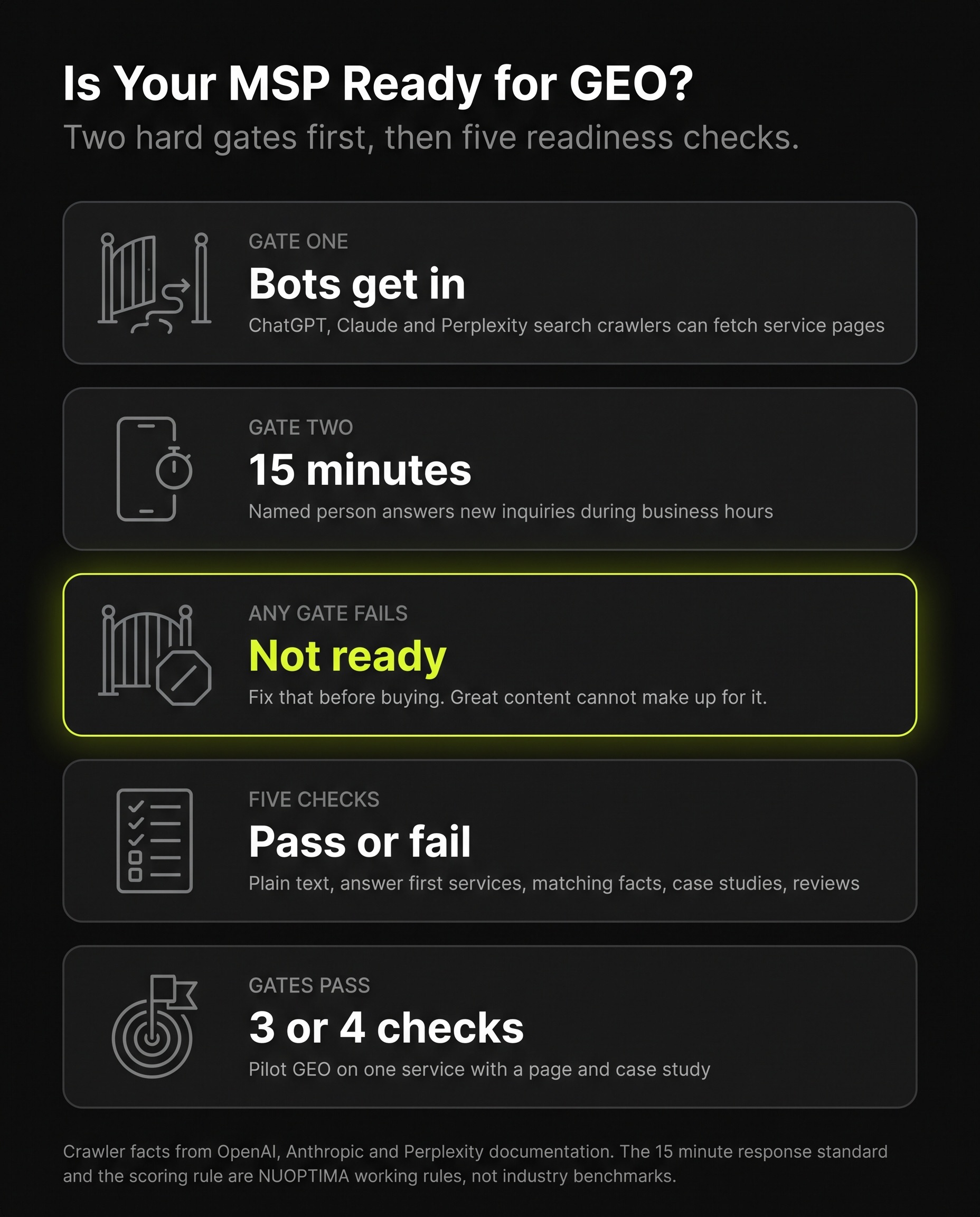
Your managed service provider (MSP) is ready for generative engine optimization (GEO) when two hard gates pass and most of five checks do. The gates: artificial intelligence (AI) search crawlers can fetch your service pages, and a named person answers new inquiries within 15 minutes during business hours. The checks: pages that read as plain text, service pages that answer the buyer's question, business facts that match across the web, at least two case studies with numbers, and a current review base.
Fail either gate and you are not ready, whatever else is true. Both gate fixes cost staff time, not an agency retainer.
Weak Google rankings are not on the list. Cortavo began its engagement with NUOPTIMA in May 2025 at an average Google position of 42.6. Twelve months later, its case study reports $403,330 in contracted sales attributed to organic and AI search, a 4.6x return on the $88,500 invested. Content can fix a poor starting position. It cannot fix a blocked crawler or an unanswered form.
Still deciding whether GEO pays at all? Read is GEO worth it for MSPs first.
Gate 1: AI Crawlers Can Fetch Your Service Pages
ChatGPT search finds websites through a crawler called OAI-SearchBot. OpenAI says sites that opt out of OAI-SearchBot will not be shown in ChatGPT search answers, apart from possible navigational links. Its training crawler, GPTBot, is controlled separately.
So you can refuse training and still be findable. The failure to look for is a blanket "block AI bots" rule, in robots.txt or at your content delivery network (CDN), that takes the search crawlers out with the training ones.
Anthropic runs three separate agents: ClaudeBot for model training, Claude-SearchBot for search and Claude-User for pages Claude visits while answering a question. It says its bots will not try to get past a "prove you are human" test, so one on your firewall works as a block. Perplexity says PerplexityBot surfaces and links websites in its search results and is not a training crawler.
Check four things:
- robots.txt does not disallow OAI-SearchBot, Claude-SearchBot or PerplexityBot, unless you mean it to.
- Your CDN or web application firewall (WAF) does not serve those crawlers a human-verification test, a challenge page or a country block.
- Server logs show
200responses to those crawlers on your priority service pages. - Allowlist rules match each vendor's published internet protocol (IP) ranges, not just the bot's name, which is easy to fake.
You do not need NUOPTIMA or any agency for this. It is a ticket for your own technicians.
Gate 2: A Named Person Answers New Inquiries Within 15 Minutes
GEO can put your name on a buyer's shortlist. It cannot answer the form that buyer submits, and if replies take two days, more visibility only sends more buyers into the gap. The authors of The Short Life of Online Sales Leads in Harvard Business Review reported that "most companies are not responding nearly fast enough."
The standard this page uses is NUOPTIMA's own working rule: a qualified inbound inquiry gets a human response within 15 minutes during business hours.
Test it the way a buyer would. Submit your own website form at 10:30 on a Tuesday, call your main number at 4:45 on a Thursday, and time the first human reply to each. Miss 15 minutes, or hit voicemail and silence, and intake comes before visibility.
The first reply does not need to sell. It acknowledges the inquiry, checks fit, books the next step and sends one relevant case study. A service coordinator, an office manager or the owner can own it, as long as one named person does and someone covers their absences. The fix costs a routing rule and a name.
Five Readiness Checks
Once both gates pass, score these five as pass or fail.
Your service pages read as plain text
Turn off JavaScript in your browser and load the pages you most want buyers to find: managed information technology (IT), cybersecurity, co-managed IT, your industries and your markets. The service description, locations, proof and call to action should still be there as text. If a page collapses to a blank shell or a row of empty tabs, the words only exist after scripts run, and none of the crawler documentation cited above says those bots run scripts. You rarely need a rebuild, just the key text in the HyperText Markup Language (HTML) your server sends.
Priority service pages answer the buyer's question first
Most MSP service pages describe the service from the provider's side, then ask for a call. A page an AI answer can quote starts with the buyer's question. A co-managed IT page says who it is for, what is in and out of scope, and what changes in the first 30 days. A cybersecurity page says which controls and frameworks you cover and where your responsibility ends.
The pattern:
- A direct answer of 40 to 80 words at the top.
- Best fit: company size, industry and the events that trigger a switch.
- Scope: what is included and what is not.
- One quantified proof point or a case study link.
- Answer-first frequently asked questions (FAQ) on pricing drivers, onboarding and response model.
- One call to action, not four competing buttons.
Your business facts match everywhere
The web should agree on who you are. Start with name, address and phone number (NAP), then go wider: legal and trading name, homepage title, Google Business Profile, LinkedIn page, directory listings and site footer. If one profile says "IT support," another says "cybersecurity consultants" and a third carries your pre-rebrand name, an AI assistant has to guess which company is real.
Write one truth set (company name, website, main phone number, a service description under 80 words, core services and service areas) and make every profile match it. Then mark it up. Google says Organization structured data can help it understand your administrative details and tell your organization apart from others, and that LocalBusiness structured data can describe hours, departments and other business details. Markup repeats clean facts. It does not fix conflicting ones. Our guide to entity consistency covers the full cleanup.
You have at least two case studies with numbers
"Great to work with" tells a buyer nothing they can check. A case study a stranger can believe names the client or says why it cannot, gives the client's industry, size and risk, describes the problem in operational terms, and shows the outcome with numbers or dates.
You can do that without exposing anyone's systems. A line like "cut onboarding for a 90-person law firm from 30 days to 12" beats "improved operations." If clients will not be named, publish anonymous versions with tight context and no inflated claims. Our guide to case study structure shows the format. The facts have to come from you and your client.
Your review base is current
Reviews are the corroboration you do not write yourself. Google says you can ask customers to leave reviews with a Google review link, and suggests replying to them. NUOPTIMA's rule of thumb: recency, relevance and replies count for more than the star average.
Before a GEO program, NUOPTIMA's rule of thumb is:
- At least 10 Google reviews, two or more from the last six months.
- No negative review left unanswered for more than 30 days.
- Some reviews name the services you want to sell, not only "great team."
- Business Profile categories, services and service area are current.
A regulated or privacy-sensitive niche can get by with fewer public reviews if it has strong private references. If your profile is stale, your own team can work through the Google Business Profile playbook for MSPs.
Score Your MSP
The scoring is NUOPTIMA's working rule. Read it from the gates down: no amount of good content outscores a failed gate.
| Check | Pass if | Who usually fixes it |
|---|---|---|
| Gate 1: crawler access | Search crawlers allowed, no firewall challenge, 200 responses in your logs |
Your technicians |
| Gate 2: inquiry response | A named person replies within 15 minutes during business hours | You and your front office |
| Plain-text pages | Priority page text visible with JavaScript off | Your web developer |
| Answer-first service pages | Each priority service has a direct answer, scope, proof and FAQ | An in-house writer or an agency (NUOPTIMA sells this) |
| Consistent business facts | Truth set matches across site, profiles and markup | Your team for listings; markup by a developer or agency (NUOPTIMA sells this) |
| Two case studies | Client context, the problem and a measured outcome | Facts from you and your clients; NUOPTIMA sells the writing |
| Current review base | Rule of thumb met, or the niche exception | Your team |
Then read your result:
- Either gate fails: not ready. Fix the gate first. Buying GEO now pays for visibility that cannot reach your pages or cannot turn into a meeting.
- Gates pass, zero to two checks pass: foundation first. Spend the next quarter on pages, facts and proof, in-house or bought, before any GEO program.
- Gates pass, three or four checks pass: pilot-ready. Run GEO on one service or one market where the service page and a case study already exist, and fix the rest alongside it.
- Everything passes: ready to scale across services, industries and markets.
The table cannot score runway. GEO builds over quarters (the GEO results timeline sets out what to expect when). If you would need to cancel within a few months to protect cash, a long-horizon program is the wrong buy for now, from NUOPTIMA or anyone else.
Run a One-Hour Baseline Before You Buy
You do not need a GEO dashboard before you buy; tracking is a month-one job for whoever runs the program. But an hour with a spreadsheet shows where you start and gives you a number to hold any vendor to. A simple version (the prompt split is our working method, not a standard):
- Write 20 prompts a buyer might type: 10 unbranded ("best managed IT provider for law firms in Denver"), five problem-led ("who can help a 60-person manufacturer with a cyber insurance questionnaire") and five about you ("is [your firm] a good MSP", "[your firm] vs [competitor]").
- Run each one in ChatGPT, Gemini, Claude and Perplexity.
- Log whether you are named, who is named instead, which page is cited and whether the description of your firm is right.
- Rerun the same prompts every month. Changing them resets the baseline.
A wrong description (an old name, dropped services, the wrong city) means fixing your business facts before writing anything new.
Then check your analytics. OpenAI says publishers that allow OAI-SearchBot can track ChatGPT referrals in tools such as Google Analytics, because ChatGPT adds utm_source=chatgpt.com to referral links. Add "an AI assistant" to the "how did you hear about us" options on your intake form too. For the ongoing stack, see how to track AI citations.
What to Fix Yourself and What to Buy
The gate work, your listings, review requests and the baseline need no agency, NUOPTIMA included. Outside help earns its fee on writing and structure at volume: answer-first service pages, case study writing, structured data, link building and tracking which AI answers name you. NUOPTIMA sells all of these through its GEO service and link building. A strong in-house marketer or a good freelance writer can do the pages and case studies too. If you already employ one, start there.
If you fail a gate, NUOPTIMA is the wrong purchase this quarter, and so is any other GEO agency. The order that wastes the least money:
- Open crawler access.
- Name an inquiry owner and meet the 15-minute standard.
- Run the baseline.
- Clean up your business facts.
- Rewrite the priority service pages.
- Publish two case studies.
- Refresh the review base.
- Pilot GEO on one service or market.
For budget once you are ready, see GEO cost for MSPs. If the real problem is an agency that is not delivering, read why MSP marketing agencies fail. Asking the same question about search engine optimization (SEO)? When SEO is a waste for MSPs runs the break-even test.
For a second opinion, book a call. Bring your website, your Google Business Profile, the two services you most want to sell and your baseline sheet. That is enough to tell whether GEO is your next step or a distraction for now.
Sources
- OpenAI, "Overview of OpenAI Crawlers": https://developers.
openai. com/ api/ docs/ bots, accessed September 28, 2026. - OpenAI Help Center, "Publishers and Developers - FAQ": https://help.
openai. com/ en/ articles/ 12627856-publishers-and-developers-faq, accessed September 28, 2026. - Anthropic, "Does Anthropic crawl data from the web, and how can site owners block the crawler?": https://support.
claude. com/ en/ articles/ 8896518-does-anthropic-crawl-data-from-the-web-and-how-can-site-owners-block-the-crawler, accessed September 28, 2026. - Perplexity, "Perplexity Crawlers": https://docs.
perplexity. ai/ docs/ resources/ perplexity-crawlers, accessed September 28, 2026. - Google Search Central, "Organization Schema Markup": https://developers.
google. com/ search/ docs/ appearance/ structured-data/ organization, accessed September 28, 2026. - Google Search Central, "Local Business (LocalBusiness) Structured Data": https://developers.
google. com/ search/ docs/ appearance/ structured-data/ local-business, accessed September 28, 2026. - Google Business Profile Help, "Tips to get more reviews": https://support.
google. com/ business/ answer/ 3474122, accessed September 28, 2026. - Harvard Business Review, "The Short Life of Online Sales Leads" (March 2011): https://hbr.
org/ 2011/ 03/ the-short-life-of-online-sales-leads, accessed September 28, 2026.