Search engine optimization (SEO) is worth it for a managed service provider (MSP) when four things are true: you can fund the 6 to 12 month runway a newer or low-authority site needs, your team can onboard new clients without service slipping, your buyers actually search for what you sell, and a break-even test on your own gross profit clears. If any one of those fails, SEO is a waste of money for now.
That applies to NUOPTIMA too. We sell SEO, and we also sell Google Ads and outbound. Below are the situations where you should not buy SEO from us, from another agency or from a freelancer, and what to fund first in each.
Five Situations Where SEO Is the Wrong Buy
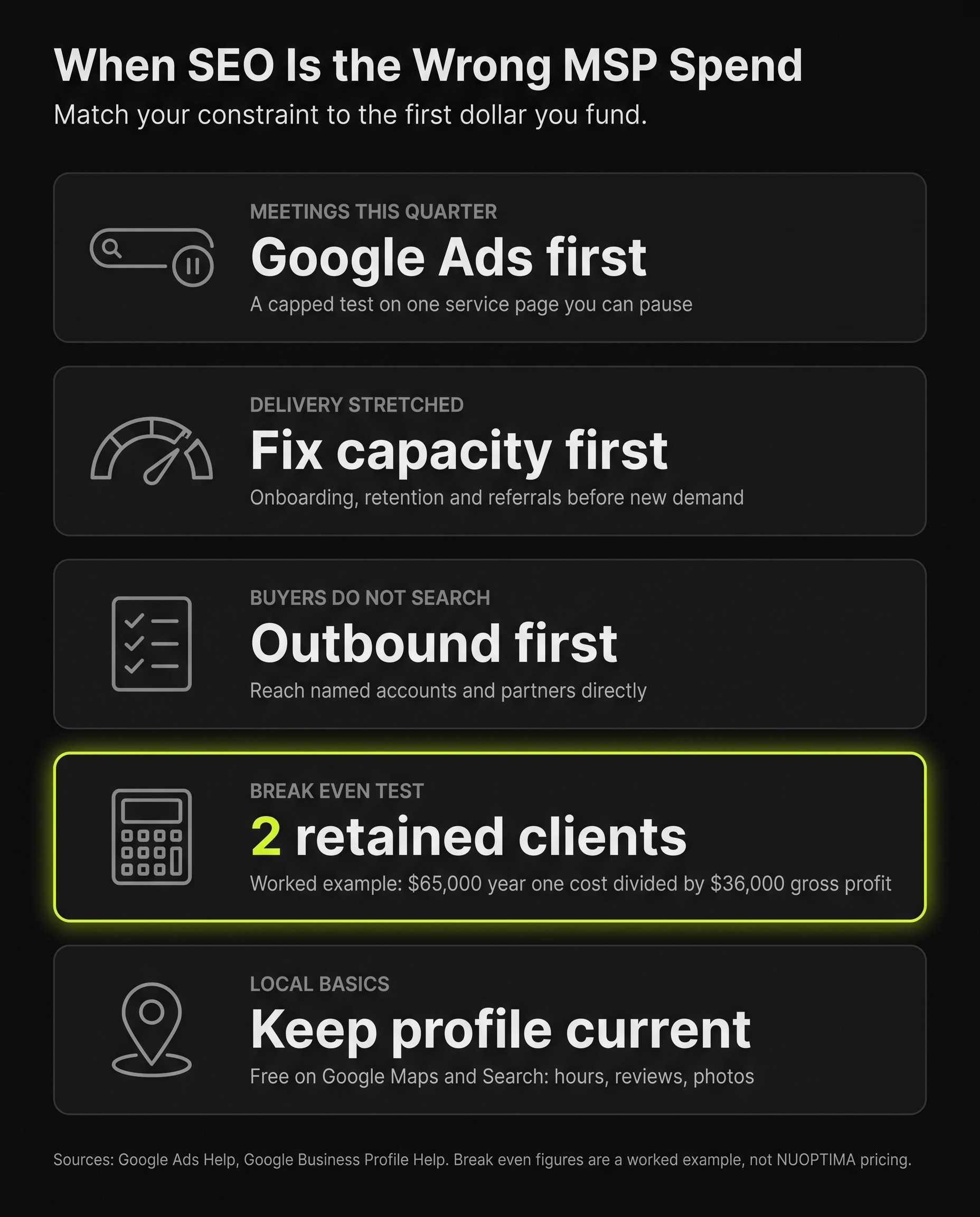
Do not buy an SEO program because competitors are publishing blogs or because your traffic chart looks flat. Match your constraint to the first dollar:
| Your situation | SEO is the wrong buy if | Fund this first |
|---|---|---|
| You need meetings this quarter | Your cash cannot carry a ramp of several months | A capped Google Ads test on one service page |
| Delivery is stretched | Two more clients would break onboarding or support | Onboarding, retention and referrals |
| Buyers do not search | Deals come from named accounts, partners or procurement lists | Outbound and partner introductions |
| The math fails | Realistic wins do not repay the year-one cost | Your offer, your close rate or a cheaper channel |
| Local proof is messy | A referred prospect cannot verify you on Google | Your Google Business Profile and reviews |
In those conditions SEO is the wrong first dollar, even from a good vendor. Google's own guidance on hiring an SEO calls it a big decision that can improve your visibility and save you time, but can also risk damage to your site and reputation. Treat it like any other capital decision and ask one question: does SEO fix the constraint you have this quarter?
When You Need Meetings Before SEO Can Mature
If the next two quarters look thin and you need qualified sales conversations soon, SEO is the wrong first spend.
Our guide to how long SEO takes puts a new or low-authority site on a 6 to 12 month runway. Local search is often faster, at 3 to 6 months, and an established site that only needs refocusing can move within weeks. None of those is a promise, and none of them helps if your cash cannot carry the ramp. Start SEO in a cash squeeze and you will probably cancel before it compounds, then conclude that SEO does not work when the real problem was timing.
Start with paid demand capture instead. A narrow Google Ads campaign pointed at one high-intent service page tests your offer, geography, budget and sales follow-up in weeks rather than months. It also has a clean stop button: Google says pausing a campaign stops its ads and prevents further charges, and keeps your settings and history for a restart. Keep the account narrow: a sloppy paid account can burn cash faster than a sloppy SEO program, because every wasted click is billed.
Know what you are not buying. Google says advertising with Google has no effect on your site's presence in its search results. The ad budget buys intent while it runs and leaves no organic position behind when it stops.
Run this path when:
- You need sales conversations before an organic program could reasonably mature.
- Your offer is specific enough to send traffic to one service page.
- Someone can answer calls and form fills quickly.
- You set a budget ceiling and kill criteria before launch.
Disclosure: NUOPTIMA also runs Google Ads for MSPs, so we have a stake in this advice. You do not need an agency to follow it. A capped test on one service page is within reach of a competent freelancer or an in-house marketer. If you are still weighing the two channels, our comparison of SEO and Google Ads covers the trade-offs.
When Delivery Capacity Is the Real Bottleneck
SEO can create demand your operation cannot absorb. When that happens you pay twice: once to win the client, and again in margin and reputation when their first 90 days go badly.
If referrals already fill the calendar, onboarding is slow, tickets are slipping, or the owner is still the escalation path for every new client, new-logo marketing makes the business worse. Run a blunt test: could you onboard two new clients of your typical size next month without the owner doing the technical work? If the answer is no, do not buy SEO yet. Fund capacity and your existing clients first.
That work is less glamorous:
- Shorten onboarding and write down what happens in a new client's first 30 days.
- Tighten the handoff from sales to service.
- Clean up the customer relationship management (CRM) fields for source, stage, close date and contract value.
- Ask your best clients for specific introductions instead of running a generic gift card referral campaign.
- Capture proof from stable accounts that already trust you.
Sales capacity belongs in the same test. More leads are useless if nobody answers quickly, qualifies properly, chases proposals and logs the outcome. Our readiness checklist for generative engine optimization (GEO) sets NUOPTIMA's working response standard for new inquiries, and it applies to a lead from Google exactly as it does to one from an artificial intelligence (AI) assistant.
The rule: if a good month of inbound leads would break service delivery or sales follow-up, SEO is premature.
When Your Buyers Are Not Searching
Some MSP markets are poor fits for SEO as the main channel.
That is common when the buyer set is small and named. If you sell into a narrow vertical, a private equity portfolio, a vendor ecosystem, or a list of regional companies with known information technology (IT) triggers, waiting for them to search is slower than reaching them directly.
It is also common when the category has little search demand. A niche can be commercially valuable and still have too few searches to justify a content program. Ranking first for a term nobody types pays for nothing.
If the account list is obvious, start with cold outreach and partner introductions. NUOPTIMA sells outbound too, so the same disclosure applies. SEO can come later. Until then, your website only has to convince the buyer who checks you after your email lands.
This is also where owners misread local SEO. Local search can work, and it is often one of the faster organic paths when buyers search by city, service and urgency; our page on local SEO for MSPs covers that lane. The waste is trying to turn a generalist MSP into a publisher for "IT support in [city]" against older domains, directories and national brands, with no sharper angle.
Cortavo, an MSP client of ours, shows the middle ground. Its case study says fighting incumbents for generic terms like "managed IT services" would have "burned the budget for nothing," so the program skipped them and built city, vertical and legacy-IT pages where Cortavo had a credible angle. The same page reports $403,330 in contracted sales attributed to organic and AI search in 12 months, a 4.6x return on the $88,500 invested, with 8 new clients closed-won. The takeaway for your decision: SEO pays when your market contains searches you can realistically win. If it does not, fund the channel that reaches buyers by name.
Keep the local basics either way. Google's guidance says that if you run a small local business, you can probably do much of the SEO work yourself, and a Business Profile lets you manage how you appear on Google Maps and Search at no charge, including hours, website, phone, location, photos, videos and reviews. Our Google Business Profile playbook for MSPs is the minimum upkeep version. You do not need an SEO program to look credible to the referral who checks you before calling.
When the Break-Even Math Does Not Clear
SEO should pass a finance test before it becomes a marketing line item. Use this formula:
Clients needed to break even = year-one program cost / 36-month gross profit per new client
Use gross profit, not revenue: the spend is repaid from what a client leaves after delivery costs. The 36-month window is an assumption for the example; use your own average client life if you track it.
A worked example, not a market benchmark and not NUOPTIMA pricing:
- Assume an SEO program costs $5,000 a month plus a one-time $5,000 setup. Year-one cost: $65,000.
- Assume a new client pays $2,000 a month and delivery costs half, leaving $1,000 a month of gross profit, or $36,000 over 36 months.
- $65,000 divided by $36,000 is 1.8, so you need 2 new clients, retained for three years, to break even.
Now stress test it.
Work back to meetings. If one in five qualified sales meetings becomes a client (an assumption; use your own rate), two clients need ten qualified meetings from organic search. Ask whether your site can realistically produce those inside the time you can fund.
Watch the cash timing. The spend lands in year one, and the gross profit arrives over three years. If both clients sign in month nine, their combined $2,000 a month of gross profit does not repay the $65,000 until around month 42.
Check capacity. If your team cannot absorb two more clients, the math fails even when the lead target is reachable.
If any of those answers feels heroic, do not buy SEO yet. For the full method, including how to report SEO to finance in revenue rather than clicks, use our SEO return on investment framework.
Contract terms belong in the same test. If you need the option to stop inside a few months, a long-horizon SEO program is the wrong buy, from NUOPTIMA or anyone else. Get any vendor's minimum term and cancellation path in writing before you model the spend. If the term outlasts your horizon, run a shorter test or fund a channel you can pause.
When SEO Is the Right Buy
Flip the tests and you have the case for SEO. It is a rational investment when:
- You can fund the ramp without needing organic leads to pay this quarter's bills.
- Your team can onboard new clients without the owner doing the technical work.
- Buyers in your market search for your services, cities or verticals, and some of those searches are winnable.
- The break-even test clears on your own gross profit and close rate.
When all four hold, SEO deserves a serious look, and our MSP SEO service is one option. When one fails, NUOPTIMA is the wrong buy for now, and so is every other SEO vendor. Fix that constraint first.
If you tried SEO before and it failed, work out whether the vendor or the conditions were at fault before you buy again. Our guide to why MSP marketing fails walks through that test. If your real question is about AI answers rather than Google rankings, read is GEO worth it for MSPs.
For a blunt answer on which situation you are in, book a call. Bring your average contract value, gross margin, close rate and delivery capacity. Without those numbers, any agency is guessing, including us.
Sources
- Google Search Central, "Do you need an SEO?": https://developers.
google. com/ search/ docs/ fundamentals/ do-i-need-seo, accessed September 28, 2026. - Google Ads Help, "Enable, pause, or remove a campaign": https://support.
google. com/ google-ads/ answer/ 2404259, accessed September 28, 2026. - Google Business Profile Help, "Get started with Google Business Profile": https://support.
google. com/ business/ answer/ 7039811, accessed September 28, 2026.