A managed service provider (MSP) should size its generative engine optimization (GEO) budget from two numbers: company revenue and the gross profit one new client brings in. As a NUOPTIMA working estimate, a $1M to $3M MSP should buy a one-time baseline audit first and keep any monthly spend after it to a $1,500 to $3,000 pilot. A $3M to $7M MSP should plan $3,000 to $5,000 a month, and a $7M to $15M MSP $5,000 to $9,000. Then run one test: a year of fees divided by the gross profit from one retained client is the number of new clients the program has to win.
This page covers budget, scope and payback. For market price ranges and what drives them, see what GEO costs. For whether the channel belongs in your plan at all, read whether GEO is worth it for MSPs.
Budget Bands by MSP Size
Every figure in this table is a NUOPTIMA working estimate, not a published market benchmark. The annual column is plain arithmetic on those estimates, so you can see the spend the way your finance partner will.
| MSP revenue | Monthly budget (NUOPTIMA working estimate) | Annual cost and share of revenue | What it should buy |
|---|---|---|---|
| $1M to $3M | Baseline audit first ($1,500 to $7,500 one time, NUOPTIMA working estimate), then a $1,500 to $3,000 pilot or add-on | $18,000 to $36,000 a year plus the audit, 0.6% to 3.6% of revenue | One service, one buyer problem or one local market. Stop at the audit unless one new client's gross profit covers most of a year of fees. |
| $3M to $7M | $3,000 to $5,000 | $36,000 to $60,000, 0.5% to 2% of revenue | Baseline measurement, two to four page rebuilds, proof assets, technical cleanup and citation work, judged at day 90. |
| $7M to $15M | $5,000 to $9,000 | $60,000 to $108,000, 0.4% to 1.5% of revenue | Several service, vertical and comparison pages, review work and ongoing authority building. |
These are budgets by firm size. Against the price bands in the GEO cost guide, $3,000 to $5,000 a month is a focused retainer, and $5,000 to $9,000 runs from the top of that band into the bottom of a full program. Above $15M, plan for a full program across several markets or verticals.
Below $1M, the bar is higher: you need a high-value offer and evidence that buyers research online before they buy. If either is missing, read the signs your MSP is not ready for GEO before you spend.
Revenue sets the ceiling. Client value decides whether the spend makes sense. In Cortavo's case study, a single won account is worth $47,000 to $100,000+ in lifetime value, which is why a year of search spend can pay back on a small number of wins. An MSP whose typical new client pays $800 a month needs a much smaller scope, and the payback section below shows why.
What a $3,000 to $5,000 Monthly GEO Engagement Should Buy
For a $3M to $7M MSP, $3,000 to $5,000 a month should buy named deliverables. If the proposal is mostly an artificial intelligence (AI) visibility dashboard, you are paying program prices for a tool. As a NUOPTIMA working estimate, a sound engagement at this level includes:
- A baseline of which buyer questions, provider shortlists and local or vertical prompts mention you today, and which name a competitor instead.
- A priority list of the pages that should answer those questions first.
- Two to four money pages rebuilt in the first 90 days: service, vertical, pricing, comparison or location pages.
- Technical cleanup so important pages are crawlable, internally linked and readable as text.
- Structured data checks. Google's guidance on AI features asks for structured data that matches the visible text on the page and says no special markup is needed, so do not pay extra for "AI schema."
- One or two proof assets, such as a case study, migration story, compliance page or buyer guide.
- Review and citation cleanup on the sites buyers and AI assistants use to check you.
- Reporting that ties visibility changes to calls, forms and customer relationship management (CRM) records.
At this budget, do not expect a full digital public relations program, unlimited content, a multi-city rollout, paid media management or a website rebuild. If a proposal promises all of that for $3,000 to $5,000 a month, ask who is staffed on it and what is templated.
Why pay for work on other people's websites? ChatGPT answers that use web search may include citations to their sources, and Google's AI Overviews and AI Mode surface links to supporting pages. Many of those pages will not be yours. NUOPTIMA's view is that reviews, directory listings, list mentions and partner pages belong in the first year's scope.
Count your own time as well. If a proposal expects you or your engineers to draft the content, those hours are part of the price. For comparison, NUOPTIMA's GEO program plans on roughly thirty minutes a month of owner input, on technical accuracy.
Finally, ask for the quote in two parts. Setup covers measurement, technical fixes, page architecture and the first rebuilt pages. Recurring work covers new pages, proof, authority and reporting. If the first 90 days are mostly audits and meetings, you are paying for discovery. If the recurring fee buys no new work after setup, you are paying for reporting. How retainer, project and performance contracts handle that split is covered in GEO pricing models.
Payback Logic for an MSP Owner
The question your finance partner will ask is how many retained clients it takes to cover the spend. Two lines of arithmetic answer it:
- Gross profit per new client = monthly recurring revenue (MRR) × gross margin × months retained
- New clients needed to break even = annual program cost ÷ gross profit per new client
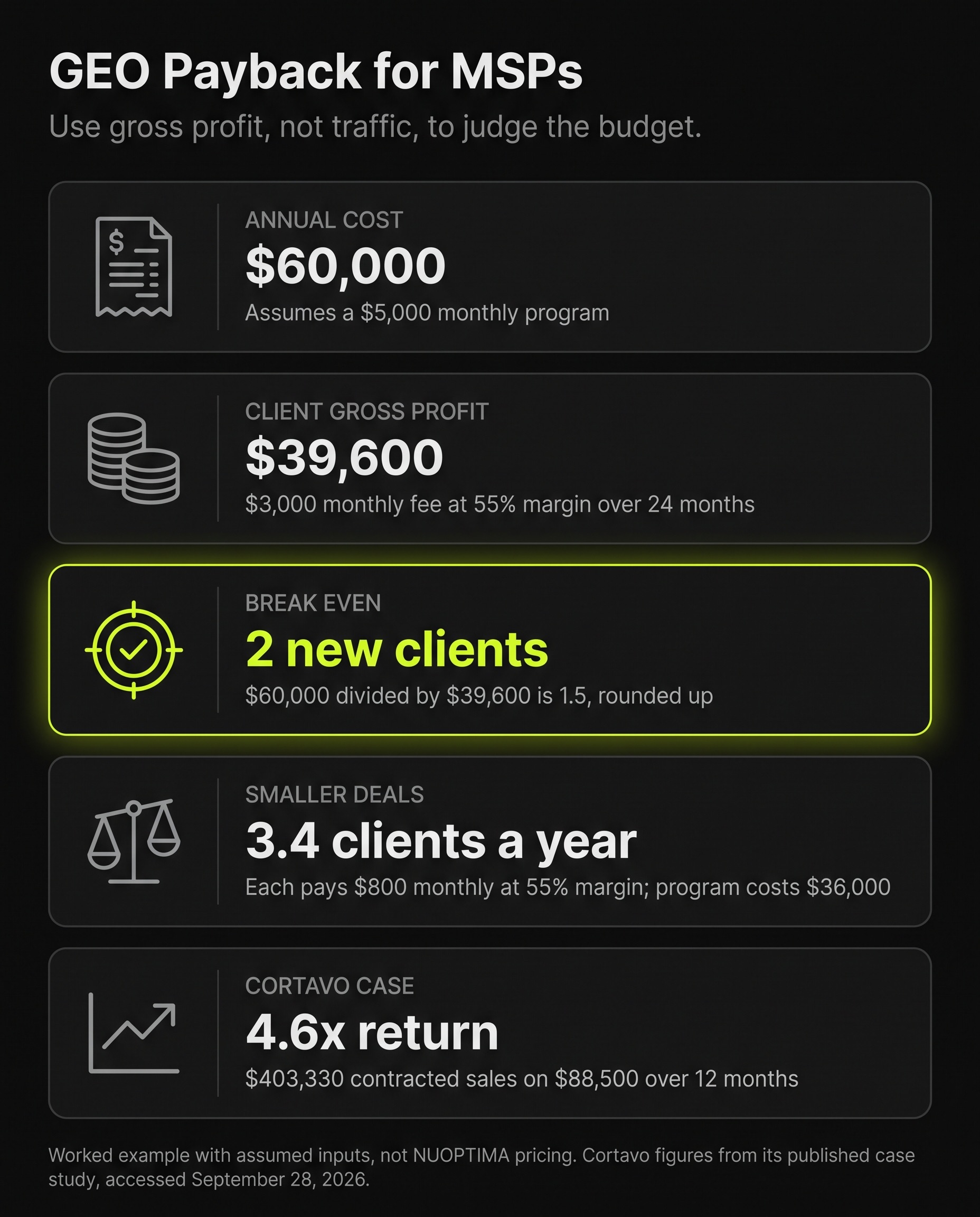
Here is a worked example with assumed inputs. The $5,000 is an assumption for the math, not a NUOPTIMA price.
| Input | Example |
|---|---|
| Monthly GEO program cost | $5,000 |
| Annual program cost | $60,000 |
| New client MRR | $3,000 |
| Gross margin | 55% |
| Months retained | 24 |
| Gross profit per new client | $39,600 |
| New clients needed to break even | 1.5, so plan on 2 |
Change one input and the answer moves a lot. If that client stays 36 months, it produces $59,400 of gross profit and one win nearly covers the year. If your typical new client pays $800 a month at the same margin and retention, it produces $10,560, and even a 3, 000amonthprogram(36,000 a year) needs about 3.4 new clients a year to break even. Use your own figures, and do not let an agency model the deal on contract value when your constraint is gross profit.
Timing is the second test. Clients do not sign in month one. A $3,000 MRR client signed at the end of month six returns $9,900 of gross profit by month 12 (six months at $1,650, which is $3,000 × 55%), against $60,000 of fees that year. A program can be on track for lifetime payback and still look negative on year-one cash, so agree both views with your finance partner before you start.
Cortavo shows that shape on published numbers: $88,500 invested over 12 months, $403,330 in contracted sales from organic and AI search, 8 new clients closed-won and a 4.6x return. The case study says the running return dipped below 1x in the early months and crossed breakeven for good in December 2025. That is contracted sales value, not gross profit, so apply your own margin before you borrow it.
Once the work starts, measuring the return is a separate job, covered in measuring GEO return on investment (ROI).
A 90-Day Checkpoint That Finance Can Judge
Because payback lags, set your own decision point at day 90, whichever provider you hire. The first 90 days should not promise revenue. They should show whether the provider ships, whether visibility starts to move, and whether your sales team handles the inquiries that follow.
As a NUOPTIMA working estimate, here is what the first 90 days with any provider should look like:
| Period | What should ship |
|---|---|
| Weeks 1 to 2 | Baseline prompts, competitor shortlist review, CRM source tracking, priority page list and technical blockers. |
| Weeks 3 to 6 | Two to four priority pages rebuilt around buyer questions, proof, pricing logic and comparison intent. |
| Weeks 7 to 12 | One or two proof assets, citation and review cleanup, internal linking, structured data checks and a first review of visibility movement. |
| Day 90 | Your kill, narrow or scale decision, based on shipped work, technical health, visibility movement and how fast sales followed up. |
Day 90 is your checkpoint, not the payback window. As a NUOPTIMA working estimate, the first 90 days build the foundation, and compounding visibility in search and AI answers takes 6 to 12 months of consistent work. The month-by-month curve is in how long GEO takes, and the wider plan is in a 90-day plan finance will approve.
Questions to Ask Before You Sign
Five questions test a $3,000 to $5,000 proposal against this page. The cost guide has the fuller list of what a fair proposal should show.
- Which pages ship in the first 90 days, and which of our service lines does this budget leave out?
- How many new proof assets are included, and who gathers the material?
- Who implements the technical fixes, and are those hours inside the fee?
- How will a client won through AI-assisted research be tagged in the CRM, so we can count payback?
- What is the day 90 decision rule, and what work stops if the budget stays flat after it?
If the answers do not fit on one page, the proposal is still a sales story.
When the Budget Is Too Early
Hold the budget if any of these is true:
- Nobody answers new inquiries within 15 minutes during business hours. More visibility sends buyers to a slow desk, so fix response first.
- Your service pages do not say what you sell, to whom and at what scope.
- You have no case studies. Build two before you pay anyone to amplify them.
- Your deal economics look like the $800 a month example above, where a $3,000 a month program needs three or more new clients a year just to break even.
In those cases, the better first spend is a one-time baseline audit plus a basic search engine optimization (SEO) cleanup of your service pages, or no marketing spend at all until sales can answer the phone. NUOPTIMA sells SEO as well as GEO, so weigh that suggestion accordingly: your website vendor or a competent freelancer can do a service-page cleanup.
If the margins, proof and sales follow-up are in place, start with a baseline. Book a call to see where AI assistants already name you and your competitors before you commit to a program.
Sources
- OpenAI Help Center, "Searching the web with ChatGPT", https://help.
openai. com/ en/ articles/ 9237897-searching-the-web-with-chatgpt, accessed September 28, 2026. - Google Search Central, "AI features and your website", https://developers.
google. com/ search/ docs/ appearance/ ai-features, accessed September 28, 2026. - NUOPTIMA, "Cortavo: $403K Contracted Sales at 4.6x ROI from Organic + AI Search", https://nuoptima.
com/ case/ cortavo-msp-case-study, accessed September 28, 2026.