Generative engine optimization (GEO) return on investment (ROI) is the gross profit from new contracts that artificial intelligence (AI) search helped you win, minus the fully loaded cost of the program, divided by that cost. For a managed service provider (MSP):
GEO ROI % = (GEO-attributed gross profit minus fully loaded GEO cost) ÷ fully loaded GEO cost × 100
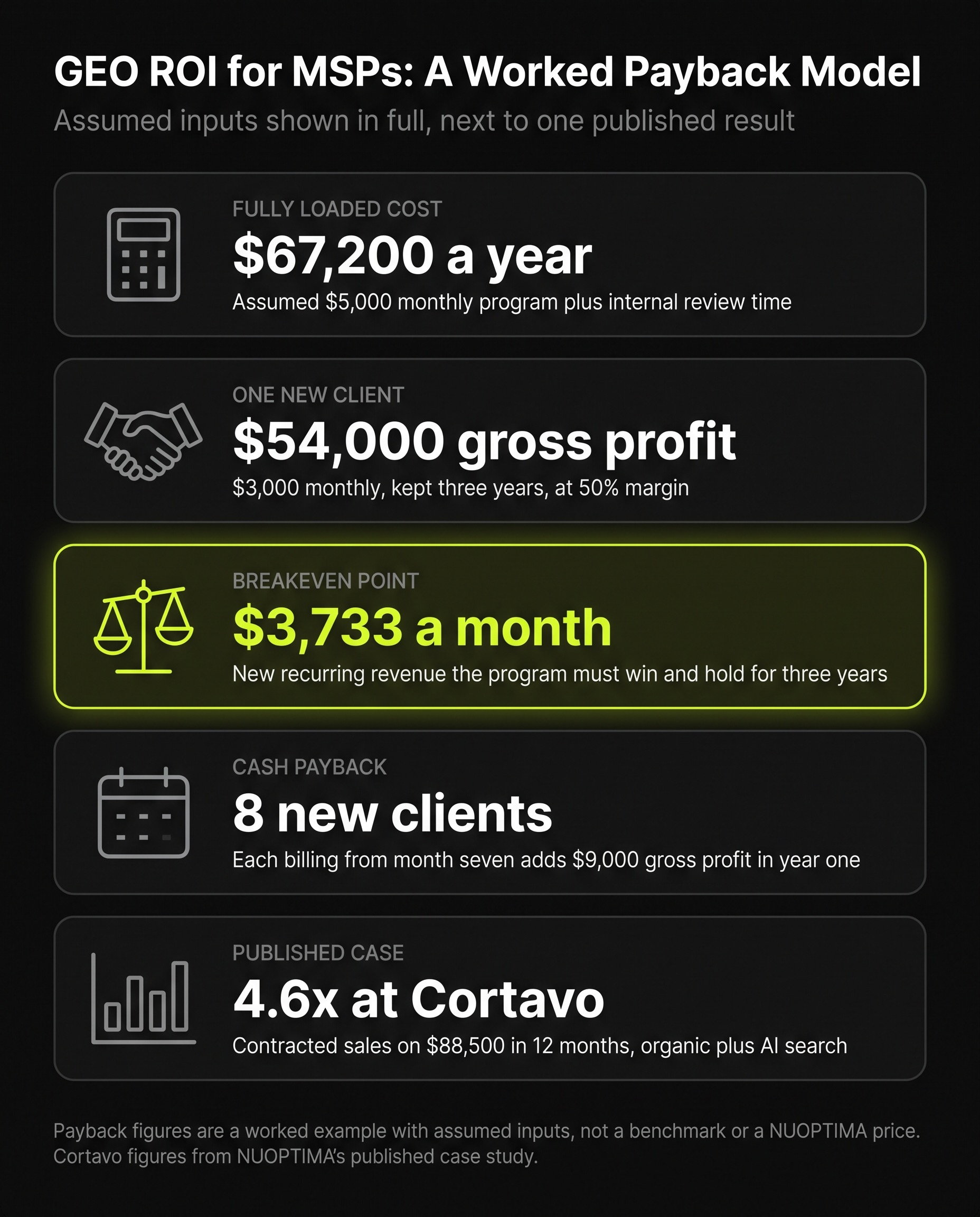
The strongest published MSP example is Cortavo, whose customer relationship management (CRM) system recorded $403,330 in contracted sales from organic plus AI search over 12 months, a 4.6x return on $88,500 invested.
The formula is the one NUOPTIMA uses for search engine optimization (SEO) in the SEO ROI framework, so read that for the general method. This page covers what changes when the channel is AI search: which revenue counts when a buyer sees your name in an answer and never clicks, which costs owners leave out, and how many new clients a program has to win before it pays.
Revenue: Count Gross Profit From Signed Contracts
AI visibility tells you whether ChatGPT, Gemini, Perplexity and the other assistants put your firm on the shortlist when a buyer asks for a provider. That makes it a leading indicator. It enters the ROI calculation only when a contract is signed.
Keep these out of the numerator:
| Input | Why it does not belong |
|---|---|
| AI mention or citation count | Being named is not a signed contract |
| Prompt visibility score | Useful for running the program, not for valuing it |
| Sessions from AI tools | Too few to carry the case, and they miss buyers who never click |
| Pipeline value without close rates | Counts deals you have not won |
| First-month revenue | Undercounts a contract that runs for years |
What goes in is gross profit over the life of the contract. If a new client pays $3,000 in monthly recurring revenue (MRR), stays 36 months and carries a 50% gross margin:
$3,000 × 36 × 50% = $54,000
That $54,000 is the numerator, not the $108,000 of revenue. Test your retention and MRR assumptions against real accounts before you trust the output. For reference, Cortavo's case puts a single won account at $47,000 to $100,000+ in lifetime value.
Attribution: Report a Floor and a Ceiling
The SEO ROI framework reports a range between last-click and data-driven attribution. GEO needs a different range, because a buyer influenced by an AI answer may never click at all.
The clearest public evidence is about Google. Pew Research Center tracked the browsing of 900 adults in the United States in March 2025. When a search showed an AI summary, users clicked a traditional result on 8% of visits, against 15% when there was no summary, and clicked a link inside the summary on 1% of visits. The study covers Google only, but it shows how an answer can do its work without sending a visit.
When the buyer does arrive later, the trail is often gone. Someone who reads your name in an AI answer and then types your web address shows up in Google Analytics as (direct) / (none), which Google describes as traffic that doesn't have a clear referral source.
So report three layers:
| Layer | What counts | How to use it |
|---|---|---|
| Floor | Closed-won deals whose CRM lead source is an AI referral, recorded when the lead arrived | The number you defend to finance |
| Middle | Add closed-won deals where the buyer said, on a form or a discovery call, that an AI assistant named you | Influenced revenue, backed by the buyer's own words |
| Ceiling | Add closed-won deals from branded search or direct visits while your tracked citations were rising | Directional upside only, never the budget case |
Cortavo shows the floor in practice. Every lead was "tagged at source" in the client's CRM as "Search - Organic" or "Referral - AI" and followed to closed-won. Its $403,330 headline combines both tags, and the case does not split AI search from organic. If you want a GEO-only floor, create the AI source value before the first page ships, because you cannot tag leads retroactively with any confidence.
A holdout test adds evidence. Improve one set of pages and buyer prompts, leave a similar set alone, and compare citations, branded search and closed-won deals over the same months. If the improved set gains citations and the floor rises, you have a directional signal. It is not proof: referrals, paid search, seasonality and competitors all hit the same pipeline. The prompt sets, analytics channels and citation logs behind all of this are covered in how to track AI citations.
Cost: Add the Lines the Invoice Leaves Out
Start from the fully loaded cost checklist in the SEO ROI framework: people, content, technical work, tools and authority building. Add AI citation tracking to the tools line. Then add two costs that owners tend to skip.
Internal review. GEO content has to be technically right, so someone on your team checks it. If your technical lead spends four hours a month on review and you value that time at an assumed $150 an hour, that is $600 a month, or $7,200 a year. Leave it out and the return is overstated.
Source capture. The floor only exists if your sales team records where each lead came from. That means a lead source field in the CRM, a question on your contact form ("Did an AI assistant recommend us?"), and a rule that sales confirms the source on every discovery call. The setup time belongs in the cost line.
For what GEO programs cost in the market and how to read a proposal, see what GEO costs for MSPs.
A Worked Payback Model
This is a worked example with stated assumptions. It is not a benchmark and not a NUOPTIMA price. Swap in your own numbers.
| Input | Assumption |
|---|---|
| Program fees | $5,000 a month for 12 months: $60,000 |
| Internal review | 4 hours a month at $150 an hour: $7,200 |
| Fully loaded cost | $67,200 |
| New client | $3,000 MRR, 50% gross margin, retained 36 months |
| Gross profit per client | $54,000 |
| Retained new clients | Gross profit | ROI |
|---|---|---|
| 1 | $54,000 | negative 20% |
| 2 | $108,000 | 61% |
| 3 | $162,000 | 141% |
One retained client recovers about 80% of the year's cost. Two clear it.
The more useful planning number is breakeven MRR, the new recurring revenue the program has to add and keep:
Breakeven new MRR = fully loaded cost ÷ (gross margin × retention months)
Here that is $67,200 ÷ (50% × 36), or about $3,733 of new MRR retained for three years. Divide it by your average new client's MRR to get the number of wins AI search has to produce. At $3,000 a month, that is 1.2 clients. At $800 a month, it is about five.
If five new logos from one channel in a year is more than your whole business signs, a program at this spend will not pay back on these assumptions. Price a smaller scope, or put the money into case studies and faster sales follow-up first. Is GEO worth it for MSPs covers who should wait.
Cash Payback Is a Different Test
The lifetime view is not the cash view. A client signed in month six who starts billing in month seven produces six months of gross profit inside year one:
$3,000 × 6 × 50% = $9,000
On these assumptions, recovering the full $67,200 from gross profit earned inside the first year would take eight such clients. So your report needs both lines: cash payback inside the year and gross margin lifetime value (LTV) over the contract. A program can pass the LTV test and still be cash negative at month 12. With multi-year contracts that is normal, and your finance partner should see it coming rather than discover it.
Cortavo's Published Curve Next to the Model
Cortavo's case publishes the path as well as the endpoint. The running ROI multiple "dipped below 1x in the early months, crossed breakeven for good in December 2025, and compounded to 4.6x as the larger contracts closed."
| Point in the engagement | Published figure |
|---|---|
| Early months | Running multiple below 1x |
| December 2025 | $210,000+ in contracted sales value; breakeven for good |
| May 2026 | $403,330 on $88,500 invested: $4.56 back for every $1, or 4.6x |
Two notes before 4.6x goes into your board pack. It is contracted sales value divided by spend, which makes it a sales multiple, not gross profit. And it covers organic and AI search together. If you ran it through this page's formula at the worked example's assumed 50% margin, $403,330 would become about $201,665 of gross profit, an ROI of roughly 128%. Cortavo's margin is not published, so that figure only illustrates the conversion. For the month by month sequence behind the curve, see how long GEO takes.
What the Other Two Case Studies Can Tell You
Only Cortavo measures AI search directly. NUOPTIMA's other two published results are SEO programs for cybersecurity consultancies, measured between 2022 and 2024.
Microminder's case reports a 16.6x return on SEO spend and $1M+ in SEO-attributed revenue across the partnership, which began in August 2022. The page does not describe CRM attribution the way Cortavo's does. Treat it as evidence that search authority compounds, and keep it out of your GEO forecast.
Eden Data's founder credits the work with a 400% increase in inbound leads in the first six months, May to November 2023. Leads are not revenue, so a result like that goes in the leading-indicator section of your report.
The One-Page Monthly Report
| Line | What to show |
|---|---|
| Fully loaded cost | Program fees plus internal time, year to date |
| Floor | Closed-won gross profit with an AI lead source in the CRM |
| Middle and ceiling | Influenced and directional gross profit, assumptions stated |
| ROI range | Floor to ceiling, in both the cash and LTV views |
| Leading indicators | Citations on your tracked prompts, branded search, high-intent conversions |
| Decision | Continue, adjust scope, pause or scale |
End every report on the decision line. A report that only lists activity invites argument. For the wider reporting structure, see SEO reporting for MSPs.
When to Scale, Pause or Cut
Scale when the floor is rising, the middle is backed by what buyers say on calls, and lifetime gross profit clears the fully loaded cost without assuming every lead closes.
Pause when citations are climbing but deals are not. GEO can put you on the shortlist. It cannot fix slow response, loose qualification or proposals nobody chases.
Cut or rebuild the program when, at the review point you agreed at the start, there is no citation movement, nothing in the floor and no credible explanation why.
If you want this model run on your own numbers, book a call and bring your average new-client MRR, gross margin, close rate, retention and whatever your CRM records as lead source.
Sources
- https://nuoptima.
com/ case/ cortavo-msp-case-study, accessed September 28, 2026. - https://nuoptima.
com/ case/ microminder-cybersecurity-case-study, accessed September 28, 2026. - https://nuoptima.
com/ case/ eden-data-case-study, accessed September 28, 2026. - https://www.
pewresearch. org/ short-reads/ 2025/ 07/ 22/ google-users-are-less-likely-to-click-on-links-when-an-ai-summary-appears-in-the-results/ , accessed September 28, 2026. - https://support.
google. com/ analytics/ answer/ 15258820?hl=en, accessed September 28, 2026.